

"Pudgy World continues to grow rapidly, delivers one of the most fun and novel web experiences out there, and being wholly ours, has everything we need to make it the flagship gaming product of the Pudgy Penguins universe." That was the official word from the Pudgy Penguins team when they announced on June 12 that Pudgy Party was done. No wind-down period. No final season. Just gone.
The game disappeared from iOS and Android simultaneously, leaving over a million players staring at a dead download link.
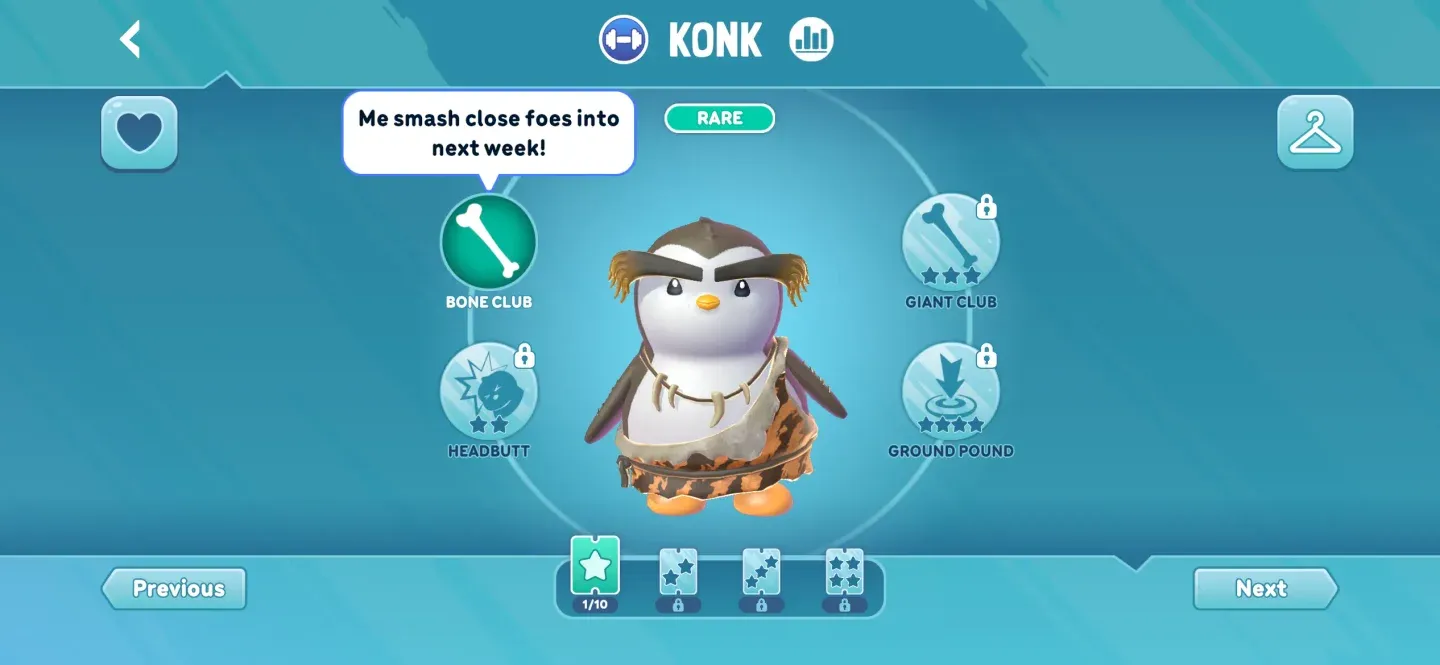
Pudgy Party lobby before shutdown
From Times Square ads to offline in ten months
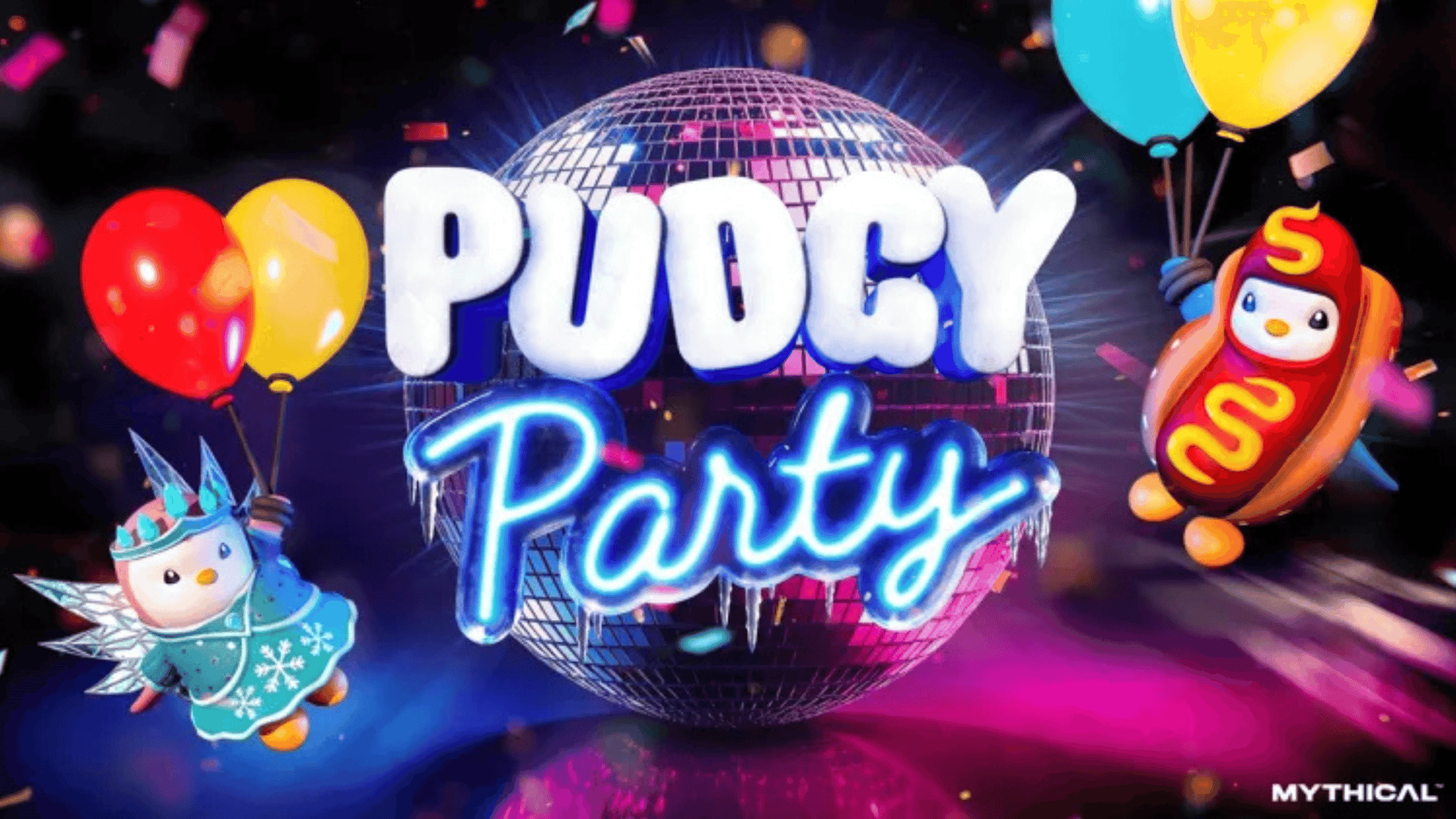
Pudgy Party launched globally in August 2025 with genuine momentum behind it. The concept was solid: take the Fall Guys obstacle-course formula, skin it with Pudgy Penguins characters, and layer in optional NFT ownership of in-game items. Mythical Games, the studio behind FIFA Rivals and NFL Rivals, co-developed the title, which gave it real production credibility.
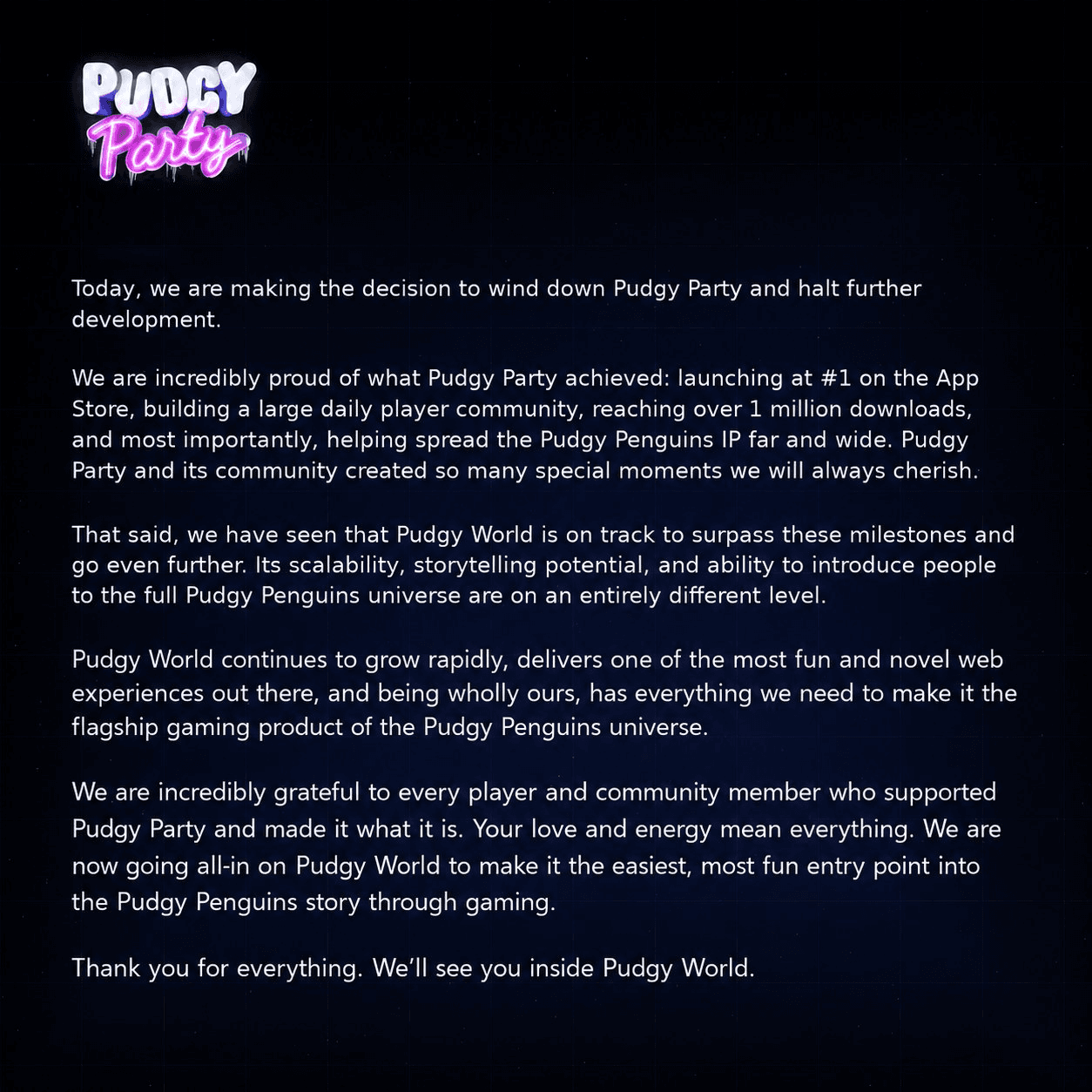
Pudgy Party Shuts Down After Less Than a Year on the Market
The marketing was loud. A Times Square ad campaign ran in September 2025, just weeks after launch. The game crossed 1 million total downloads. Its X account had nearly 98,200 followers. It even picked up a 2025 Game of the Year nod.
Then, ten months later, it was over.
Pudgy Penguins CEO Luca Netz told community members on a call that the company had lost millions trying to keep the project running. A Pudgy Penguins spokesperson confirmed that characterization. The official statement from the game's X account framed the closure as a resource decision, not a failure, pointing to Pudgy World as the product that is "wholly ours" and better positioned to grow.
Here's the thing: Pudgy Party was a co-development with Mythical Games, which means the Pudgy Penguins team didn't fully control the product or its roadmap. Pudgy World, built in-house, removes that dependency entirely.
What players actually lost
The community reaction was immediate and not particularly gentle. The core complaint isn't really about the closure itself. It's about the silence around what happens next for anyone who spent real money inside the game.
Pudgy Party let players mint and trade tokenized in-game items as NFTs. People bought characters, cosmetics, and collectibles. When the shutdown announcement dropped, there was no mention of refunds, no asset migration path to Pudgy World, and no compensation plan for existing item holders.
For a game that marketed tokenized ownership as a feature, the absence of a clear exit plan for those assets stings. The whole pitch of web3 gaming is that players own their items. Shutting down without addressing that ownership creates an obvious contradiction.
The game's X account had its own community distinct from the broader Pudgy Penguins ecosystem. Some players were there specifically for the mobile game experience, not because they cared about NFT collections or Pudgy World's browser-based hangout format. Those players have nowhere to go.
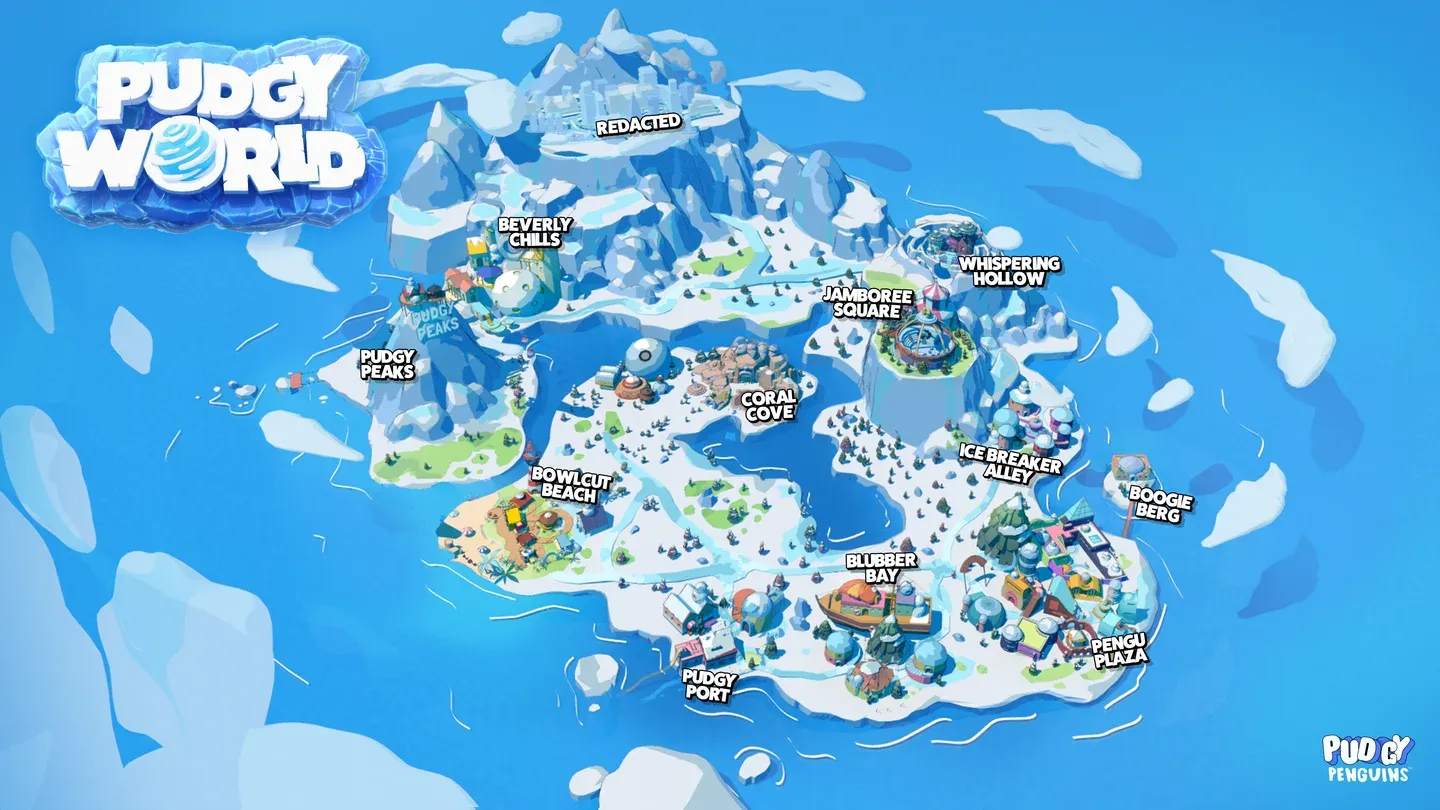
Pudgy World, the pivot target
Pudgy World: the bet that replaced it
Pudgy World launched in March 2026 as a free-to-play browser game. No download required. The environment is called "The Berg" and features 12 cities, story quests, and mini-games. The team built their own physics engine and optimized it to run on low-end devices, which matters a lot if you're trying to reach audiences who don't own gaming PCs.
The design philosophy is deliberately anti-crypto in its presentation. Blockchain elements are mostly hidden from players who don't go looking for them. The comparison that keeps coming up is Club Penguin, which is intentional. Pudgy Penguins wants to be a mainstream consumer brand, not a crypto product with a game attached.
That strategy actually makes sense when you look at the broader Pudgy Penguins business. The brand has physical toys on shelves at Walmart and Target, with reportedly over $10 million in physical merchandise sold. There are licensing deals with Visa and Manchester City. The NFT collection itself, with 8,888 items and around 5,100 unique holders, remains active.
Pudgy World is meant to be the digital center of all of that. A place where someone who bought a toy at Target can log in without needing a crypto wallet, while someone who holds a Pudgy Penguins NFT gets extra functionality underneath. That's the theory, anyway.
The broader pattern this fits into
Pudgy Party isn't an isolated case. web3 gaming has been cycling through shutdowns for the past 18 months. Deadrop, Nyan Heroes, and MetalCore all ceased development in 2025. Fishing Frenzy, built on the Ronin network, announced its own shutdown on June 25, 2026, with its developers writing that they "were ultimately unable to prove our thesis on crypto gaming and could not find product-market-business fit."
The pattern is consistent across these closures: games launch with strong initial numbers, struggle to convert downloads into retained paying players, and eventually can't justify the ongoing operating costs against the revenue they're generating.
The NFT market context makes this harder. Total NFT market capitalization sits around $1.5 billion in 2026, compared to over $17 billion at the 2022 peak. That's not a market that makes it easy to sell the ownership angle to new players. Binance has also announced it's ending NFT support on its main exchange platform, moving the service to its wallet product instead.
Pudgy Penguins is in a better position than most web3 gaming projects because it has physical retail revenue and brand recognition that exists outside of crypto. But even with those advantages, Pudgy Party couldn't find a sustainable path.
What the pivot needs to prove
The shutdown creates a short-term trust problem that Pudgy World now has to overcome. Players who invested time and money in Pudgy Party need to see a clear answer on what happens to their assets before they'll commit to the next product. Without that, the pivot risks carrying resentment into Pudgy World's growth phase.
The strategic logic of the pivot is sound. Owning the product entirely, targeting mainstream audiences through a browser with no download barrier, and tying it to an existing physical merchandise business is a more defensible position than a co-developed mobile game competing in a crowded market. Whether the execution matches the strategy is what Pudgy World now has to demonstrate.
For players who want to stay current with how the Pudgy Penguins gaming ecosystem develops, the Pudgy Party strategy guides offer useful context on the game mechanics that carried over from Pudgy Party's competitive design into the broader brand direction.