

I review Steam demos. Play, Maybe, or Skip. That’s the whole system.
I started after a couple of developers sent demos over asking for feedback. Looking through them, I noticed how many demos were launching every day, how wide the range of quality was, and how different the development cycles behind each project seemed to be. So I started reviewing them consistently. I’m over 50 reviews now, usually doing four or five every week.
Out of 51 reviews on the site, only three have been Skips. That ratio sounds generous. It isn’t. There’s a huge amount of filtering happening before a game even reaches the point where I download it, and most of that filtering happens within seconds. This article is about that process - and everything that happens after.
This is written for developers. Take it as one reviewer’s perspective, not gospel.

Use code TRYHARD33 at checkout to redeem this offer before code expires again.
Get 33% Off GAMES+ Subscription
Getting Found on Steam
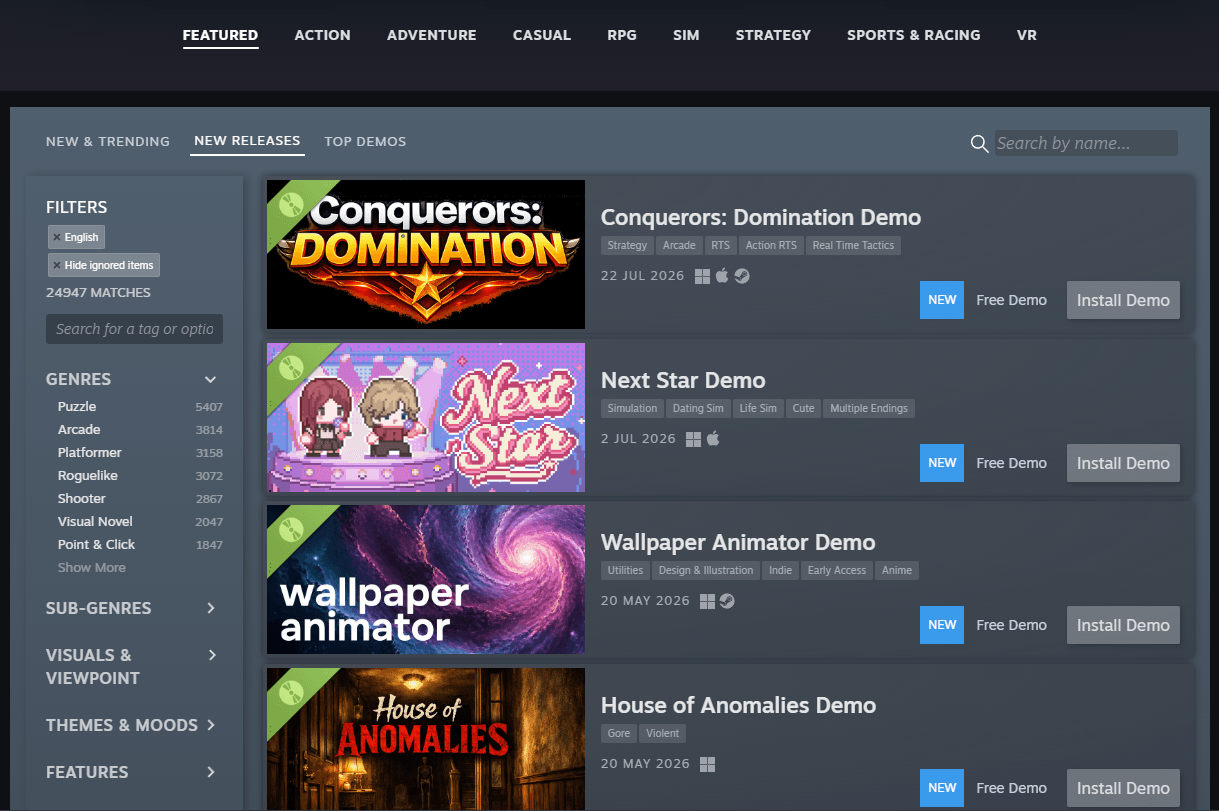
Some days there are 30 new demos released on Steam. I’m scrolling through them quickly, making decisions fast. Most of them never even get played.
The filter order is simple:
- Capsule art
- The first five seconds of the preview video
- Tags
- Description
That’s it. If one of those fails, I’m gone. Most players are the same.
A few things I’ve consistently noticed:
Capsule Art Needs to Match the Game
If the art style on your Steam page looks polished and professional but the actual game looks completely different, that creates a trust issue before the game even loads.
Players notice that disconnect immediately.
This becomes even more important in oversaturated genres. Bullet heaven games, generic retro pixel art, survival crafting games - players have seen hundreds of them already. If your game sits inside a crowded genre, your capsule art and store description need to work harder than everyone else’s.
The First Five Seconds of Your Trailer Matter Most
The autoplay preview video is basically your capsule art in motion.
The first few seconds are the decision point for players who clicked past the thumbnail. Start with movement, gameplay, chaos, or something visually interesting. Don’t open on a logo, a menu screen, or a slow cinematic pan.
The hook needs to happen immediately.
Social Media Found 20% of the Demos I Reviewed
Roughly 80% of the demos I reviewed came directly from browsing Steam. The other 20% came from social media - Reddit, X, TikTok, or creators posting gameplay clips.
Twenty percent isn’t the majority, but it matters.
One good post, one creator picking up the game, or one thread in the right community can give a project visibility it otherwise never would have had. Social media costs almost nothing to use heading into a demo launch, and those early traffic spikes matter on Steam.
The important part is building that audience before the demo launches.
If your first social media post about the game is “our demo is live,” you’re starting from zero at the exact moment momentum matters most. The people already following your project are the ones who create the early traction Steam’s algorithm responds to.
Announce the Demo Launch - and Every Update After
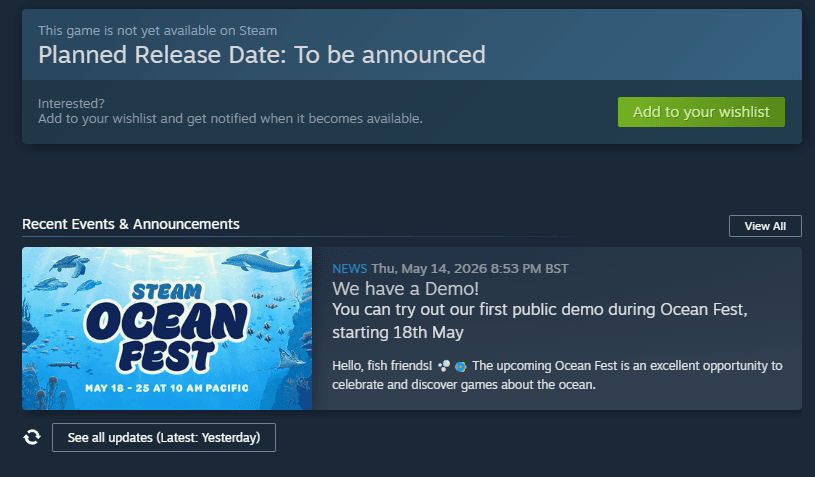
A surprising number of Steam demo pages barely use the announcements or events sections at all.
That’s a mistake.
When you announce your demo launch through Steam, notifications go directly to everyone who has wishlisted the game. It’s free visibility most developers ignore.
The same applies to patches and updates.
Many demos either never get updated or update silently. Players know a huge percentage of demos never become finished games. If your page looks inactive, people assume the project is dead.
Visible updates - even small ones - signal that development is ongoing.
If a social post unexpectedly goes viral weeks later, you want the demo page to still look active. You want people arriving there to see signs of life.
Be Ready for the Players Who Show Up
A demo is a public appearance. Once it’s out there, players need somewhere to go afterward.
If someone enjoys your demo and wants to follow development, what happens next?
- Is there a Discord?
- Are you active on X?
- Are Steam discussions being monitored?
- Is there an actual community space somewhere?
If your game is still far from launch and you have no social presence, no Discord, and no way to engage with feedback, the demo may have launched too early - not because the game isn’t ready, but because the studio isn’t ready to support the audience.
Momentum disappears quickly when communication disappears with it.
Developer responsiveness matters more than most people realize. I’ve had reviews shift positively while writing them simply because developers were actively reading feedback and patching issues in response.
That changes perception immediately.
Participate in Every Festival You Can
Steam Next Fest and similar events still generate major traffic spikes.
But the games that perform best during festivals are usually the ones that already built momentum beforehand. The developers who treat the festival as the start of marketing often struggle more than the ones who arrive with an existing audience ready to download immediately.
An early spike matters more than a slow trickle.
Use social media before the event starts. Build anticipation. Give players a reason to show up early when the festival goes live.
Don’t Ask Players to Do Five Things at the End of the Demo
This happens constantly.
The demo ends and players immediately see:
- Wishlist the game
- Join the Discord
- Follow on X
- Leave feedback
- Tell your friends
- Watch the trailer
That’s too many asks at once.
Players usually make one decision, maybe two.
Pick the CTA that matters most right now and focus entirely on that. If wishlists are the priority, make wishlisting simple and obvious. If feedback matters most, focus on gathering feedback.
Too many options lowers the chance players do any of them.
Demo Length Depends on How Fast Players “Get” the Game
I’ve given a Play rating to demos that lasted 15 minutes. I’ve also given Play ratings to demos I spent seven hours inside before finishing.
Both worked for the same reason:
They let me understand the game.
That’s the benchmark. Not runtime.
Games with tight gameplay loops can communicate themselves quickly. More system-heavy games usually need longer demos because players need enough time to get past the learning curve before the depth starts becoming enjoyable.
One of the biggest risks with complex games is ending the demo before the player reaches the moment where the systems finally click.
If the fun starts after the demo ends, players often never come back.
Show the Interesting Mechanics Early
A demo doesn’t have time for perfectly natural progression pacing.
If there’s a mechanic, ability, weapon, or system that makes your game special, let players experience it early. Don’t save the best part for several hours later like you would in the full game.
You never know which specific mechanic becomes the thing that sells someone on the project.
The demo’s job is to convince players the full game is worth buying - not perfectly replicate progression pacing.
Introduce Mechanics One at a Time
The flip side of showing exciting mechanics early is not overwhelming players immediately.
I’m not going to learn four major systems from scratch during the first ten minutes of a demo. Most players won’t either.
The demos that work best introduce depth gradually:
- One mechanic
- Then another
- Then expanded complexity
Players should already be enjoying themselves before the larger systems appear.
If someone actively trying to recommend your game quits during the tutorial, players downloading casually will leave even faster.
Multiplayer Demos Are Extremely Difficult
PvP demos are hard to evaluate because empty lobbies don’t communicate anything positive about the experience.
If the player launches the game and immediately sits in matchmaking with nobody there, that first impression is incredibly difficult to recover from.
The multiplayer demos that work usually have one of three things:
- Bots
- Scheduled play windows
- Enough players seeded at launch to keep matchmaking alive
Without one of those, a multiplayer demo often hurts perception more than it helps.
Bugs Are Fine. Broken Core Loops Aren’t.
Players understand demos are unfinished.
Some of the highest-rated demos I’ve reviewed had obvious bugs. That usually isn’t the issue.
The problem is when bugs interrupt the core experience itself.
One of the few demos I gave a Skip rating to wasn’t because the idea was bad - it was because a bug broke the main gameplay mechanic badly enough that I couldn’t meaningfully experience the game.
The standard is simple:
Can players actually play the thing?
Read Feedback for the Problem, Not the Solution
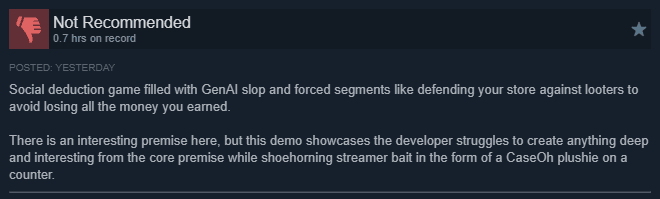
Players are very good at identifying when something feels wrong.
They’re usually much less reliable at identifying how to fix it.
When reading feedback, strip away the emotional wording first and look at the underlying issue:
- Where did players get stuck?
- What confused them?
- What interrupted flow?
- What felt bad?
Take the problem seriously. Don’t automatically implement the exact solution players suggest.
Players understand their experience. Developers understand the game.
Those are different things.
Track Creator Coverage, Not Just Wishlist Numbers
Wishlists are the obvious metric, but they aren’t the only useful one.
Pay attention to the content creators making videos, Shorts, streams, or reviews around your demo. Look at how those posts perform relative to their normal content.
If a small creator usually gets 500 views but your game suddenly hits 2,000 on their channel, something about your game connected unusually well with that audience.
That’s valuable information.
Engaging with creators also matters more than many developers realize. A retweet, comment, or acknowledgment costs almost nothing but helps build long-term relationships with people actively promoting your game.
The developers who notice that tend to get covered again at launch.
Who This Feedback Is Coming From
Feedback only matters if you understand the perspective behind it.
I’m in the 35–40 age bracket with three kids. I’ve been gaming since I was around 12, but I don’t have unlimited free time anymore, so I’m selective about what I play.
A lot of evenings I default back to what I’d call “brain-rot games” - things like Battlefield 6, League of Legends, or World of Warcraft Hardcore - games I already know and can play almost on autopilot while watching something else.
The audience around todaywegame.gg looks very similar: mostly male, mostly 30–40, mostly UK/EU/US-based players with limited time and a lot of gaming history.
So all of this feedback is filtered through that lens.
If your game targets a completely different audience, some of this will matter less. But after reviewing more than 50 Steam demos, one thing has become very clear:
The games that stand out usually aren’t the ones with the biggest scope.
They’re the ones that communicate what makes them interesting the fastest.
All Steam demo reviews at todaywegame.gg. Play, Maybe, or Skip.