

In this guide, I'll walk through the exact process I use to turn any video game character into a GTA VI cover star using ChatGPT's image generator for a little fun. One prompt. Swap two variables (the character name and the game they're from). Let the model do the rest.
Drake from Uncharted as a Vice City antihero. Arthur Morgan trading his horse for a neon-soaked muscle car. Leon Kennedy with a tactical vest standing on Ocean Drive. Kratos with the Leviathan Axe in front of a flamingo neon sign. Same prompt, same Rockstar visual language, four very different stars.
By the end, you'll have the full prompt, the reasoning behind each line, four working examples, and the rules that make this work on literally any character you can name.
Use code TRYHARD33 at checkout to redeem this offer before code expires again.
Get 33% Off GAMES+ Subscription
Before You Start
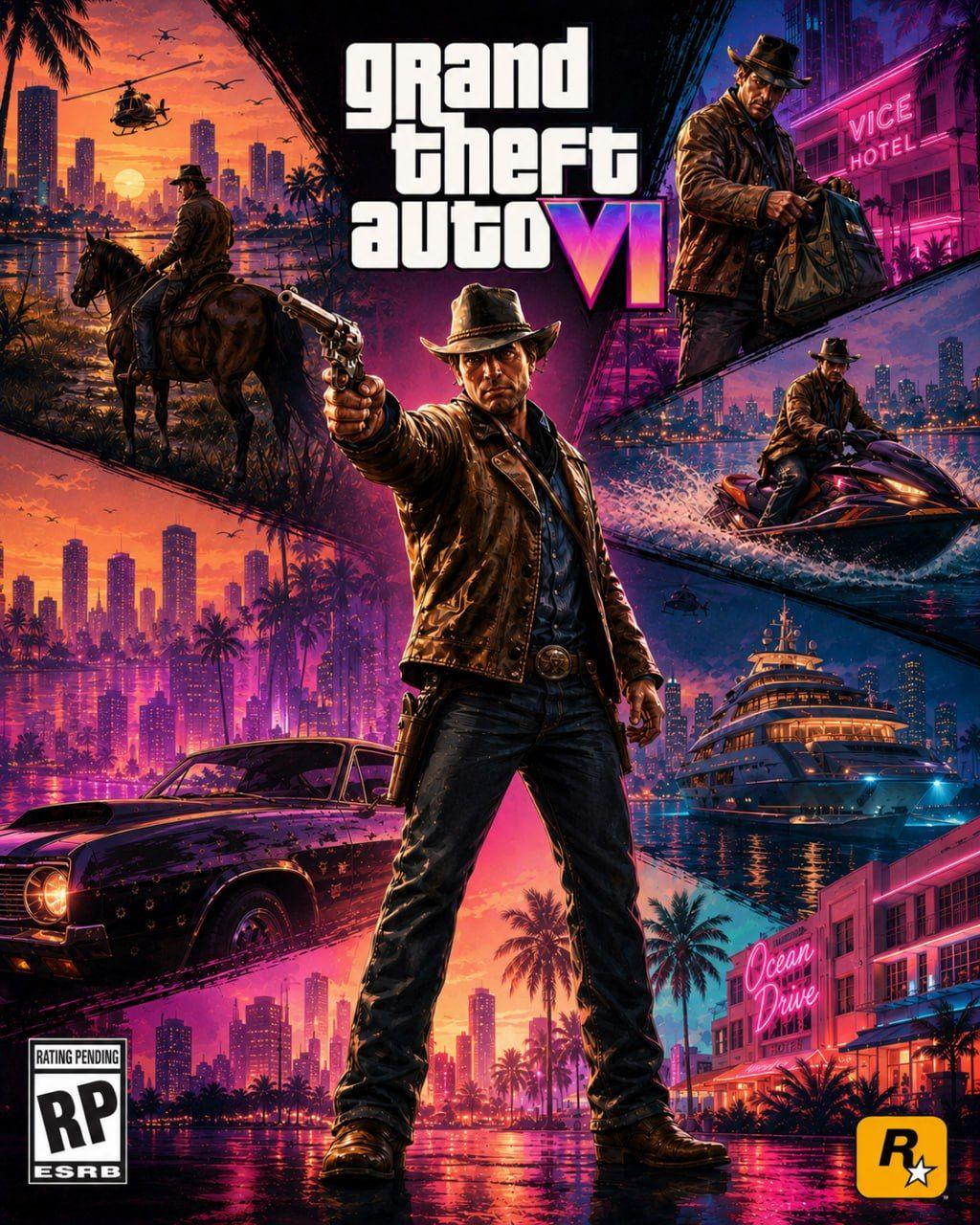
This works in ChatGPT with image generation enabled (the 4o model). No plugins, no Midjourney, no Stable Diffusion setup. If you can paste a prompt, you can do this.
The whole point of this guide is that you don't need to write a custom prompt for each character. ChatGPT already knows what Nathan Drake, Arthur Morgan, Leon Kennedy, and Kratos look like. The prompt below is engineered so that the only variables you ever change are the character's name and the game they come from. Everything else stays identical.
The Master Prompt
Here it is. We won't keep you scrolling and hunting for the secret sauce, but keep reading if you want to see what some of the results can look like and a few tips and tricks we learned while working on this.
Copy it, swap "[CHARACTER NAME]" and "[GAME NAME]" for any character you want, paste into ChatGPT.
Transform [CHARACTER NAME] from [GAME NAME] into a bold official GTA VI-inspired game poster featuring the character in a confident full-body pose from an extreme low-angle cinematic perspective.
Preserve the character's recognizable face, signature outfit elements, and iconic attitude while adapting them into Rockstar-style promotional artwork with sharp silhouettes, layered composition, and high-energy visual storytelling.
Reimagine the character wearing stylized GTA-inspired fashion that still reflects their original identity, using clean edge separation, dramatic shape language, and realistic-but-stylized anatomy with simplified details designed for maximum poster impact.
Build the background as a vibrant Miami-inspired neon montage filled with mission-style action scenes, palm trees, fast cars, nightlife, skyline silhouettes, and environmental storytelling panels showing the character in different scenarios.
Arrange the composition with layered foreground, midground, and background depth that naturally directs attention toward the main hero portrait while maintaining cinematic scale and dynamic visual flow.
Render the artwork as a polished digital game-poster illustration using painterly textures, hard-contour edgework, subtle halftone grit, high-contrast shadows, neon rim lighting, and a saturated palette of magentas, teal-cyans, warm golds, and deep shadow tones.
Finish the design with authentic GTA-style presentation elements including subtle film grain, atmospheric bloom, layered graphic panels, and a clean reserved placement for the official GTA VI logo near the upper center of the poster.
That's it. That's the whole guide.
But understanding why it works is what lets you remix it for other Rockstar styles (GTA V tiles, Red Dead-style sepia posters) or even adapt it for other franchises entirely. So let's break it down.
Anatomy of the Prompt: Why Each Line Exists
Line 1, the format and pose declaration. "Bold official GTA VI-inspired game poster" plus "full-body pose from an extreme low-angle cinematic perspective" is what locks in the Rockstar cover language. The low-angle is non-negotiable. Every GTA cover hero is shot from below to make them look bigger than life. Drop this and you get a generic character render.
Line 2, the character preservation rule. "Preserve the character's recognizable face, signature outfit elements, and iconic attitude" is what stops the model from generating a generic dude in a tank top. It forces ChatGPT to look up the character's actual visual identity in its training data and keep what matters. The phrase "iconic attitude" is doing a surprising amount of lifting here. It's why Drake looks cocky, Kratos looks furious, and Leon looks haunted even when they're all wearing GTA-adjacent fashion.
Line 3, the wardrobe translation. "Stylized GTA-inspired fashion that still reflects their original identity" is the magic line. This is what lets the model swap Kratos's leather pauldrons for a Vice City-friendly outfit while keeping the red war paint and the axe. Arthur Morgan keeps the cowboy hat but gets a leather jacket. Drake keeps the henley and the holster. Without this line, the model either keeps the original outfit untouched (boring) or strips it entirely (loses the character).
Line 4, the background brief. "Vibrant Miami-inspired neon montage filled with mission-style action scenes" is what gives you the panel-collage background that Rockstar uses for every official GTA cover. Palm trees, fast cars, nightlife, skyline silhouettes. These specific nouns are what trigger the format.
Line 5, the depth instruction. Foreground, midground, background. Same rule as the cinematic poster guide. The model stacks elements in the order you mention them, so always describe layers from front to back.
Line 6, the color and rendering direction. This is the longest line in the prompt and it's load-bearing. "Magentas, teal-cyans, warm golds, and deep shadow tones" is the exact Vice City palette. "Painterly textures, hard-contour edgework, subtle halftone grit" is what produces the Rockstar illustrative style instead of a photorealistic render. Drop any single phrase here, and the output drifts toward generic AI art.
Line 7, the GTA-specific finishing touches. Film grain, atmospheric bloom, layered graphic panels, logo placement. The logo placement instruction prevents the model from hallucinating fake text across the cover. Without it, you get gibberish in fake fonts.
The Results: Four Posters from One Prompt
Here's the proof. Same exact prompt, four different characters from four different franchises, zero changes other than the character name and source game. Notice how the model handles each character's identity, wardrobe, and pose differently while keeping the GTA VI visual language consistent across all four.
1. Nathan Drake (Uncharted)
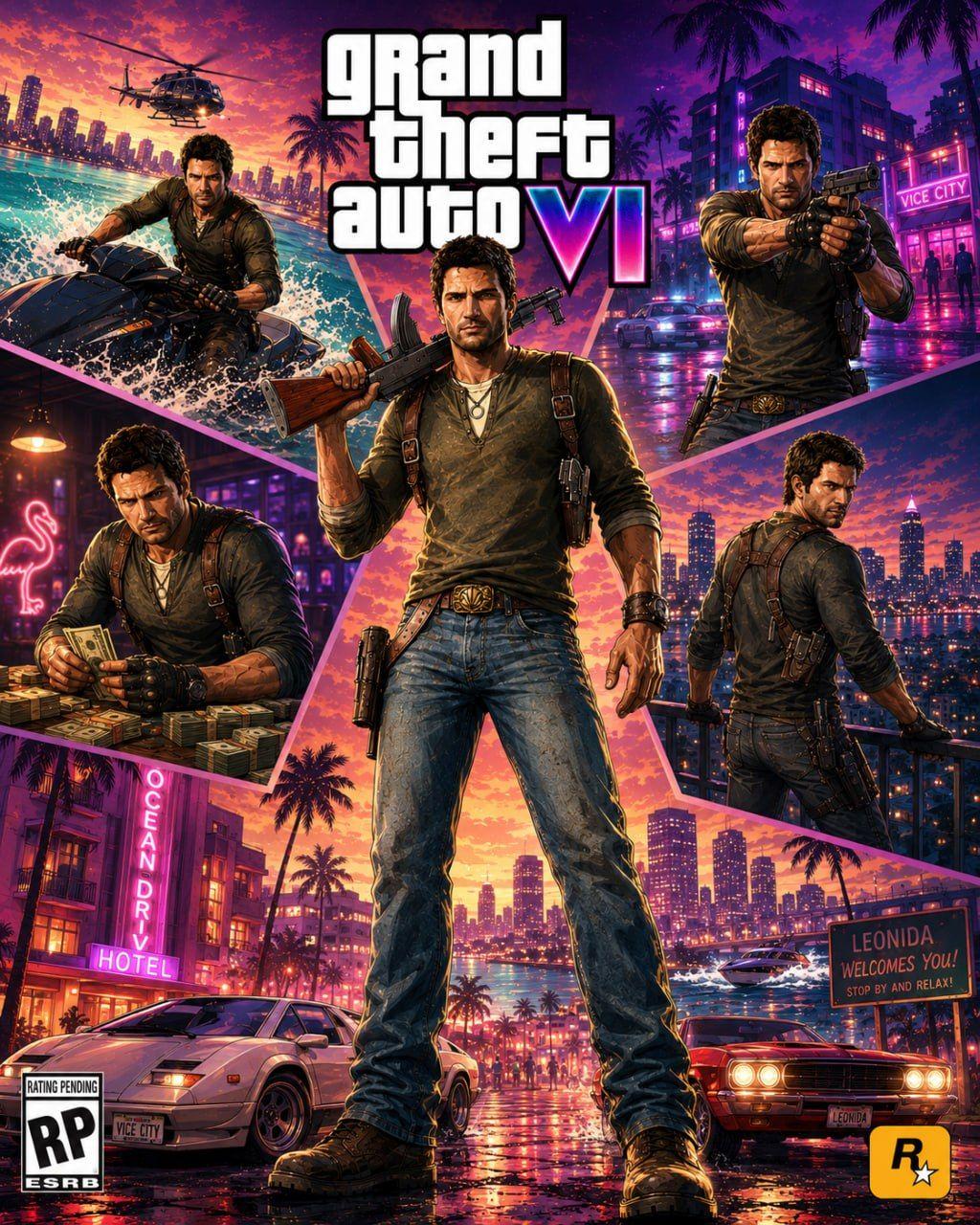
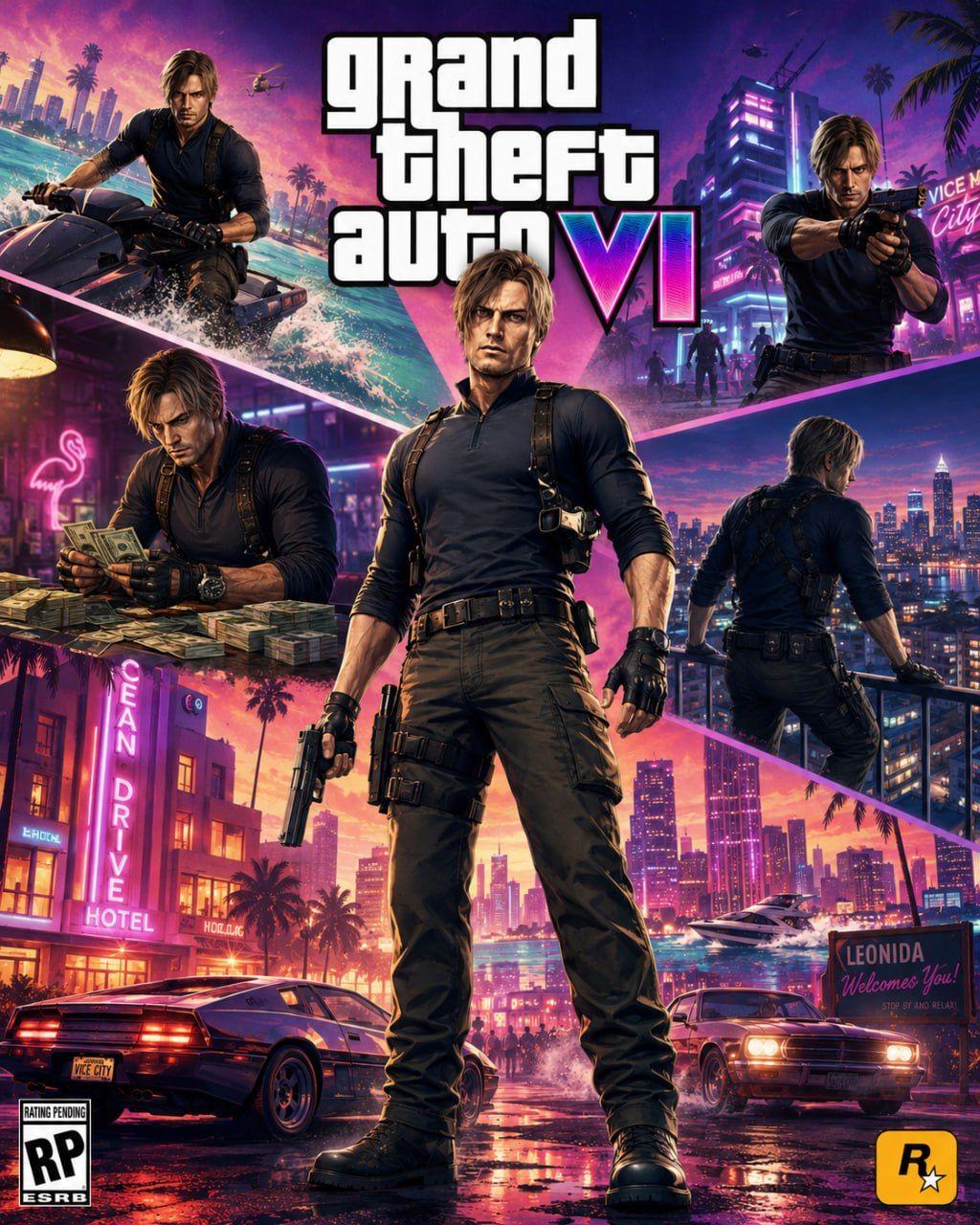
Same prompt, but this time it kept Drake's signature half-tucked henley, the holster, the cocky grin, and the messy brown hair.
Reimagined him with an assault rifle slung over his shoulder in the center panel, jet-skiing through Vice City harbor in the upper left, counting cash under a neon flamingo sign in the lower left, holding a pistol Vice City style on the right. The Rockstar panel-collage layout is intact, the magenta-to-amber sunset palette is locked in, and the "Leonida welcomes you" sign is a perfect Easter egg.
2. Arthur Morgan (Red Dead Redemption 2)
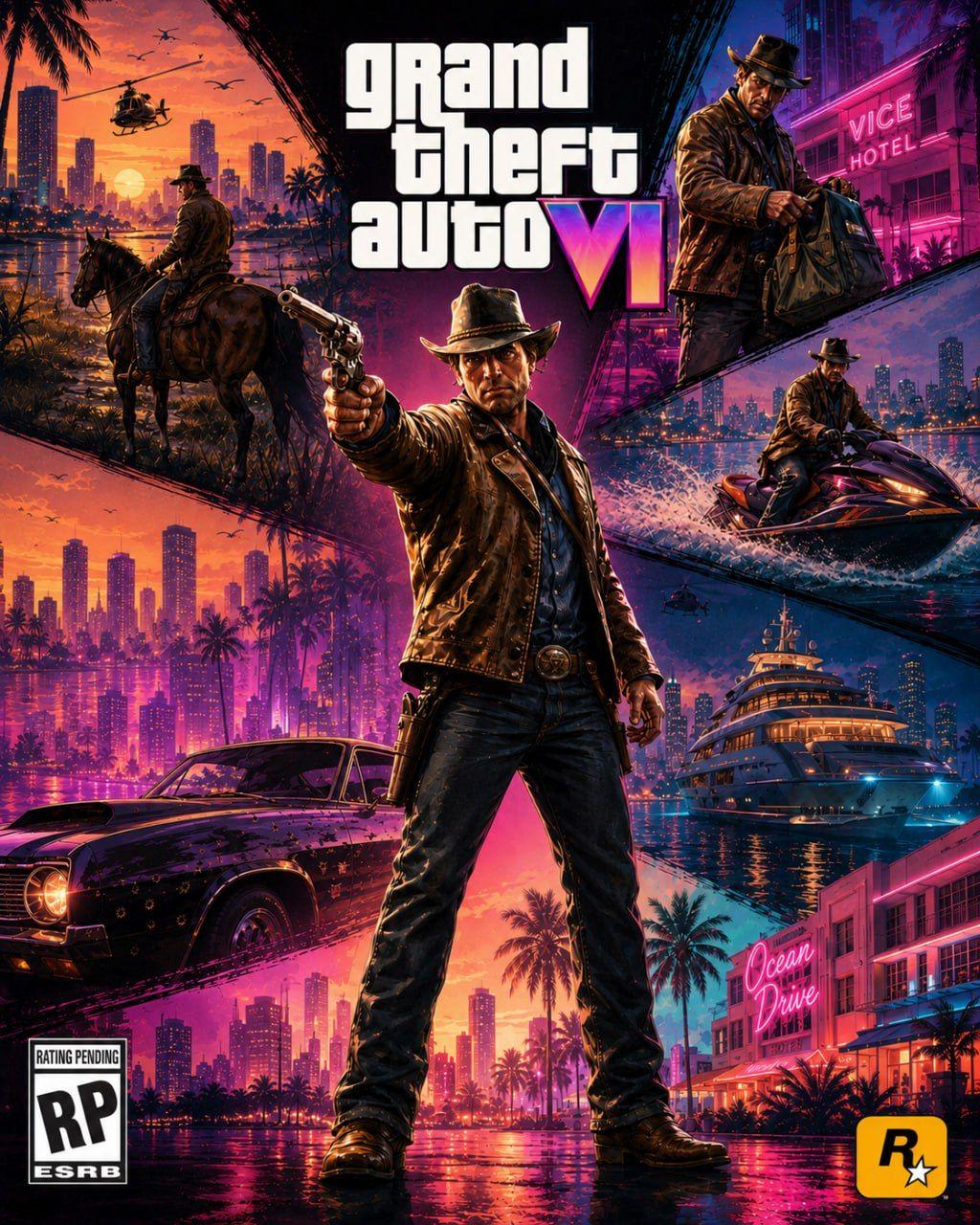
Same prompt, totally different vibe. The model kept Arthur's iconic cowboy hat, the leather jacket (translated from his frontier coat), the stubble, and the revolver grip.
But it placed him in Vice City: jet-skiing in the upper right, riding horseback through a neon-lit swamp in the upper left, walking out of an Ocean Drive hotel with a duffel bag of cash. The hat in Vice City is the joke that makes the whole image work. The model understood that the cowboy hat is part of Arthur's identity, so it kept it even in a setting where it makes zero sense.
3. Leon S. Kennedy (Resident Evil)
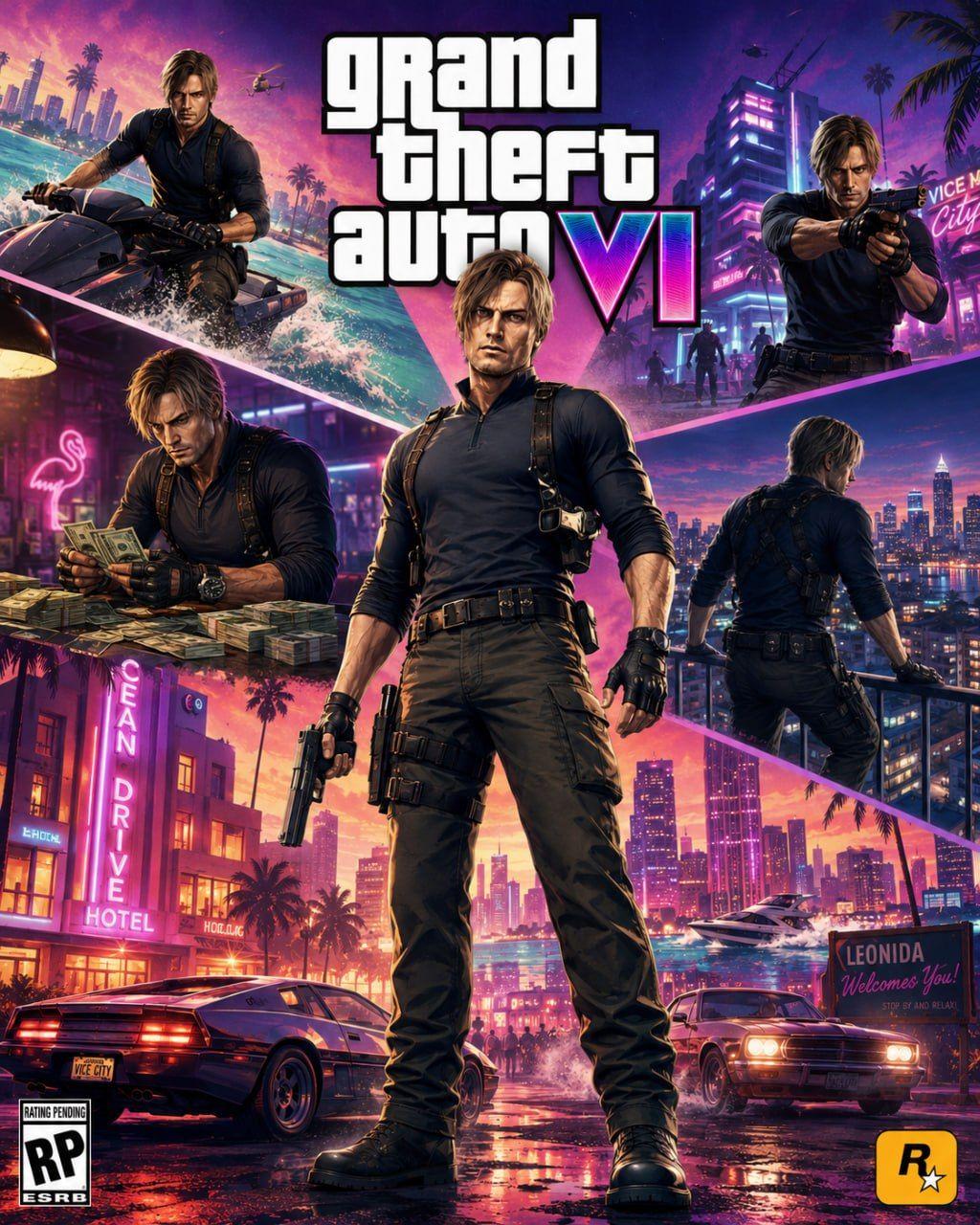
The model kept Leon's signature blonde side-swept hair, the tactical vest reinterpreted as a holstered chest rig, the fingerless gloves, and the lean RPD-officer build.
Pose is dead-center, pistol drawn at the hip, full Rockstar low-angle. Side panels show him jet-skiing into Vice City harbor, counting cash in a neon-lit bar, surveying Ocean Drive from a rooftop. The cool blue tone of his outfit pops against the magenta backdrop, which is exactly what Rockstar does on the real GTA VI cover with Lucia and Jason.
This might personally be my second favorite, right behind…
4. Kratos (God of War)
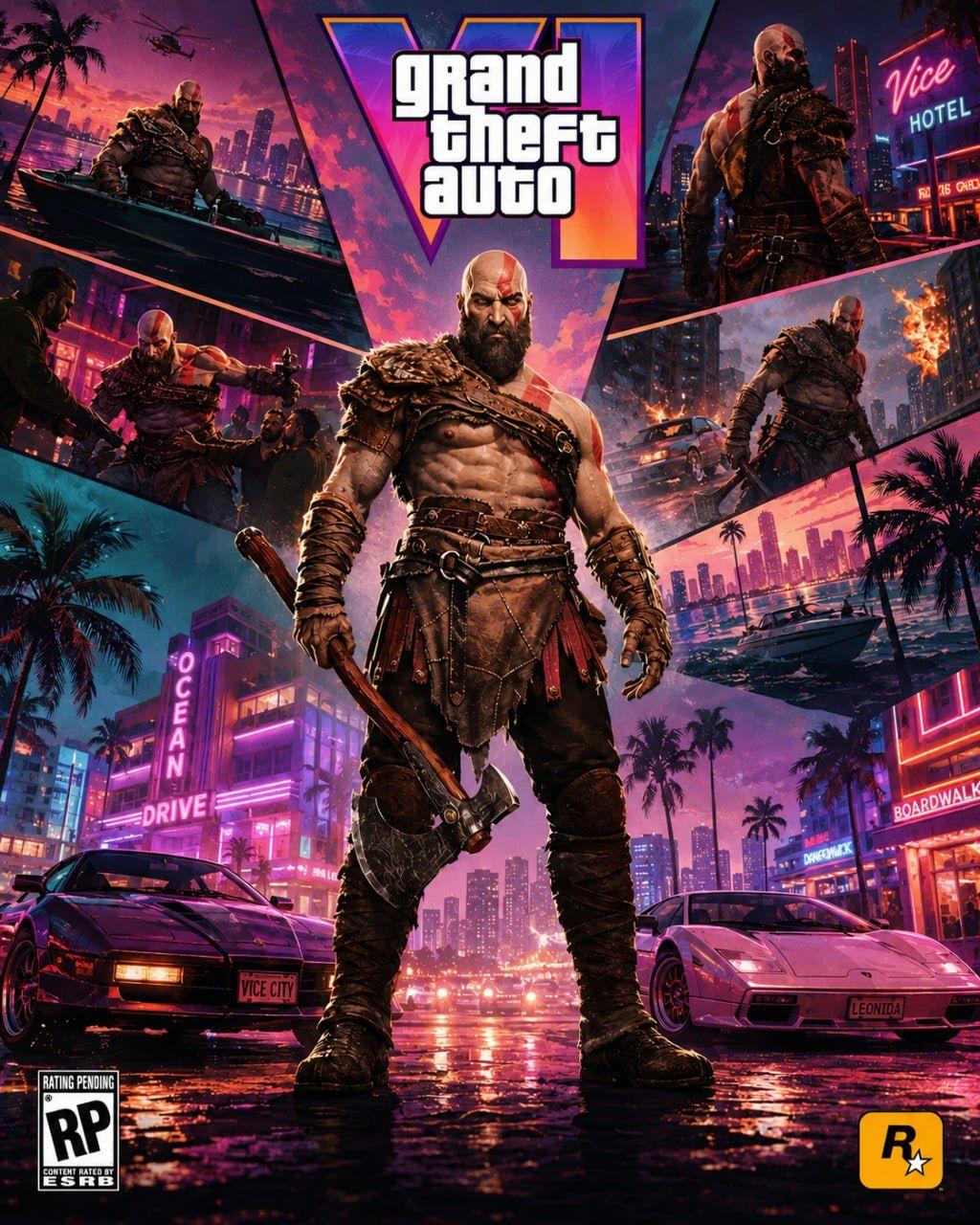
The hardest test of the prompt. Kratos has the most distinctive silhouette in gaming (shaved head, red war paint, leather skirt, Leviathan Axe).
The model could have stripped any of it to fit the GTA aesthetic, but it kept everything. Bald head, the red mark across the face and torso, the wrapped forearms, the axe in his hand. He just happens to be standing in front of a pink Ocean Drive boardwalk sign and a Lamborghini. The contrast between the Norse god and the Vice City palette is what makes this one go viral. The prompt didn't tell ChatGPT to do that. The prompt told it to preserve identity. The collision is the model's own decision.
Why This Works on Any Game
Look at the four covers together. Same prompt produced:
- A treasure hunter, an outlaw cowboy, a special agent, and a Greek god of war.
- Four completely different silhouettes, hair colors, body types, and wardrobes.
- One unified Rockstar visual language across every output.
The reason it works is that the prompt isn't telling ChatGPT what each character looks like. It's telling ChatGPT how to design a GTA VI cover. The character knowledge is already in the model. The prompt is just the brief, plus a set of constraints that lock in the Rockstar style.
That's the unlock. The prompt is a translation engine. You give it a character from one universe, and it ports them into the Vice City universe without losing what made them iconic in the first place.
This is the format that gets shared on Reddit, X, and TikTok. It's instantly recognizable, it's a fun "what if" exercise, and the variance between runs means every generation produces something slightly different. Run the same prompt for Kratos five times and you'll get five different covers. Pick the best one.
The Five Rules That Make This Work
If you want to take the prompt apart and remix it for other franchises (Marvel, DC, Halo, Star Wars), these are the rules to keep.
1. The low-angle pose is the format. Rockstar shoots every cover hero from below to make them feel larger than life. Drop the "extreme low-angle cinematic perspective" and you lose the GTA-ness immediately.
2. Preserve identity, translate wardrobe. The instruction "stylized GTA-inspired fashion that still reflects their original identity" is what makes the swap work. The character keeps what makes them iconic (Kratos's red paint, Arthur's hat, Leon's hair) but loses what doesn't fit the universe.
3. The palette is non-negotiable. Magentas, teal-cyans, warm golds, deep shadow tones. This is the Vice City color identity. Even when ChatGPT renders a character whose own palette is completely different (Kratos is grey and red), the background has to lock to Vice City.
4. Panel composition is what makes it look official. Mission-style action scenes in side panels around the central hero portrait. This is the Rockstar cover format. Single-scene backgrounds make it look like generic AI fan art.
5. Lock the logo or the model will hallucinate. Always include the line about reserved logo placement at the upper center. Otherwise, you'll get gibberish text scattered everywhere.
Frequently Asked Questions
Do I really only need to swap the character name and game name?
Yes. Every cover in this guide was generated from the exact same prompt with only "[CHARACTER NAME]" and "[GAME NAME]" replaced. The model handles wardrobe translation, pose, palette, and composition based on its training data on each character.
Which ChatGPT model should I use to generate GTA-style covers?
You need ChatGPT with image generation enabled, which uses the 4o model. It's available on the Plus, Team, and Enterprise plans, and has limited access on the free tier. No plugins or external tools are required.
Can I use this for any character, not just video game protagonists?
Yes. Swap "[CHARACTER NAME] from [GAME NAME]" for "Tony Stark from Marvel" or "Geralt from The Witcher" or "John Wick from John Wick" and the prompt still works. The model only needs enough training data on the character to know what they look like and what they wear. For obscure or original characters, add a sentence describing their appearance and signature gear.
Why does my cover not look "GTA enough"?
You're probably missing one of three things: the low-angle pose instruction (line 1), the panel-collage background brief (line 4), or the specific palette (line 6). All three are what make it read as Rockstar instead of generic neon AI art. Don't strip them out.
How do I stop ChatGPT from generating fake text on the cover?
Keep line 7 of the prompt intact: "a clean reserved placement for the official GTA VI logo near the upper center of the poster." That single line is what stops the model from hallucinating fake fonts and gibberish across the cover.
Can I use these AI-generated GTA covers commercially?
No. Grand Theft Auto, the GTA VI logo, the Rockstar wordmark, and the Vice City aesthetic are all owned by Rockstar Games and Take-Two Interactive. These covers are fan art and personal use only. Don't sell prints, don't run paid ads with them, don't put them on merch. For commercial work, take the prompt structure and adapt it to your own IP.
Does this work for female characters?
Yes, and arguably better. Try Ellie from The Last of Us, Lara Croft from Tomb Raider, Aloy from Horizon, or 2B from Nier Automata. The prompt is gender-neutral and the model handles each character's identity correctly. Just swap the name.
Ready to Build Your Own?
Copy the master prompt. Swap in any character. Paste it into ChatGPT. That's the whole workflow.
If the first output isn't quite right, don't rewrite the prompt. Re-run it. Same prompt, different generation, different result. The variance between runs is part of the system. The third or fourth pass is usually the keeper.
If you're an indie dev sitting on a great game but no key-art budget, this prompt is yours to piggyback off the GTA publicity. If you're a fan who wants to see your favorite character reimagined in the Vice City universe, this prompt is yours too. Both use cases are why we wrote this.
The next move is to apply this same skeleton to other franchise styles. Swap out the Vice City palette and panel layout for Red Dead's sepia-and-dust frontier aesthetic, or the dark gothic style of Bloodborne, or the comic-book panels of Spider-Verse. The format is the format. The franchise just happens to be the easiest case to learn it on.