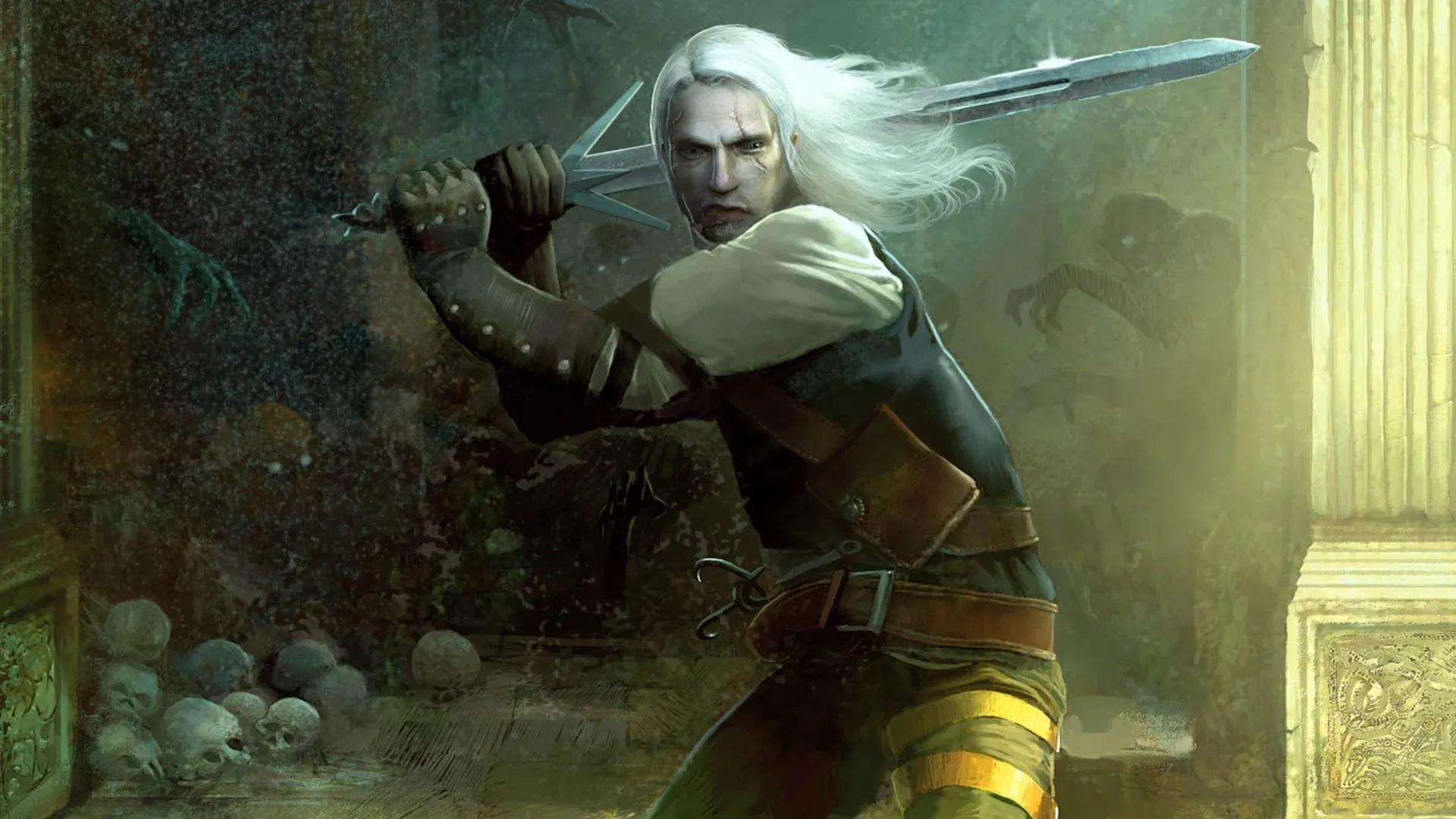

The Witcher remake was announced in 2022. Four years later, there is still no release window, no gameplay footage, and almost nothing concrete to show for it. For a lot of fans, that silence has been frustrating. Turns out there is a very good reason for it, and it goes deeper than scope or budget.
Artur Ganszyniec, a designer on both the original Witcher and Witcher 2, recently broke down the core problem in an interview with Polish outlet Chip. His comments are the clearest explanation yet of why turning a tightly scripted 2007 RPG into a modern open world is not just a visual upgrade. It is a structural rebuild from the ground up. Fans of Reigns: The Witcher will recognize just how much the Witcher universe's storytelling depends on controlled pacing and carefully gated player choices, even in its more experimental formats.
Why the original game's design breaks in open space
The Witcher 1, released in 2007, was built around a fundamental assumption: the developers always knew where the player was. That sounds simple, but it touches everything. Scripted scenes fire at specific triggers. NPCs appear in specific locations at specific times. Story-critical characters like Alvin, an NPC central to the game's major plot threads and several of Geralt's more complicated personal entanglements, could be placed precisely because the game controlled when and how players arrived at any given moment.
Open worlds remove that control entirely.
"In The Witcher 1, many things worked because we knew exactly where the player would be at any given moment," Ganszyniec said. "We could trigger a trigger, launch a scene, or insert Alvin between the fields and the village. In an open world, this would have to be handled completely differently."
Here's the thing: that is not a small problem to solve. Every scripted sequence, every NPC placement, every puzzle that assumed a particular approach now has to account for players arriving from any direction, at any level, with any combination of completed or skipped content. Developers at Fool's Theory, the studio handling the remake, have to rebuild the logic of the entire game, not just its visuals.
The boat question that sums up the whole problem
Ganszyniec used one specific example to illustrate just how far the problem reaches. In the fifth act of The Witcher 1, the action converges around Lake Vizima in a way that feels earned precisely because the player has been funneled there through a controlled sequence of events.
In an open world, that funnel disappears.
"When everything falls into place on the map around Lake Vizima in the fifth act, one might ask a simple question: if this were an open world, would I have a boat?" Ganszyniec asked. "What's stopping me from getting on a boat on the outskirts of Vizima and sailing straight to the old manor? As a player, I might be happy about that, but as a designer, I'm starting to get gray."
That single question captures the entire tension. Players want freedom. Designers need consequence. In a linear game, you can engineer both. In an open world, every shortcut a player takes risks collapsing a carefully constructed narrative moment into nothing.
What this means for the remake's timeline
Fool's Theory is not a small studio working in a vacuum. Their 2024 RPG The Thaumaturge demonstrated real competence with narrative-driven design, and CD Projekt has been publicly committed to the remake since its announcement. But commitment and competence do not automatically solve the problem Ganszyniec is describing.
Rebuilding a scripted, corridor-adjacent RPG as a genuine open world means the team is essentially designing two games simultaneously: the original story, and an entirely new systemic layer that makes that story survive player freedom. That is the kind of work that takes years before it produces anything showable.
Four years of near-silence starts to look less like mismanagement and more like an accurate reflection of how hard the problem actually is.
For players who want to revisit the Witcher universe in a more contained format while the remake takes shape, the Reigns: The Witcher guides collection covers the card-based spin-off that distills Geralt's world into sharp, choice-driven sequences. It is a reminder that the franchise has always been built on the weight of player decisions, whether in a full RPG or a deck of cards.
The Witcher remake has no confirmed release window. What it does have, apparently, is a designer problem that anyone who has ever tried to make a boat optional will recognize immediately. Keep watching Fool's Theory. When they do finally show something, it should be worth the wait.