




Biggest discounts, free games, and limited-time offers across every major gaming store.
Never pay full price again.
Overview
Paradise Killer, developed by Kaizen Game Works and published by Fellow Traveller, is an open-world investigation game set on Paradise Island, a pocket dimension existing entirely outside the boundaries of known reality. Players take on the role of Lady Love Dies, a self-described "investigation freak" recalled from exile to solve the most consequential crime in this bizarre civilization's history: the murder of the ruling Council on the eve of the island's rebirth as Perfect 25. The world is dense with cryptic lore, alien theology, and a cast of suspects who each carry secrets heavy enough to bury them.
What immediately distinguishes Paradise Killer from other mystery games is its refusal to funnel players toward a single predetermined solution. The crime scene is the entire island, and the investigation unfolds entirely on the player's terms. Evidence can be gathered in any order, suspects can be interrogated at will, and the final accusation belongs entirely to the player. The game never tells you who the killer is. It asks you to decide.
The setting draws from an alternate future history in which a rogue human civilization worships fallen alien gods, periodically regenerating their island home to channel psychic energy into the cosmos. This cycle, however, has been fatally interrupted. Demons have corrupted the island before, but this time, something worse has happened from within.

Gameplay and Mechanics: How Does the Investigation Work?
Paradise Killer structures its investigation around free exploration rather than guided progression. Lady Love Dies moves through the open world on foot, uncovering evidence, speaking with characters, and solving hieroglyph-based puzzles on ancient computers to access locked areas of the island. Every piece of testimony and every discovered relic feeds into a growing case file managed through Starlight, the player's personal electronic assistant.

Key mechanics include:
- Free-roaming evidence collection across the full island
- Open interrogation of all suspects without a set order
- Hieroglyph puzzle-solving to unlock new areas
- Evidence-based case building with player-chosen accusations
- A courtroom trial where the player argues their interpretation
[IMAGE: Lady Love Dies surveys the sprawling, sun-drenched streets of Paradise Island, relics and clues scattered across the environment.]
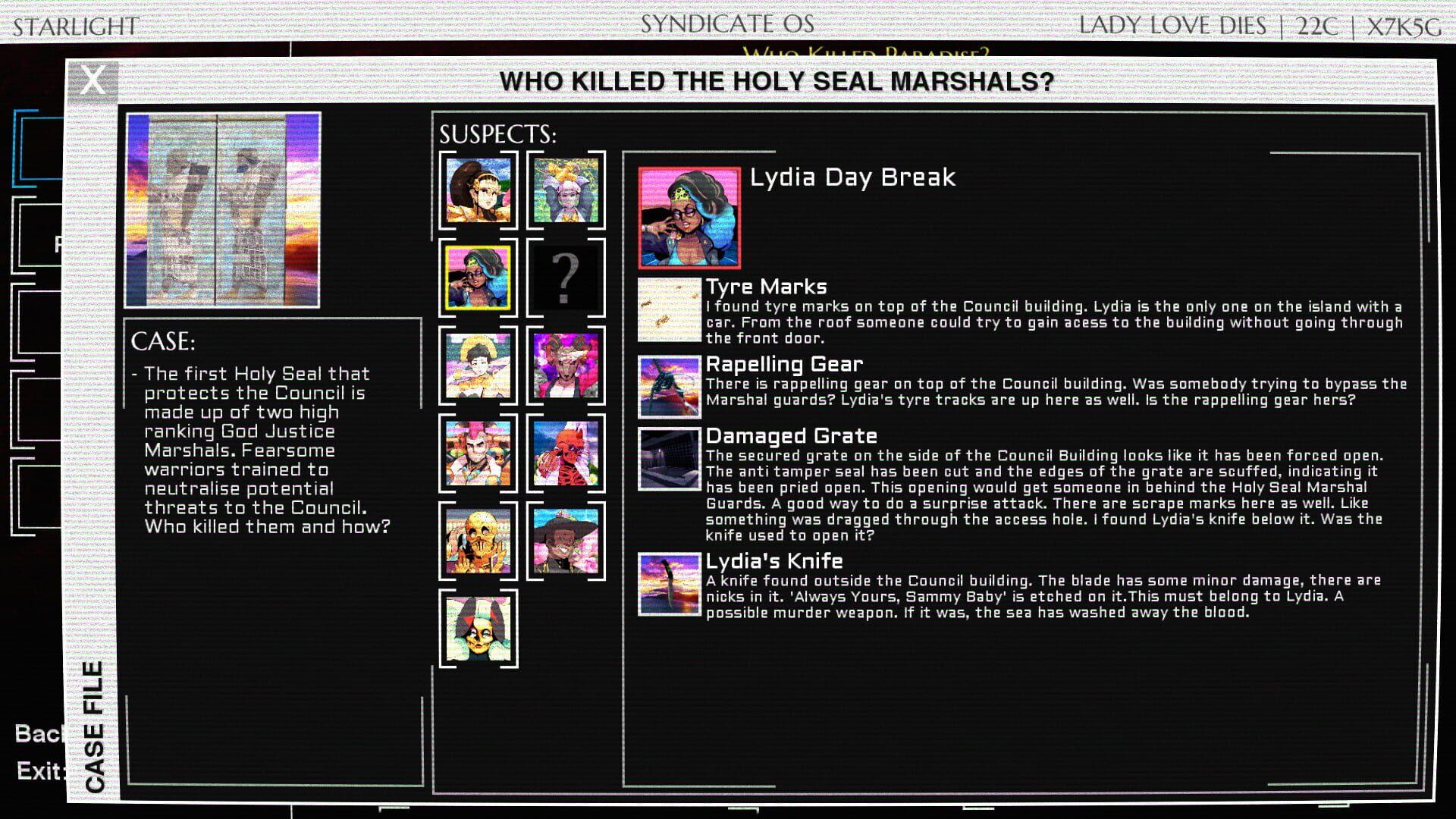
The courtroom sequence at the game's conclusion is where every choice crystallizes. Players present their assembled evidence and argue their case before a judge. The system rewards thorough investigation but does not invalidate less complete playthroughs. A conviction is possible without a perfect case, raising the question of whether justice and truth are always the same outcome.
World and Setting: A Universe Built on Surreal Mythology
The lore of Paradise Killer runs remarkably deep for an independent title. The island itself is a living structure, one that regenerates across millennia as its inhabitants funnel psychic worship toward dead alien gods. Each iteration of the island, numbered sequentially, carries the sins and secrets of the last. Paradise 24, the version players explore, is a place soaked in history, corruption, and institutional rot.

[IMAGE: Ancient nightmare computers display cryptic hieroglyph puzzles, gateways to hidden corners of the island and its buried secrets.]
Characters populating the island are not incidental. Old friends of Lady Love Dies now sit in the suspect pool, and the game forces genuinely uncomfortable choices between loyalty, evidence, and personal interpretation of guilt. Everyone on the island has something to hide, and the game's writing leans into moral ambiguity without ever becoming nihilistic.
Innovation and Unique Features: What Sets Paradise Killer Apart?
The game's most radical design choice is its commitment to player-authored truth. Most investigation games converge on a single correct answer. Paradise Killer does not. Multiple characters can be credibly accused based on the evidence available, and the game acknowledges this openly. The "truth" is framed as a personal construction rather than an objective discovery, which gives the experience a philosophical weight that lingers well beyond the credits.
The visual identity reinforces this strangeness. A vaporwave-inflected aesthetic, all warm lighting, retro-futurist architecture, and surreal iconography, gives the island a distinctive atmosphere that feels genuinely unlike anything else in the genre. The original soundtrack, composed to match the island's otherworldly mood, has earned considerable praise independently of the game itself.
Impact and Legacy
Paradise Killer launched to strong critical reception, earning scores including 9/10 from GameSpot and PC Invasion, 91/100 from PC Gamer, and a perfect 5/5 from Windows Central. It currently holds a 4.44-star rating on PlayStation Store from over 1,100 user ratings. The game is available across PlayStation 4, PlayStation 5, Xbox, Nintendo Switch, PC via Steam, and the Epic Games Store, with the PS5 version supporting DualSense haptic feedback and adaptive triggers.
Conclusion
Paradise Killer is a genuinely singular open-world mystery that treats player agency as its central design philosophy. By refusing to impose a single correct solution, it transforms the investigation genre into something more introspective: a meditation on evidence, belief, and the stories people construct to make sense of the world. For players drawn to atmospheric adventure games with deep lore and meaningful player-driven narrative, it stands as one of the most distinctive independent titles of its era.