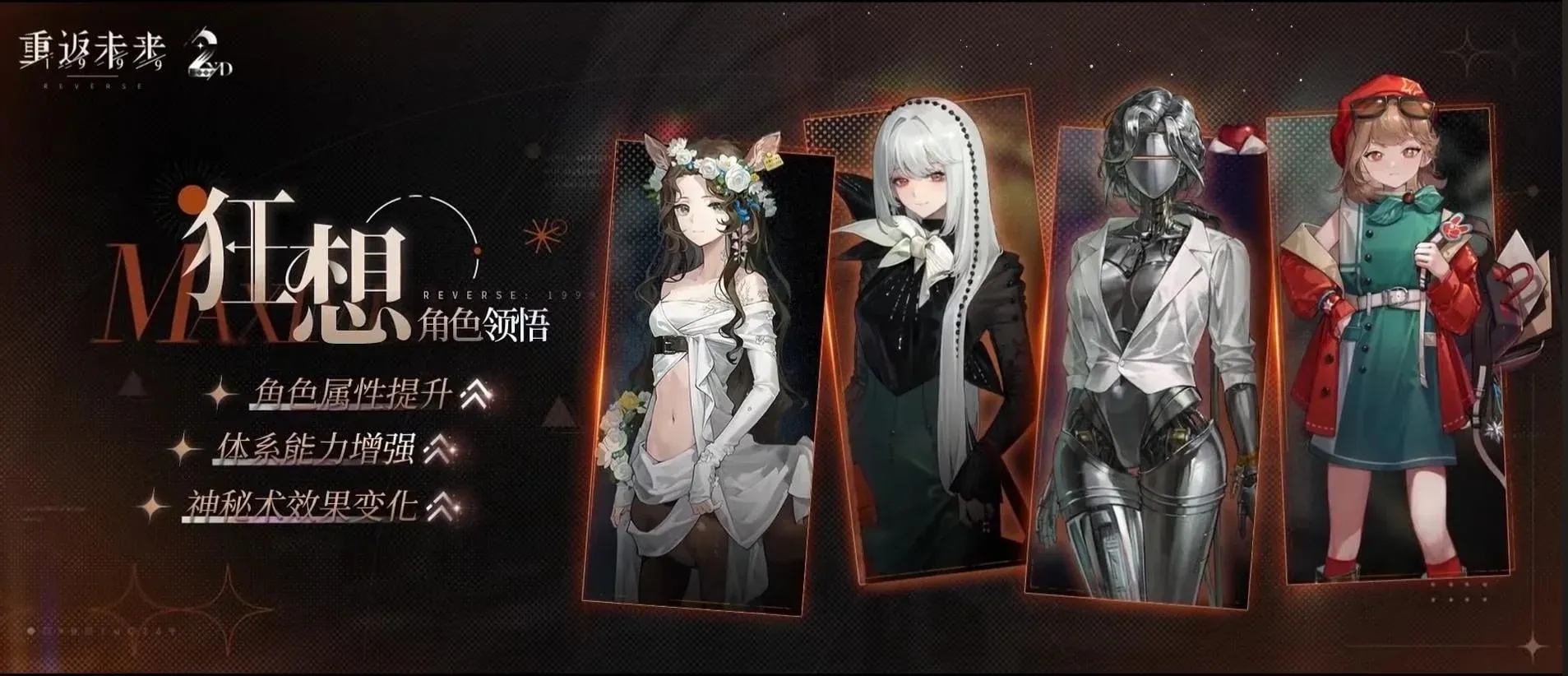

Reverse: 1999 has never been more complex to navigate than it is right now. Version 3.5 brought a wave of new Arcanists, transformative Euphoria upgrades, and entirely new team archetypes that have reshuffled the meta from top to bottom. If you pulled Beryl and have no idea what to build around her, or if you are sitting on a roster of solid A-tier units wondering whether they can still clear Limbo, this guide has your answers.
The short version: archetype synergy beats raw character power every single time in this game. A coordinated team of A-tier Arcanists will consistently outperform a randomly assembled group of S+ picks. Keep that principle in mind as you read through the rankings below.
The full Reverse: 1999 tier list for Version 3.5
The table below covers all notable Arcanists from S+ down to E tier, based on performance across Limbo, Reveries, Mane's Bulletin, and general story content. Rankings reflect current Global server data from Version 3.5.
| Tier | Arcanists |
|---|---|
| S+ | Beryl, Brume, Liang Yue, Anjo Nala, Charon, Marsha |
| S | Paper Heron, Ezio Auditore, Recoleta, Lorentz Butterfly, Windsong, Flutterpage, Fatutu, Jiu Niangzi, Getian, Kakania, Nautika, Lucy, Isolde, Vila, Tooth Fairy, An-An Lee, Dikke, Medicine Pocket, Sentinel, Ulrich, Ezra Theodore, Kiperina, 6 |
| A | Argus, Kaalaa Baunaa, Centurion, Regulus, Shamane, Mercuria, Druvis III, Pickles, Eagle, Lopera, Aleph, Barbara, Reed, Semmelweis, Bkornblume, Black Dwarf, Voyager, Tuesday, Name Day, Moldir, Willow, Alexios, Melania, A Knight |
| B | Ramona, Cheng Heguang, Spathodea, Charlie, Baby Blue, Barcarola, Noire, Marcus, Balloon Party, Lorelei, Bette, Erick, Oliver Fog, La Source, APPLe, Yenisei, Loggerhead, White Rum, Kanjira, Ezra, Leilani, Lilya, J, Mondlicht, Matilda |
| C | 37, The Fool, Pavia, X, Twins Sleep, Ms. Newbabel, Cristallo, Rabies, Nick Bottom, Satsuki, Mr. Duncan, Sotheby, Ulu, Avgust, Sweetheart, Zima, Click, Flannel, Necrologist |
| D | Darley Clatter, aliEn T, Tennant, Door, Ms. Moissan, Mesmer Jr., Poltergeist |
| E | Brimley, Bunny Bunny, Ms. Radio, John Titor, TTT, Onion, Sputnik |
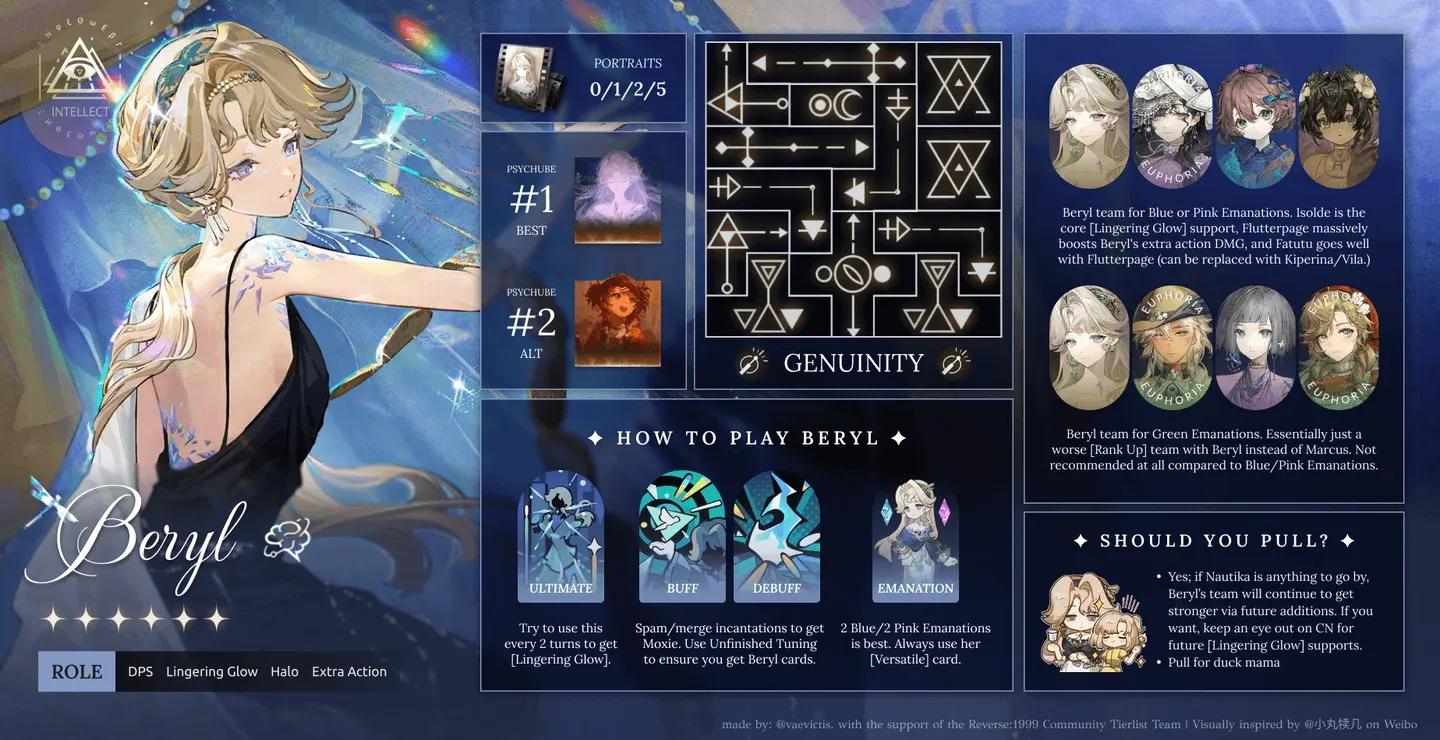
Beryl's Lingering Glow setup


How does the tier list work in Reverse: 1999?
Unlike most gacha RPGs where you slot in the highest-rarity unit and call it a day, Reverse: 1999 evaluates characters through the lens of archetype compatibility. The current meta in Version 3.5 rewards three core mechanics above everything else: Extra Action (FUA) spam, Moxie cycling, and Incantation Might buffing. Characters who enable or amplify these mechanics sit at the top regardless of raw damage numbers.
When placing characters in tiers, the following factors carry the most weight:
- Role flexibility — can the unit function as a Damage Dealer, Sub Carry, Support, or Survival pick?
- Archetype compatibility — does the unit slot into Lingering Glow, Dynamo, Bloodtithe, or Impromptu team structures?
- Euphoria scaling — does an upgrade at E1 or E2 dramatically change what the character does?
- Portray requirements — is the character functional at P0, or does it need heavy duplication investment?
- Content versatility — does it perform across Limbo, Reveries, and Mane's Bulletin, or only shine in one mode?
Every viable team needs a Damage Dealer, a Sub Carry, a Support, and a Survival unit. That four-role framework is the foundation of every composition in this guide.
What makes S+ tier characters so dominant?
The six S+ tier Arcanists in Version 3.5 do not just perform well. They define entire team archetypes and make previously impossible damage outputs routine.
Beryl
Beryl is the centerpiece of the Lingering Glow archetype. Her Thermoelectric Conversion stacking generates Genesis DMG in a self-sustaining loop that handles most endgame content without requiring perfect execution. What separates her from other damage dealers is genuine flexibility: she works in dedicated Lingering Glow teams, slots into hybrid setups, and can even function as a budget Sub Carry. Her E2 Euphoria upgrade is the breakpoint where she becomes genuinely hard to stop.
Brume
Brume rewrote the Ultimate spam meta on release. His Pulsing Field mechanic creates a feedback loop where each Ultimate generates resources for the next, producing exponential scaling that peaks in longer battles. Top players pair him with high-frequency Ultimate users and Incantation Might supports to reach damage numbers that simply were not achievable before his introduction. He demands more setup than Beryl, but the ceiling in optimized teams is unmatched.
Liang Yue
Liang Yue is a Euphoria story. Before her E2 upgrade, she was a niche A-tier pick. After it, she provides team-wide buffs that persist through character swaps, functioning as a permanent damage steroid for your entire roster. The key mechanic is her Array system: properly maintained Arrays stack bonuses multiplicatively rather than additively, and players who master her rotation timing report damage increases of 40% or more across the full team.
Anjo Nala
Anjo Nala has held her position at the top of the support category through multiple new releases. She amplifies Reality DMG while providing consistent Moxie generation, and unlike most supports who only fit one archetype, she improves virtually any team she joins. Her value actually scales upward as your Damage Dealers gain better Psychubes and Resonance builds, because her buffs interact multiplicatively with those improvements.
Charon
Charon is the engine behind the Dynamo Asylum archetype. His Electric Field creation adds passive damage over longer battles, but his real value is Moxie economy maintenance. Without Charon, the Lucy and Ulrich synergy that defines Dynamo teams simply does not function at the level needed for difficult Limbo stages. For players who prioritize consistent performance over burst, he is irreplaceable.
Marsha
Marsha transformed FUA teams from an interesting novelty into a dominant meta force. Her Gust stacking turns units with moderate FUA output into damage machines, and her ability to trigger and amplify Follow-Up Attacks while contributing meaningful personal damage makes her the centerpiece of Plantpromptu compositions. Pair her with Flutterpage and Jiu Niangzi for the fastest clear times currently available.
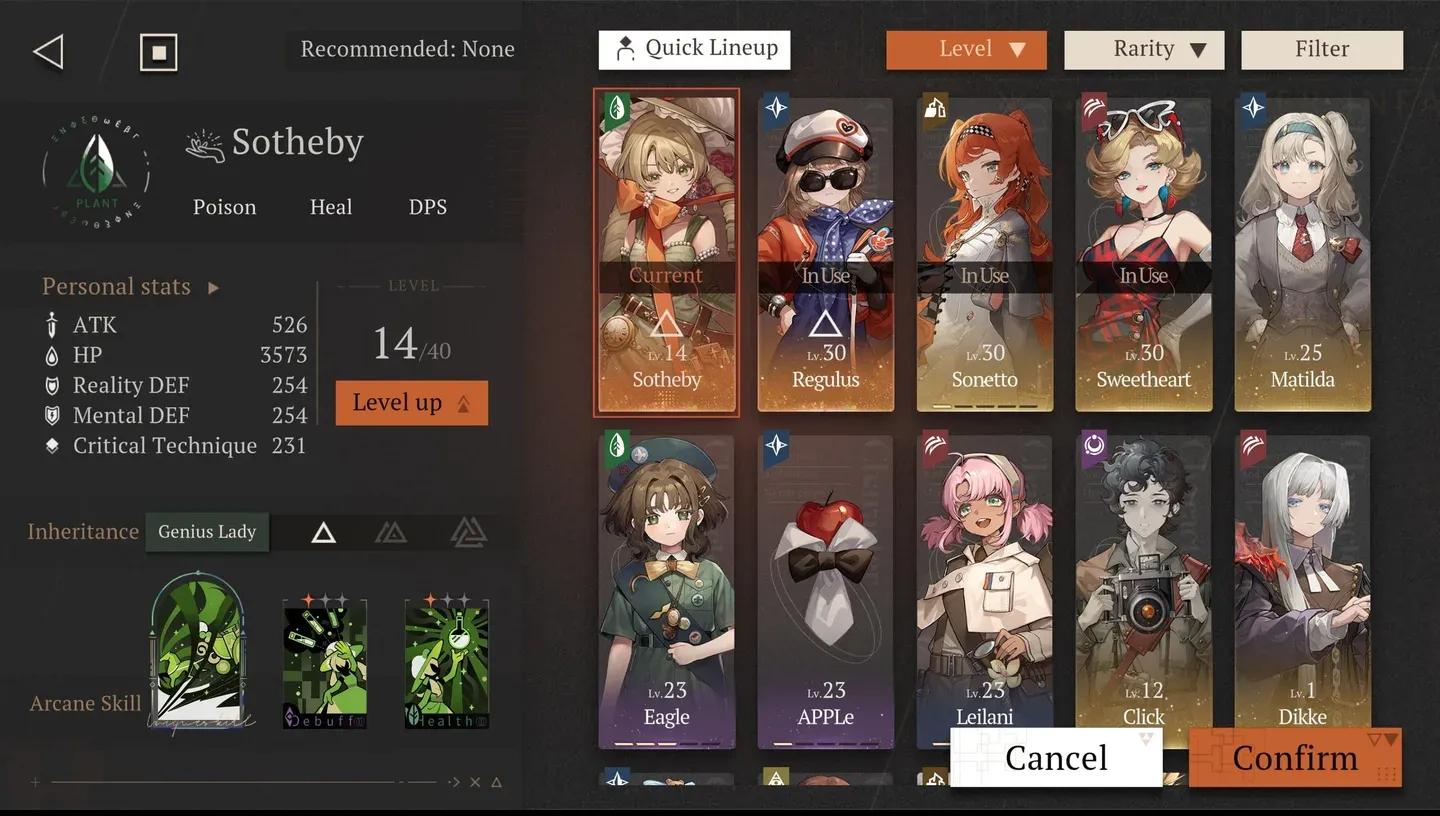
Team role assignment screen
Which characters are worth pulling in S tier?
S tier contains Arcanists who excel in specific roles without necessarily redefining the meta. They consistently deliver in their niches and most of them fit into multiple team types.
Tooth Fairy is the clearest success story in recent patches. She climbed from B+ to S tier through her Euphoria upgrade, which introduced auto-cast healing at sub-70% HP. That passive sustain frees up her AP for buffs, making her the top Survival option for teams that cannot sacrifice action economy for healing. Her E1 breakpoint is the one to target.
Kakania dropped from S+ to S tier not because she got weaker, but because newer releases offer more specialized utility. She remains the best generalist support available. New players should absolutely prioritize her since her consistent cross-content performance makes her the safest early investment in the game.
Paper Heron arrived as a flexible Sub Carry who bridges support and damage. Consistent debuff application combined with meaningful personal damage makes her invaluable in teams that cannot afford a dedicated support slot. Her E1 Euphoria secured her S tier placement through improved buff consistency.
Lorentz Butterfly brings Inspiration-based damage scaling that has a genuinely high ceiling. The setup requirement is real, but advanced players have posted record Reveries scores using her in optimized compositions.
How do Euphoria upgrades change the meta?
Euphoria upgrades have become the single biggest driver of tier movement since their introduction. The system lets older Arcanists compete with newer releases and creates dramatic power spikes that can shift characters by multiple brackets.
Here are the most impactful Euphoria breakpoints currently active in Version 3.5:
| Character | Euphoria Level | Tier Change | Key Improvement |
|---|---|---|---|
| Liang Yue | E2 | A to S+ | Array buffs become permanent team-wide |
| Tooth Fairy | E1 | B+ to S | Auto-cast healing below 70% HP |
| Argus | E2 | B to S | Gains real damage output alongside debuffs |
| A Knight | E2 | B to A+ | Excels in wave-based and high enemy count stages |
| Paper Heron | E1 | Secured S | Improved buff consistency and damage scaling |
Full Euphoria upgrades require 12 Keys of Thought, 165 Sprouts of Fantasy, and 2600 Seeds of Inspiration. These materials cannot be reclaimed, so plan investments carefully. Prioritize characters you use across multiple team compositions first, then supports with transformative E1 or E2 breakpoints, then Damage Dealers with exponential scaling mechanics.
Euphoria upgrade material screen
What are the best team compositions in Version 3.5?
The top teams in Version 3.5 each exploit a specific mechanical archetype. Here is a breakdown of the six most effective compositions right now.
Lingering Glow (current top meta)
Core: Beryl + Charon + Anjo Nala Flex: Tooth Fairy or Medicine Pocket
The premier archetype of Version 3.5. Beryl drives Thermoelectric Conversion stacking, Charon maintains Dynamo generation and Moxie economy, and Anjo Nala amplifies the entire team's output. This composition handles all content types with minimal mechanical execution required.
Plantpromptu
Core: Marsha + Flutterpage + Jiu Niangzi Flex: Fatutu or Sentinel
Maximum FUA frequency with Gust stacking. Marsha enables the team through her FUA amplification, while Flutterpage and Jiu Niangzi provide the rapid-fire attacks that trigger the snowball. Fastest clear times in multi-target scenarios.
Starpromptu
Core: Brume + Lorentz Butterfly + Getian Flex: Kakania or Vila
Ultimate frequency spam at its peak. Brume's Moxie cycling enables constant Ultimates, Lorentz Butterfly and Getian capitalize on the resulting damage windows. High investment, high reward. Rotation management separates good results from great ones.
Dynamo Asylum
Core: Lucy + Charon + Ulrich Flex: Medicine Pocket or Tooth Fairy
Consistent Electric Field generation creates passive damage that accumulates significantly over time. AFK-friendly and reliable for Reveries farming. Prioritizes consistency over burst.
Bloodtithe Burst
Core: Nautika + Semmelweis + Sentinel Flex: Medicine Pocket
HP manipulation combined with Crit stacking produces devastating 2-round nukes. Nautika consumes HP to self-buff, Semmelweis enables the health manipulation loop, and Sentinel provides the Crit bonuses that make the team function. Best for speedrunning content where eliminating the boss before mechanics trigger is the goal.
FUA Snowball
Core: Windsong + Lopera + Fatutu Flex: Vila or Kakania
Classic FUA composition that stays competitive through Gust stacking and channel maintenance. Less explosive than Plantpromptu but significantly more forgiving for players who do not have Marsha yet.
Who should new players reroll for?
If you are willing to reroll for an optimal start, the three best targets are Beryl, Anjo Nala, and Charon. Each of these S+ tier units enables multiple top-tier team archetypes, meaning your starting pull will remain relevant regardless of which direction your roster develops.
If you cannot land an S+ tier unit, any S-tier Damage Dealer paired with Medicine Pocket gives you a functional foundation. Medicine Pocket is accessible early, provides reliable healing, and remains S tier through the current patch.
For your first team, focus on these accessible characters before chasing meta picks:
- Medicine Pocket — early accessible healer, S tier, works in any comp
- Sonetto — guaranteed story reward, reliable damage output
- Regulus or Voyager — flexible damage options that do not require specific teammates
Bring one complete team to Insight 3 before expanding your roster. Spreading resources across too many characters early is the most common mistake new players make.
Which characters work best for F2P players?
Free-to-play viability in Reverse: 1999 comes down to finding characters who perform well without requiring specific teammates or high Portray investment. The following units meet that standard:
- Reed — recently added as an accessible damage option with solid scaling
- Barbara — available through standard acquisition methods
- Medicine Pocket — the benchmark accessible healer, S tier
- Sonetto — guaranteed through story progression
- APPLe — budget option for players with limited rosters
When building F2P, prioritize characters who function at Insight 1-2, provide utility beyond raw damage, and do not require specific partners to perform. Save Clear Drops for guaranteed pity banners rather than spending them on characters who fill a role you already have covered.
How often does the Reverse: 1999 meta change?
Expect meaningful meta shifts every 6-8 weeks when major patches drop new characters. Euphoria updates are less predictable but more dramatic, capable of moving a character up multiple tier brackets in a single patch. Balance adjustments fine-tune overperforming units, and new game modes occasionally create entirely different optimization priorities.
Version 3.x has been particularly volatile compared to earlier patches. The Euphoria system means that a character sitting in B tier today could become a meta-defining force after their upgrade drops. Check tier list updates after every major patch rather than treating any ranking as permanent.
For more guides covering gacha RPGs and other games, browse the full guides library at GAMES.GG to stay current on meta shifts across your favorite titles.
Final recommendations
The Version 3.5 meta rewards players who understand Lingering Glow, Plantpromptu, and Starpromptu mechanics over those who simply collect the highest-tier characters. Beryl, Brume, and Liang Yue are genuinely strong, but a well-built team of A-tier Arcanists with proper archetype synergy will outperform a randomly assembled S+ roster every time.
Focus on completing one team to Insight 3 before expanding. Invest in Euphoria upgrades for characters you use across multiple compositions. Save Clear Drops for characters who fill actual gaps in your roster rather than pulling on every banner with a high-tier unit. The depth of Reverse: 1999 comes from mechanical interaction, and that depth rewards players who take the time to understand it.