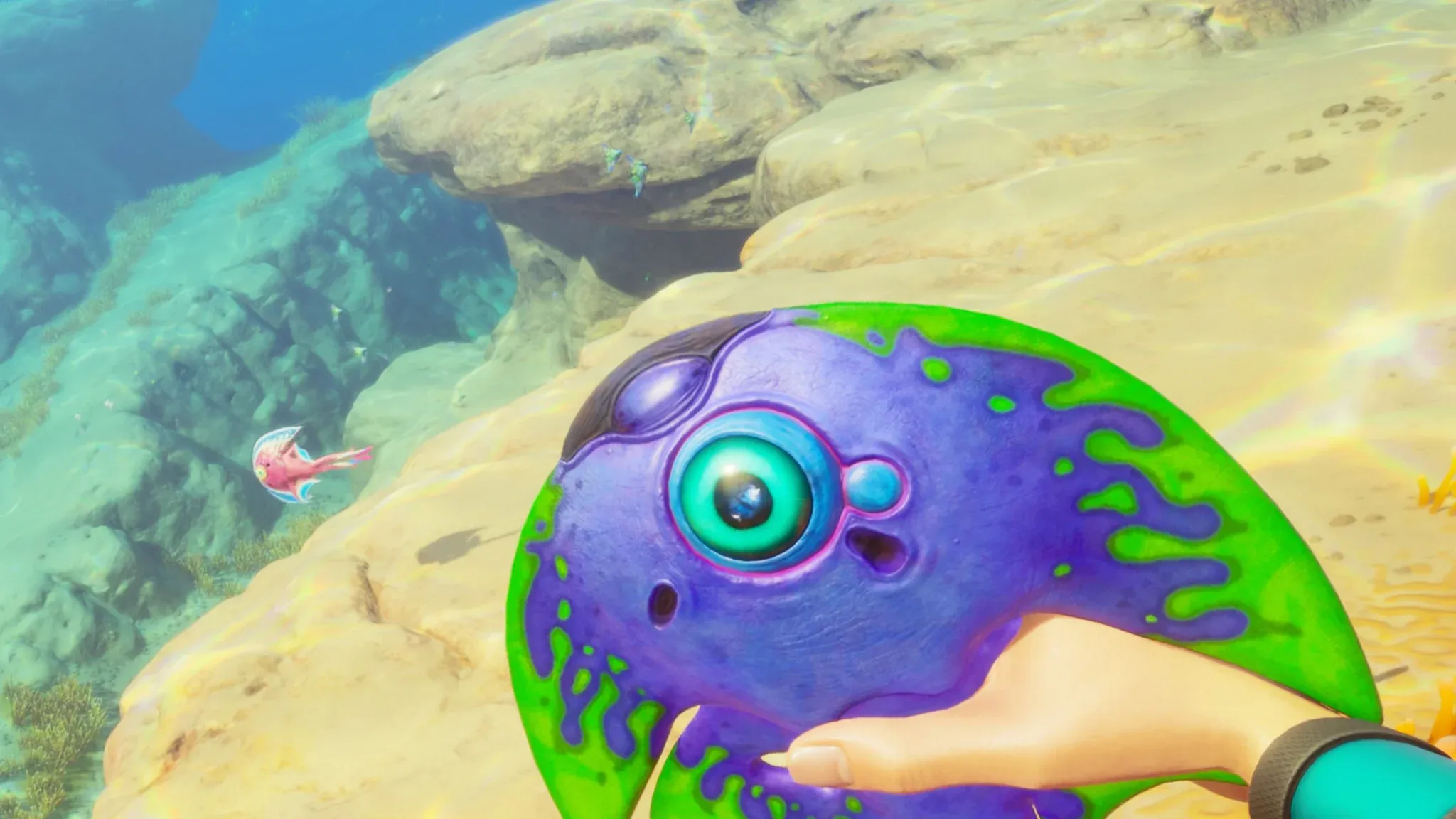

Crash-landing on Proteus is stressful enough without your stomach rejecting every fish you try to eat. Subnautica 2 throws two survival problems at you almost simultaneously: a thirst meter that drains faster than hunger, and a condition called Digestive Incompatibility that makes alien food actively harmful until you fix it. Both problems have clean solutions, and once you understand the systems, keeping your character alive becomes second nature in one of the most demanding survival games available right now.
How do you get water in Subnautica 2?
Thirst depletes faster than hunger, making water your immediate priority the second you surface from the crash. The ocean surrounds you, but drinking raw seawater isn't an option.
Finding and using Water Slugs
Dive straight down from your Lifepod and scan the seafloor for short, yellow anemone fields. Water Slugs live here in decent numbers. They look like small, transparent sea sponges with a bright blue-and-pink glow, and they move slowly enough to grab by hand without any tools.
Don't eat them raw. A raw Water Slug only restores 15 thirst points and drains 5 points from your hunger meter. Since your food options are already limited early on, that trade is terrible. Bring them back to the Fabricator inside the Lifepod and craft them into Water Bottles instead. One Water Slug produces one Water Bottle, which restores 40 thirst points.
Carrying 3 or 4 Water Bottles before any longer dive keeps your thirst meter comfortable for extended exploration sessions. Water Slugs are plentiful enough near the starting area that you can stock up quickly.
Alternative water sources
Once you construct a Processor, two additional recipes become available. 3x Fibrous Pulp can be processed into Water as a backup when slug populations thin out. The Acidic Raion Pouch also works as an alternative Processor recipe for water later in the game.
How do you fix Digestive Incompatibility in Subnautica 2?
This is the wall that stops most new players cold. You catch a Geordie, cook it in the Fabricator, eat it, and your health drops instead of your hunger rising. The game isn't broken. Your character simply can't process alien biology yet.
What is Digestive Incompatibility?
Digestive Incompatibility is a starting condition that prevents your character from gaining nutrition from any alien flora or fauna. Until you cure it, your only safe food sources are Nutrient Blocks, which you loot from supply crates and stashes scattered around the early biomes. Each Nutrient Block grants +40 food, making them a reliable bridge while you sort out the digestion problem.
Where is the Angel Comb?
The cure comes from a specific creature called the Angel Comb, located roughly 160 meters north-northeast of your Lifepod. The landmark is a massive, glowing pink-and-purple plant with spiky, wing-like protrusions. It's hard to miss once you're in the right area.
You can track it down two ways. The first is to wait for the NOA terminal inside your Lifepod to deliver a "Missing Colonists" message followed by an update about a colonist named Anita Gottschal. This places a HUD waypoint directly on the Angel Comb's location via Anita's blackbox.
The second method is to skip the wait entirely. Climb on top of your Lifepod, orient yourself roughly 20 degrees between North and Northeast, and swim 160 meters in that direction. The blackbox sits directly beneath the Angel Comb.
Once you find it, swim up to the central pink bulb and interact with it. The pod injects you with alien enzymes, permanently removing Digestive Incompatibility and unlocking the Digestion Adaptation. Keep your health topped up before the interaction, as a few hostile creatures patrol the area around the Angel Comb.
For a broader look at how Adaptations work in the game, the Subnautica 2 Biomods and Adaptations guide covers every unlock and what each one does.
What should you eat after getting the Digestion Adaptation?
Once the Adaptation is active, the ocean becomes a functional food source. Here's what to prioritize.
Easy early fish
The Geordie is the most practical early meal. Unlike Halfmoons and Harvestmoons, which swim in fast-moving schools and require some effort to catch, Geordies attach themselves to the outer shells of coral domes and stay completely still. Grab a few, cook them in the Fabricator, and each one restores 30 food points.
Halfmoons and Harvestmoons are worth catching too, especially since they factor into more efficient prepared meals later, but the Geordie is your reliable daily driver for early hunger management.
Plant-based options
If chasing fish sounds tedious, craft a Survival Multitool using 3x Titanium. This tool lets you harvest Feather Kelp from local caves and cut Whip Gorgon shoots to collect Fibrous Pulp. Two pieces of Fibrous Pulp craft into an Oily Salad at the Fabricator for +20 food, no fishing required.
Crafting Nutrient Blocks yourself
Once you have a Processor running, you're no longer dependent on supply crate drops for Nutrient Blocks. Organic materials like Fibrous Pulp and Pent can be processed into Biofuel Blocks. Combine 1x Biofuel Block with 1x Salt at the Fabricator to produce 1x Nutrient Block (+40 food). Salt deposits appear in deep caves southeast of the Lifepod.
Consumable comparison table
The best travel food: Threemoon Temaki
For long expeditions away from your base, the Threemoon Temaki is the most efficient single-slot meal in the early game. It requires 1x Halfmoon, 1x Harvestmoon, 1x Bluemoon, and 1x Fibrous Pulp, and it returns +60 food plus +15 health. That health recovery makes it genuinely useful in dangerous biomes where you might take incidental damage from predators.
The ingredient requirement is demanding since it needs three different fish types, but the payoff per inventory slot is unmatched by any simpler recipe.
Survival mode vs. Creative mode
Everything above applies to Survival Mode. If you're playing Creative Mode, hunger and thirst are disabled entirely and your character can't die from them. Creative Mode is worth considering if you want to explore the world without resource pressure, but the food and digestion systems are where a lot of Subnautica 2's early tension comes from.
For players new to the game who want to understand all the survival systems before committing to a full run, the Subnautica 2 beginner's guide covers oxygen management, base building, and navigation alongside hunger and thirst.
Food and water are just the start of what you need to manage on Proteus. For everything else, the full Subnautica 2 guides collection has you covered as you push into deeper biomes.