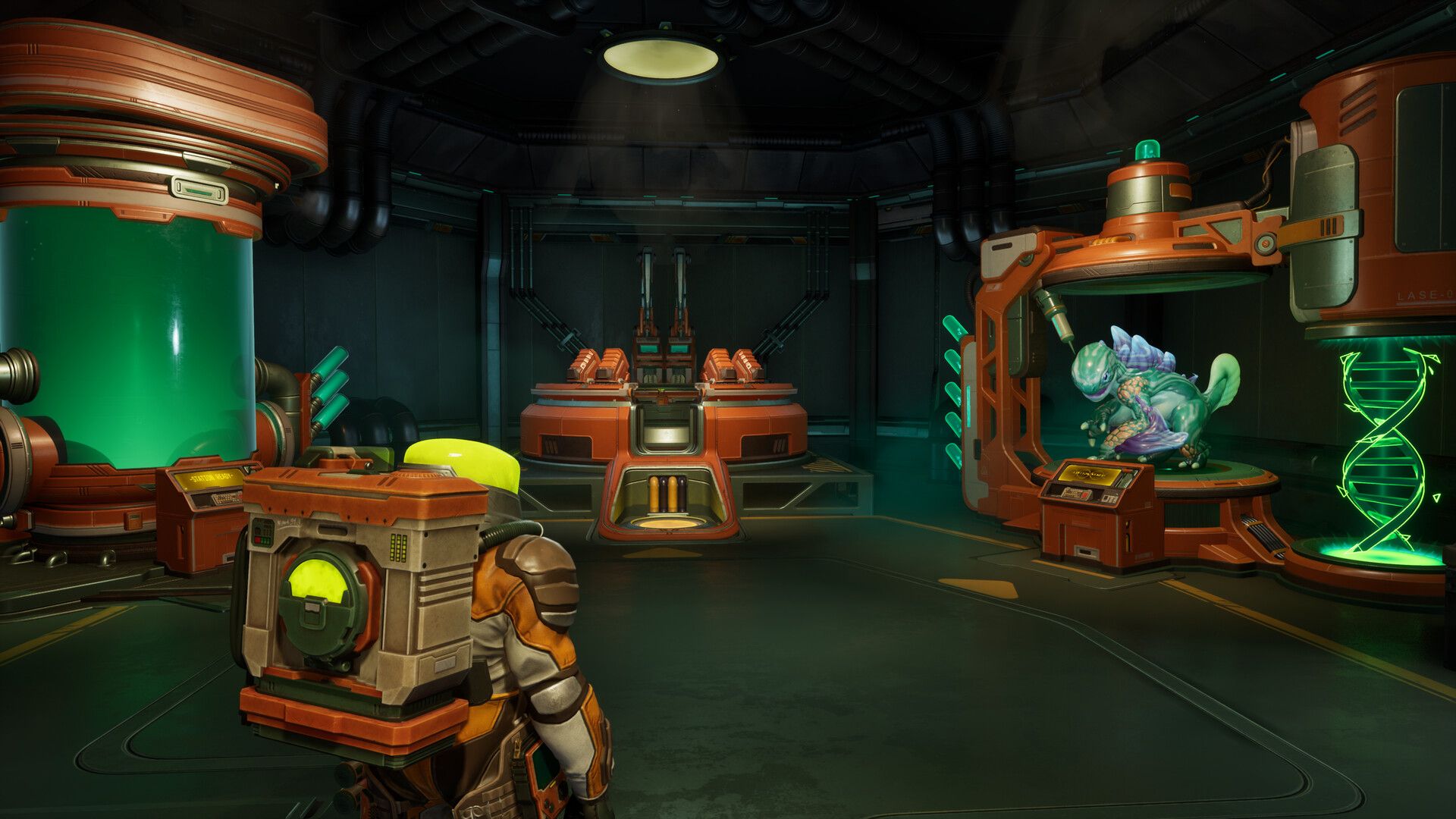
Voidling Bound is a sci-fi monster-taming third-person shooter from Hatchery Games, a Canadian indie studio founded by ex-Skylanders developers. You play as a Space Wrangler who neural-links with alien creatures called Voidlings to fight, evolve, and breed your way through corrupted planets. With 9 base species, 31 evolution branches per species, a full breeding system, and an endgame Abyss mode, there is a lot to absorb. This guide cuts straight to what matters in your first hour so you are not wasting Mutagens or releasing Voidlings you will regret losing later. If you are browsing adventure games and landed here fresh, this is the place to start.
What difficulty should you pick?
Voidling Bound opens with four difficulty options: Collector, Adventurer, Fighter, and Wrangler. The choice matters more than it sounds because the game throws several systems at you simultaneously, and being punished for combat mistakes while you are still learning evolution mechanics is genuinely frustrating.
| Difficulty | Best For | Beginner Advice |
|---|---|---|
| Collector | Exploration, collecting, low combat pressure | Pick this if you want to learn systems without dying repeatedly |
| Adventurer | Normal first playthrough with room to make mistakes | The safest default for most players |
| Fighter | Players already comfortable with third-person action | Enemies punish mistakes earlier here |
| Wrangler | Harder run where every build decision counts | Skip this on your first run |
Adventurer is the right call for most players. It gives you the intended action feel without demanding you optimize every upgrade decision from minute one. Pick Collector if you mainly want to explore, find Golden Eggs, and learn how breeding works before combat pressure forces bad choices.

Your first Voidling: Kwipeck vs Gilick
Your starting Voidling depends on whether you played the free Steam demo. The demo gives you access to both Kwipeck and Gilick, which is worth doing before spending $24.99 on the full game.
Kwipeck is the tutorial species. Its primary ability fires a fast SMG, its secondary launches a rocket, and its ultimate drops multiple large AoE explosions at spots you mark on the floor. The talon-and-beak melee combo rounds out a well-balanced kit that keeps you at safe range while you learn movement and stamina management. Kwipeck's elements are Organic and Pyro.
Gilick plays completely differently. It is built for close-range brawling: shotgun primary, a high-damage slam secondary that closes distance fast, a counter stance that grants brief invulnerability and bursts damage when hit, and a claw-into-tail-spin melee combo. Its ultimate fires a devastating cone burst in front of it. Gilick's elements are Pyro and Cryo.
For a first run, Kwipeck's ranged kit is more forgiving. Gilick rewards players who already dodge well and want to be in melee range, which is a harder ask when you are still reading enemy attack patterns.
What are the 5 attributes and which should you pick first?
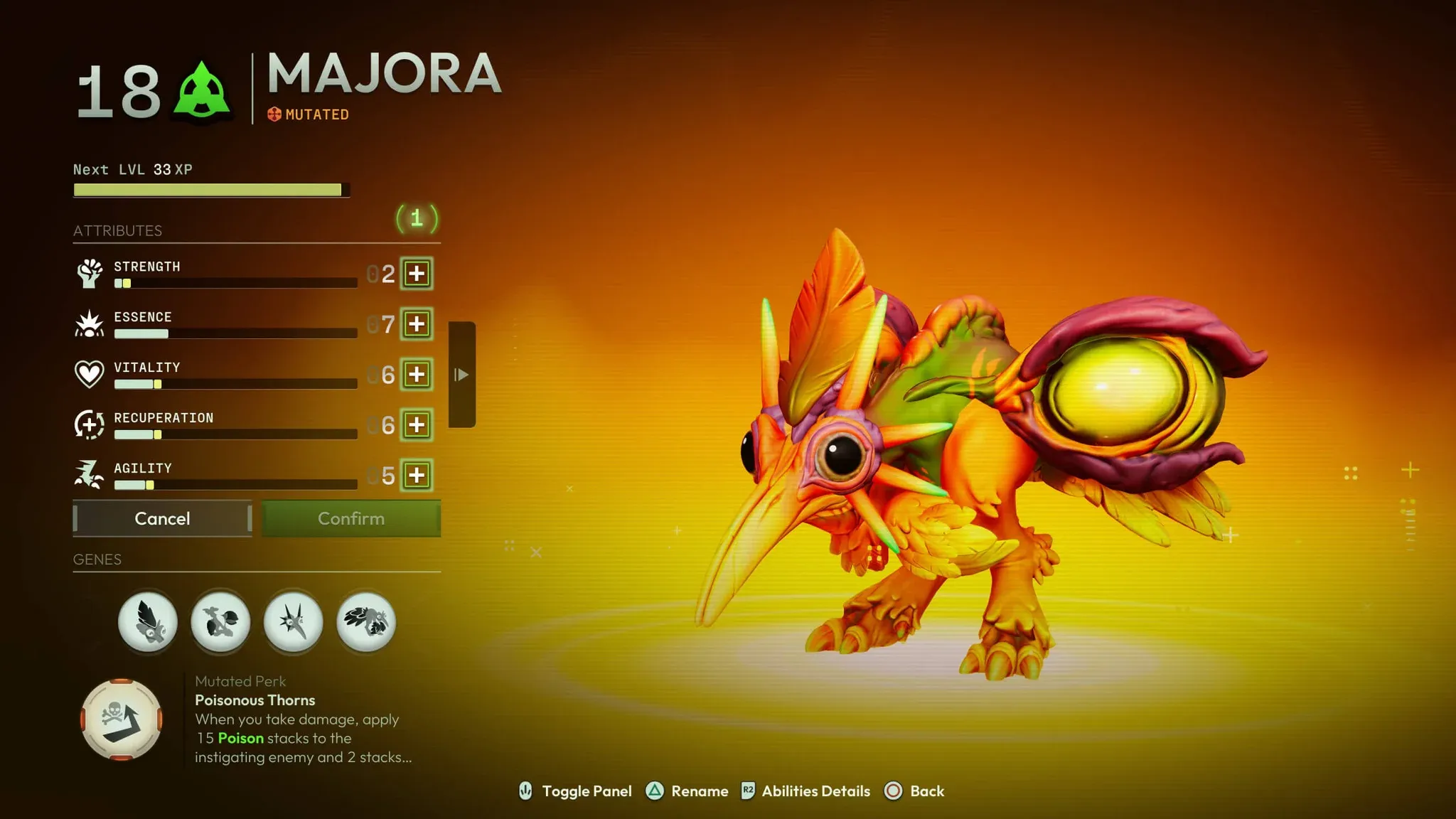
Every Voidling runs on five stats. Knowing what each one does prevents you from spending your first point on something that does not solve your actual problem.
| Attribute | What It Does | Best First Pick? |
|---|---|---|
| Strength | Attack power and critical damage | Yes, if you already survive comfortably |
| Vitality | Health, armor, and stamina | Yes, if you are still getting hit |
| Essence | Elemental damage and status effect multiplier | Wait until you are building around elements |
| Recuperation | Cooldown reduction, reload speed, ultimate fill rate, healing multiplier | Good if abilities feel too slow |
| Agility | Fire rate, movement speed, critical chance | Strong for fast attackers, not the safest first point |
The simple rule: Vitality first if you are dying, Strength first if you are not. Save Essence until you have an evolution route that consistently applies Poison, Burn, or another status effect. Spending Essence points when you cannot reliably stack a status effect is wasted scaling.
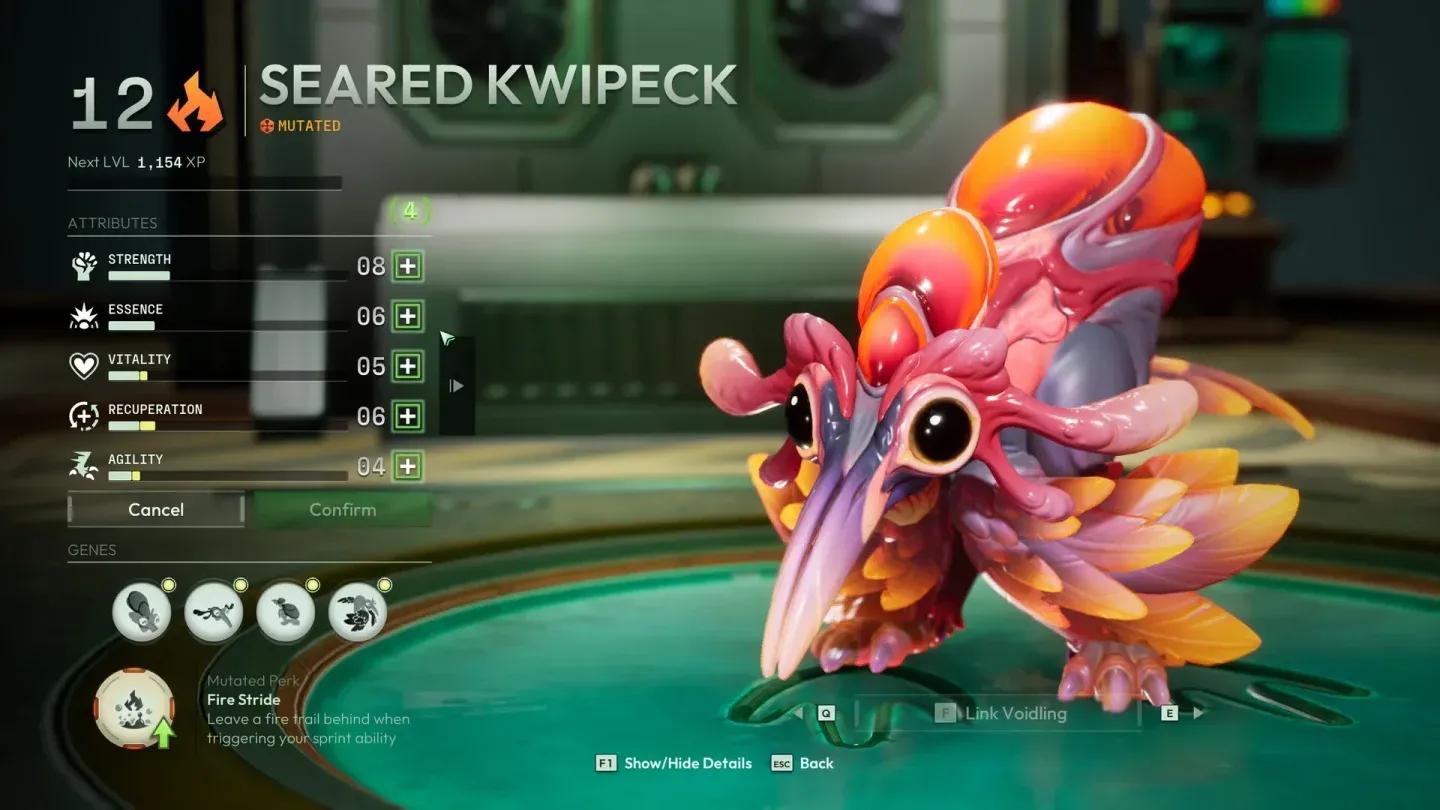
Kwipeck's five core attributes
How do element matchups work?
Voidling Bound has five elements plus Neutral damage. Bringing the wrong element into a mission is one of the most common reasons your Voidling feels underpowered, and it has nothing to do with your level.
Before entering any mission, check the Atlas Terminal for faction and weakness icons. That 10-second check can save you a failed run.
| Element | Strong Against | Weak Against | Status Effect |
|---|---|---|---|
| Neutral | All factions equally | No weakness | Bleed (damage over time) |
| Organic | Lesion-spawns, Ancients | Crystallines, GenBots | Poison (damage over time) |
| Pyro | Lesion-spawns, Crystallines | GenBots, Ancients | Burn (damage over time) |
| Cryo | GenBots, Ancients | Lesion-spawns, Crystallines | Frostbite (damage over time) |
| Cyber | GenBots, Crystallines | Lesion-spawns | Static (stacks then Cyber burst) |
| Plasma | All factions | No listed weakness | Disintegrate (stacks then Plasma overflow) |
For early missions, Organic and Pyro are strong against Lesion-spawns, which are the most common early enemy type. Cryo and Cyber become more valuable once GenBots start showing up in force. Plasma is the safest broad-coverage option once you have a reliable Plasma evolution route.
Status effects matter more than they look at first. Static and Disintegrate both require building stacks before they pay off, making them better once you have enough ability uptime. Bleed, Poison, and Burn are simpler damage-over-time effects that work immediately.
What should you upgrade first?
Two upgrade systems open early: the Evolution Chamber and the Cerebrum Enhancer. They do different jobs and it is easy to neglect one in favor of the other.
The Evolution Chamber uses Mutagens to evolve individual Voidlings. Evolution can add new abilities, change elements, open status-based playstyles, and unlock Mutated Perks at the end of each branch. Each species has two mutation tree branches with different elements. Read each node before spending because some choices change your element or status route in ways that are hard to course-correct.
The Cerebrum Enhancer uses research samples to upgrade an entire species, not just one individual Voidling. That makes it extremely valuable early because every Voidling of the same species benefits from those upgrades. Good early targets include primary attack improvements, damage upgrades for your most-used ability, fire rate or cooldown comfort, and mobility upgrades if you keep getting cornered.
The Atlas Terminal is the third system worth understanding early. Once it opens, stop choosing missions blindly. Check the mission level, faction type, weakness icons, and any missing objectives before committing. If you know the faction, you can bring a better element. If you know what objective is missing, you can plan one specific cleanup goal instead of trying to finish everything at once.

Evolution Chamber mutation paths
How does the Abyss endgame mode work?
The Abyss is Voidling Bound's infinite challenge mode. It opens after the main campaign and functions as the primary way to farm Corrupted DNA Catalysts, which unlock unique upgrades not available through normal progression.
The Abyss uses escalating difficulty, so pushing deep into it requires a well-built Voidling. The risk is real: if you push to high levels and die, you lose your run's progress. Early Abyss play is best treated as a build-testing environment rather than a resource grind until your evolution and breeding setup is solid.
Multiple players with significant time in the game note that the Abyss rewards conservative early farming over aggressive depth pushes. Get a reliable build first, then push deeper.
Common mistakes that will slow you down
| Mistake | Why It Hurts | Better Move |
|---|---|---|
| Starting on Wrangler | Combat punishes mistakes before you understand systems | Use Adventurer or Collector for your first run |
| Ignoring element matchups | A good Voidling feels weak against the wrong faction | Check Atlas Terminal before every mission |
| Spending Mutagens randomly | Evolution paths change how your Voidling plays | Pick routes that match your real playstyle |
| Releasing high-stat Voidlings early | Strong parents and rare Natures matter once Breeding opens | Keep good candidates until the Pheromone Nest unlocks |
| Trying to 100% missions on first clear | Timer routes, Golden Eggs, and Quackies pull you in different directions | Clear first, then return with one specific cleanup goal |
The Breeding and Splicing systems are not first-hour priorities, but the decisions you make now affect them. Keep Voidlings with high total stat rolls, rare Natures, and unusual Golden Egg variants. Offspring inherit attributes from parents, so releasing every strong candidate early leaves you with weaker breeding stock when the Pheromone Nest opens.
Golden Eggs hatch secret Voidling variants and matter for build options and Splicing later. Quackies are better saved for dedicated completion runs. Prioritize Mutagens first if you need power, then come back for collectibles once you know the mission layout.

Atlas Terminal mission planning
All 9 species at a glance
Beyond Kwipeck and Gilick, here is a quick reference for every species in the game:
| Species | Elements | Combat Style |
|---|---|---|
| Kwipeck | Organic, Pyro | Ranged SMG, AoE ultimate, balanced kit |
| Gilick | Pyro, Cryo | Close-range shotgun, counter stance, cone burst ultimate |
| Kerapin | Organic, Cryo | Defense-focused, shield, mine secondary, roll ultimate |
| Gwigoon | Organic, Plasma | Duplicates itself, minion-based combat |
| Anami | Cryo, Cyber | High mobility, homing attacks, agile harassment |
| Ur-Sek | Organic, Plasma | Two symbiotic forms, fastest ultimate charge time, heals on ult swap |
| Nimiod | Organic, Cyber | Infinite jumps (stamina cost), turret placement, area damage |
| Packuran | Plasma, Cyber | Radiation beams, hatchling summons, wormhole attacks |
| Morfang | Pyro, Plasma | Pure close-range melee aggression, ambush hunter |
Balancing across the 9 species is uneven at launch, with some clearly stronger than others in general play. That said, the evolution system and Splicing Station create enough build variety that most species have at least one strong route once you understand their mechanics.
For more on optimizing your setup beyond the first hour, the full Voidling Bound strategy guides cover evolution paths, breeding combinations, and endgame builds in detail. If you are running the game on PC and want to make sure you are getting clean frame rates before diving into Abyss runs, check the best PC settings guide for Voidling Bound to cut stutters without sacrificing visuals.