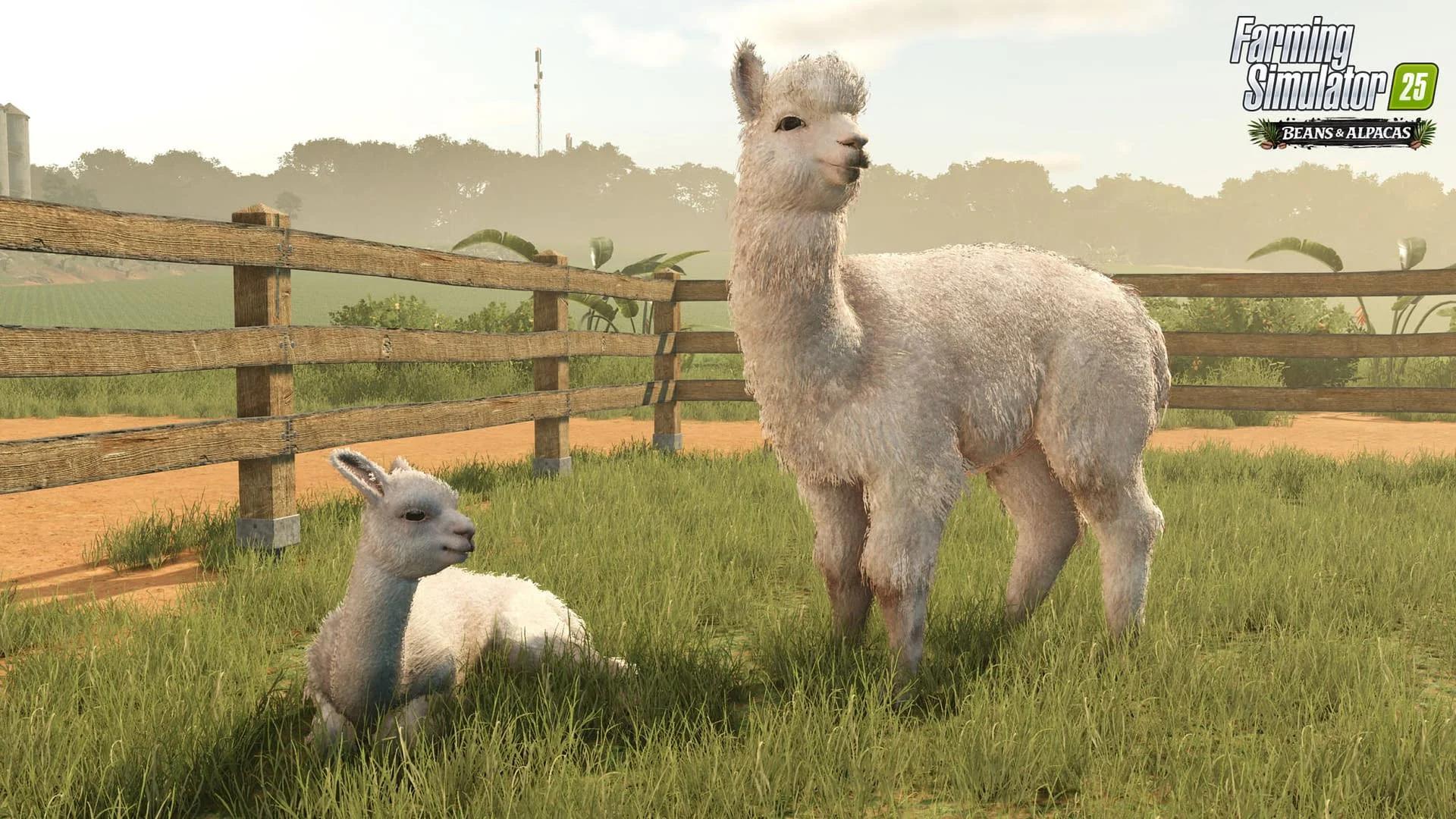

The Beans & Alpacas Expansion for Farming Simulator 25 is the biggest content drop in the Year 2 Season Pass, and it plays differently enough from the base game that your existing habits will slow you down. Coffee does not behave like wheat. Alpacas do not behave like cows. The Catuaí map runs on a southern-hemisphere calendar that will leave you a full season behind if you treat it like Elmcreek or Zielonka. Here is everything you need to know to hit the ground running.

Catuaí's red-soil terrain
What is Catuaí and how does it differ from other maps?
Catuaí is a South America-inspired region drawn from the coffee-growing landscapes of Brazil. Red soil, rolling hills, dense humid vegetation, a winding river with stilt houses along the bank, and a colorful rural town with shops and agricultural depots define the setting. Wildlife including parrots and non-aggressive caimans populate the environment.
The single most important thing to understand before spending a dollar on equipment: Catuaí runs on a southern-hemisphere crop calendar. Planting windows and harvest windows are inverted compared to the three base-game maps. Coffee goes in from September and the cherries ripen in May. If you arrive expecting a standard European or North American rhythm, you will miss your first harvest cycle entirely.
The good news is that plantations can be placed at any point in the year. The game automatically adjusts the starting growth stage to match whatever season you are currently in on Catuaí, so there is no reason to wait for September to begin laying out your operation.
How does coffee cultivation work?
Coffee is not a field crop. It belongs to the same plantation family as grapes and olives, which means no seeder and no seed rate per hectare. You place it through the construction menu using a boundary-painting tool.
Setting up a coffee plantation
The layout process works like this: paint the boundary of the area you want to use, and the game calculates row orientation automatically. You can adjust the angle, review the cost, and fine-tune the layout before committing. GIANTS Software applied the same improved placement system to grapes and olives as well, so if you have experience with those crops the workflow will feel familiar.
The mistake most players make is committing to a plantation layout without checking the row angle first. Redoing a misplaced plantation is expensive. Use the preview, confirm the cost, then build.
Coffee growth stats at a glance
| Stat | Value |
|---|---|
| Growth stages to ripe fruit | 5 |
| Growth duration | 8 months |
| Planting window | September to November |
| Harvest window | May to August |
| Yield per hectare | 36,800 litres |
| Harvested product | Coffee Cherries (not beans) |
| Required maintenance | Fungicide, once per harvest cycle |
Fungal disease and the KUHN AFS 600
Coffee introduces a maintenance step that no base-game crop requires: fungal disease. Your plants can develop leaf disease between planting and harvest, and treatment with fungicide is required once per harvest cycle. The tool for the job is the KUHN AFS 600 plantation sprayer, which treats two rows in a single pass and includes GPS guidance for the narrow spacing between plants.
If you would rather skip the management layer, fungal disease treatment can be disabled in settings. You lose a gameplay system but nothing else, since fungicide is a second pass over ground you already worked.
Harvesting: the Case IH Coffee Express 200 Multi
When the five growth stages complete, the plants show ripe reddish fruit. That color change is your harvest signal. The Case IH Coffee Express 200 Multi moves directly over the plantation rows, shaking cherries off the plants, collecting them on a belt, and separating leaves via a cleaning unit as it works.
For unloading inside the plantation without driving the harvester out after every pass, pair it with the Colombo CTG 4500 transfer trailer pulled by a tractor such as the New Holland 8030. The CTG 4500 is narrow enough to follow between rows, so you transfer cherries to a larger trailer outside the plantation rather than interrupting harvester passes.

Coffee Express in plantation rows
What does the full coffee production chain look like?
Selling cherries at the Coffee Processing Plant is the simple version. Running the full chain takes considerably more setup but keeps the crop inside your own economy through multiple product tiers.
| Stage | Facility | Input | Output |
|---|---|---|---|
| 1 | Coffee Processing Plant | Coffee Cherries | Coffee Bags |
| 2 | Coffee Roastery | Coffee Bags | Coffee Capsules, Packed Coffee |
| 3 | Coffee Shop | Coffee | Coffee Beverage |
| 3 | Bakery | Coffee + eggs + flour | Tiramisu |
| 3 | Dairy | Coffee + sugar + milk | Coffee Yogurt |
The chain branches at the Roastery. Coffee Bags go in, and Coffee Capsules and Packed Coffee come out. From there, the Coffee Shop, Bakery, and Dairy each take coffee as an input alongside other ingredients. GIANTS Software has not specified whether the Bakery and Dairy require Coffee Bags or Packed Coffee as their coffee input, so build flexibility into your chain design at that stage.
How do alpacas work?
Alpacas are the other half of the expansion's name, and they have a more hands-on care loop than any animal in the base game.
Setup and daily care
Alpacas come in four colors: white, grey, brown, and beige. They live in stalls and pastures and eat grass and hay. Happiness is the key stat, because it gates fleece production. Young alpacas start with less harvestable fluff and grow into their full fleece over time, so patience matters here.
Walking is the primary happiness lever. You take alpacas out on a leash once per day (or once per month if you play at 12 days per year). Other alpacas will wander into your path during walks, which is less charming when you are trying to get the animal back into the barn.
Shearing: the annual minigame
Shearing happens once per year, in spring, and only inside the barn. You lead the alpaca in on its leash, position it, and the minigame begins. GIANTS Software built the system after the reception of the Highlands Fishing minigame, and it has a real failure condition: overloading the machine by shearing too quickly will end the process early. Go slow.
If you would rather skip the minigame, you can hire a worker to handle the annual shearing for a fee. A fleece pallet spawns next to the barn when shearing completes.

Alpaca shearing minigame
Alpaca fleece production chain
- Spinnery processes raw fleece into Alpaca Wool
- Tailor Shop turns alpaca materials into Alpaca Plush, Alpaca Pillow, and Alpaca Socks
- Carpentry produces Alpaca Chair and Alpaca Stool
Selling the raw fleece pallet is the lowest-return option. Running it through the Spinnery and into the Tailor Shop or Carpentry extracts significantly more value per animal.
Brahman cows also join as a new livestock type. They do not produce milk.
What is the banana cultivation system?
Bananas use the same plantation system as coffee but add a unique infrastructure requirement: transport rails and washing stations that connect across the plantation and can form a complex network. You draw the plantation in the construction menu, then set up the rail and washing station network before harvesting.
Harvesting bananas can be done manually with a machete or automated through hired workers. The banana processing chain runs through the Banana Washing Station into Banana Boxes, which then feed into:
- Banana Snacks and Banana Chips (Canning Factory)
- Banana Milk (Dairy)
- Fried Banana (Banana Drying Station)
- Banana Jam and Banana Cake (Bakery)
Banana yield sits at 15,400 litres per hectare with a 7-month growth duration and a planting window that runs year-round (January through December on both ends).
What else does the expansion add beyond farming?
Pigment, resin, and the paint chain
Copper Ore, Resin, and Pigments feed a Paint Production chain that outputs Paint Buckets. The Sawmill provides Resin and the Pigment Factory produces Pigments. The payoff is not just a sale point: delivering paint to houses around Catuaí visibly restores their appearance. Six new farmhouses ship with the expansion, each with a walkable interior, and pre-placed buildings show aging that paint delivery reverses.
Collectibles and construction projects
- Dinosaur bones are buried in the soil and recovered through fieldwork. Assembled pieces go on display at the local museum.
- Research Center construction project sits at the edge of the map and functions as a long-term build goal.
The expansion adds over 80 new placeable objects including houses, fences, bushes, and sheds.
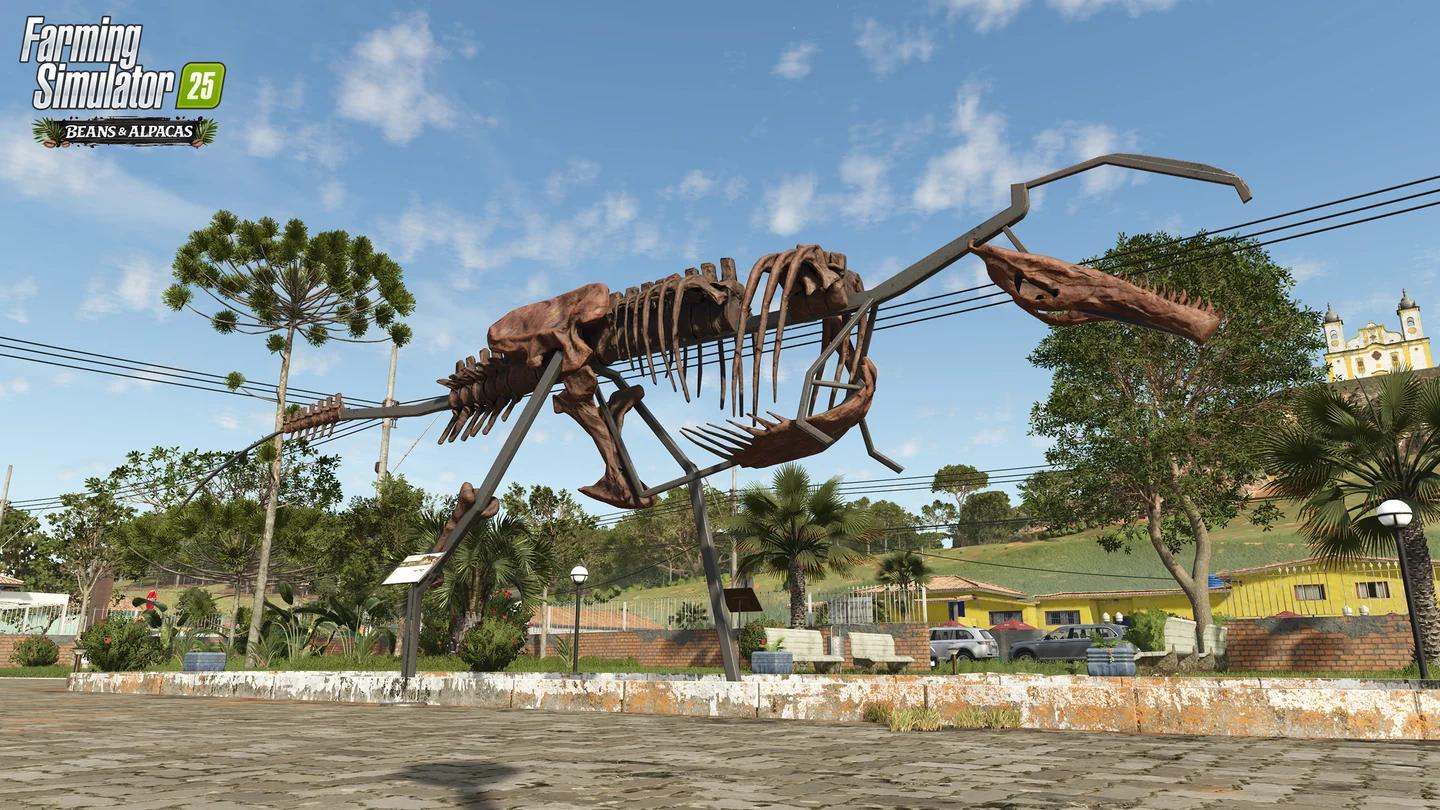
Dinosaur museum collection
What machines ship with the expansion?
More than 25 machines arrive across multiple categories. Key machines for the coffee operation:
| Machine | Brand | Role |
|---|---|---|
| Coffee Express 200 Multi | Case IH | Coffee harvester |
| Oxbo 9240+ | Oxbo | Coffee harvester |
| CTG 4500 | Colombo | Coffee transport trailer |
| AFS 600 | KUHN | Fungicide sprayer |
| New Holland 8030 | New Holland | Plantation tractor |
Full brand roster includes Case IH, Ford, John Deere, KUHN, Mercedes-Benz Trucks, New Holland, Oxbo, Stara, and Valtra. Colombo Industries and Southern Spreaders join the series as new brands. The expansion also includes sugarcane-specific machinery: the Case IH Austoft 9900 and John Deere CH950 harvesters, TT sugarcane planters and trailers, and the Randon Canavieiro semi-trailer.
Enhanced ground-working animations and improved visual effects apply across all field machinery.
How should you sequence your first season on Catuaí?
Order matters here because the coffee chain and the alpaca loop run on different clocks.
- Lay out the plantation immediately. Placement works year-round and the starting growth stage adjusts to the current season automatically.
- Paint the boundary carefully, check the row angle and cost before confirming. Redoing a misplaced plantation is expensive.
- Stock fungicide and the KUHN AFS 600 before cherries ripen. Treatment is once per cycle and happens between planting and harvest.
- Assemble the harvest fleet before the red fruit appears: Case IH Coffee Express 200 Multi, Colombo CTG 4500, and a tractor to pull it.
- Decide how deep to run the chain. Selling at the Coffee Processing Plant is the simple exit. Running through the Roastery and into a Coffee Shop, Bakery, or Dairy keeps the value in your operation.
- Build the alpaca side in parallel. You need a barn (shearing only happens indoors), grass, hay, and a daily walking routine.
- Treat spring as the shearing month. Either run the minigame slowly or hire the worker.
- Run fleece through the Spinnery and into the Tailor Shop or Carpentry rather than selling the raw pallet.
- Add the paint chain last. It requires Copper Ore, Resin, and Pigments, which means setting up the Sawmill and Pigment Factory first.
Is the Year 2 Season Pass worth it?
The standalone expansion is $26.99. The Year 2 Season Pass is $34.99 and includes the Vredo Pack, the SKY Agriculture Pack, and the Beans & Alpacas Expansion, plus the JCB Fastrac Two as a bonus. If you own none of the three packs, the Season Pass saves money and adds the Fastrac Two on top.
The Beans & Alpacas Edition bundles the base game with the expansion and includes 400 machines from over 150 brands across all four maps (North America, Central Europe, East Asia, and Catuaí). A physical release for PC, PS5, and Xbox Series X|S also includes the MacDon Pack.
For more strategy coverage across all maps and systems, the Farming Simulator 25 strategy guides collection has you covered.
