Search games, articles, guides...CtrlK
Sign InGet Started

Master seeking in MECCHA CHAMELEON with shape-hunting tactics, zone clearing, and lighting reads that catch even the best hiders.
See more GAMES.GG stories on Google
Enjoyed this guide?
Add GAMES.GG as a preferred source and Google will show you more of our guides and news when you search.
updated
June 21st 2026
posted
June 21st 2026
MECCHA CHAMELEON turns hide-and-seek into a visual puzzle, and seeking is the harder side of it. The hiders in MECCHA CHAMELEON are not tucked behind furniture waiting to be found. They have painted themselves to look like the room itself, and your job is to spot the visual lie before the clock runs out. This guide breaks down every seeking skill that matters, from reading shapes and lighting to managing the timer without burning your health pool.
Seeking looks straightforward on paper: find the painted players and tag them before the round ends. The catch is that every missed shot costs you health, and the game's maps are designed to reward hiders who understand light and shape. Spray your shots at every suspicious shadow and you will eliminate yourself faster than any hider can.
The seeker role rewards patience over speed. A slow, methodical sweep of each zone clears rooms permanently. Sprinting between areas just guarantees you leave corners unchecked and burn the clock on incomplete passes.

Seeker HUD tracks remaining hiders
The HUD helps: a row of hider icons flips from white to red as players get tagged, and the phase timer sits next to it. Use both to pace yourself. If four icons are still white with half the clock gone, you are behind and need to tighten your zone plan.
This is the single principle that separates seekers who clear lobbies from seekers who wander. A skilled hider samples wall colors with the paint tool's eyedropper and gets the hue mathematically close. Color alone will not betray them.
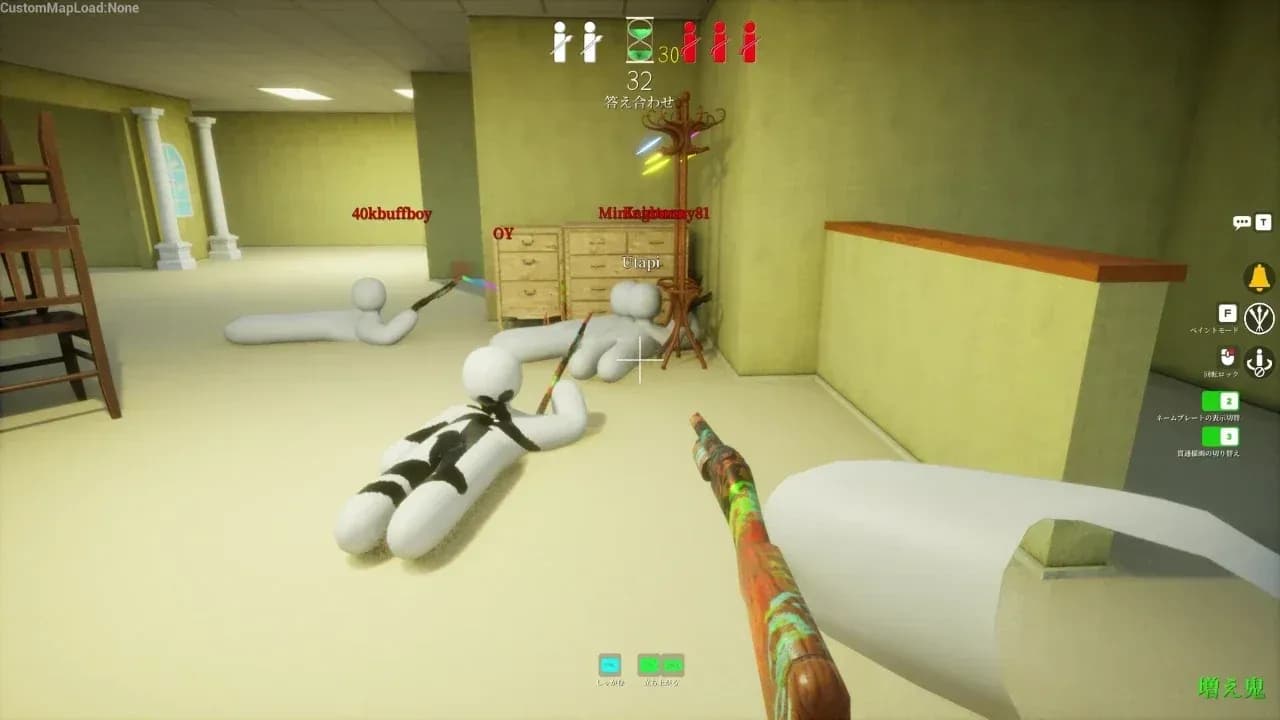
Shape will. Look for a limb that crosses a surface edge where no object should extend. Look for an outline that matches no prop the room actually contains. Look for asymmetry on something that should be perfectly uniform. Real level geometry is consistent. Painted players almost always miss a detail on the second look, and that missed detail is almost always a shape problem, not a color problem.
The same logic applies to lighting. A matte wooden shelf does not produce glossy reflections. A shadow that falls in the wrong direction relative to the room's light source does not belong to the wall. When you spot a reflection or shadow that has no explanation in the environment, you have found a person, not a surface.
Shift angle to break the disguise
The timer creates pressure that makes random searching feel productive. It is not. Bouncing between rooms without a plan just leaves zones half-checked and gives clever hiders a free pass.
Before the hunt phase starts, mentally divide the map into sections and commit to clearing each one fully before moving to the next. A reliable order:
Know why a zone is clear before you leave it. If the only reason is that nothing looked obviously wrong on a quick glance, you have not cleared it. Hiders paint to kill the obvious color tells, so your sweep has to cover shape, lighting, and context.
Even the best paint jobs have tells. Here is what to look for once color stops being a reliable signal:
| Tell | What it looks like | Why it happens |
|---|---|---|
| Shape crossing edges | A limb or outline extending past a surface boundary | Hiders misjudge their pose relative to the prop |
| Lighting mismatch | Glossy reflection on a matte surface | Metallic/roughness sliders left at default |
| Shadow direction error | Shadow falling opposite to the room's light source | Paint applied without checking light angle |
| White gaps | Bright patches between limbs | Incomplete paint coverage on elbow and joint areas |
| Too-perfect corners | A cluster of objects that looks staged | Hider arranged props or chose a suspiciously tidy spot |
| Wrong object class | A shape that belongs to no prop in the room | Hider mimicked an object type the map does not contain |
The too-perfect corner is worth its own note. As players get better, they stop hiding in dark recesses and start sitting in plain sight where nobody bothers to look. A hallway wall that looks slightly too clean, a shelf arrangement that looks slightly too deliberate: these are the spots experienced hiders pick because seekers walk past them without a second thought. Train yourself to distrust anything that looks edited.
One angle can make a disguise look flawless. Two angles almost always break it. Most hiders paint for the room's entrance view, which means they look perfect from the spawn side and completely wrong from three steps around.
When a shape looks suspicious, do not stare at it from the same position. Sidestep, climb onto a nearby surface, or drop to crouch height. If the shape moves differently from the wall or prop behind it as your viewpoint shifts, you have found a player. This works especially well against hiders who committed to a flat-wall blend, because parallax reveals the depth difference between their body and the surface.
Time management is where seeking rounds are won or lost. A stubborn seeker who locks onto one uncertain spot is a free win for every other hider on the map.
The correct move when you cannot confirm a hide: note the location, move on, and complete your zone sweep. Then circle back. A hider who survived your first pass often relaxes, assuming the area has been cleared. That second look is where movement slips happen. Hiders who held perfectly still for three minutes sometimes shift their camera or adjust their pose when they think the danger has passed, and that micro-movement is the tell that ends their round.
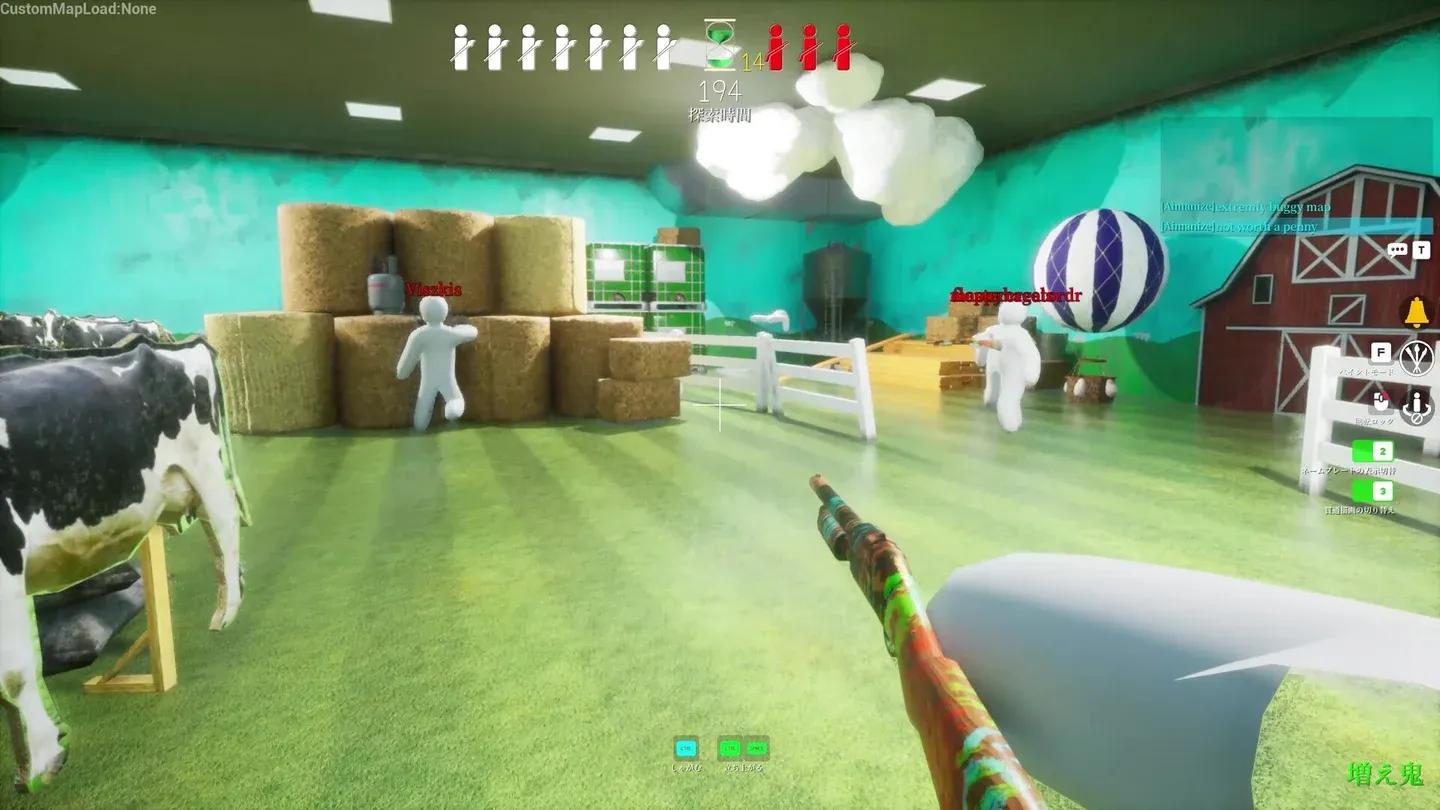
In Increasing Oni mode (shown in the HUD as 増え鬼), time management changes. Every tagged hider joins the seeker team, so clearing obvious, low-effort hides early builds your numbers fast. Prioritize the predictable prop mimics first: balloons, boxes, and shelf objects attract players who did not spend their prep time carefully. Tag them quickly, grow the team, and let the converted seekers handle the perimeter while you focus on the clever spots.
For the complete picture on what hiders are doing to fool you, the hiding patterns and pose techniques guide explains the paint tricks from the other side, which makes you a sharper seeker.
Increasing Oni grows the seeker team
If you are still getting comfortable with the game's fundamentals, the MECCHA CHAMELEON beginner's guide covers the paint tool, round structure, and first-match survival in full. For everything else, the full MECCHA CHAMELEON strategy guides collection has role-specific deep dives on hiding spots, pose techniques, and multiplayer setup.