

Taipei delivered something rare this year. Not a single hero product, but an entire wave of hardware categories that stopped making excuses.
Computex 2026 had the usual noise, but underneath it were four clear stories: monitors that finally prioritize intelligence over raw numbers, handheld gaming PCs that feel genuinely mature, creator laptops that no longer ask you to sacrifice portability for power, and ARM processors that are starting to look like a real threat to x86. Here's the lowdown on what actually matters for gamers.

Use code TRYHARD33 at checkout to redeem this offer before code expires again.
Get 33% Off GAMES+ Subscription
Monitors stopped chasing numbers and started solving problems
For years, the monitor arms race was all about refresh rates and resolution figures on a spec sheet. Computex 2026 felt different. The displays that turned heads were the ones that actually addressed real frustrations.
Alienware's AW3926QW made the boldest statement: the world's first 39-inch 5K OLED gaming monitor, built on a four-stack, three-subpixel RGB-stripe Tandem OLED panel. The technology boosts brightness and panel longevity simultaneously, which has historically been a painful trade-off on OLED displays. Gamers no longer have to choose between gorgeous visuals and a panel that dims after two years of heavy use.
MSI's MPG OLED 322URDX36 took flexibility as its angle. Powered by a 5th-generation QD-OLED panel with Penta Tandem technology, it operates in three distinct modes: 4K at 360Hz, 1440p at 520Hz, and 1080p at a staggering 680Hz. An AI Care Sensor monitors the panel's health in real time, and peak brightness hits 1,500 nits. The key here is that one monitor can genuinely serve a competitive FPS player and a cinematic RPG fan without compromise.
For esports specifically, ASUS ROG Strix OLED XG259QWPG Ace was arguably the sharpest product on the floor. The 24.5-inch panel pairs a 540Hz refresh rate with OLED response times, and ASUS added alignment markings engraved directly into the stand so professional players can reproduce their exact desk setup at tournaments down to the millimetre. That level of attention to competitive detail is the kind of thing that separates a product built for pros from one that just markets itself to them.
Working behind all of this is MediaTek's MT9820, the world's first 5K AI upscaling monitor scaler chip, developed alongside NVIDIA. Rather than stretching lower-resolution content, it reconstructs details using AI processing in real time. If this chip finds its way into mainstream monitors, the gap between budget and premium displays could narrow significantly.
Handheld gaming PCs grew up fast
The handheld gaming PC space has had a credibility problem. Great concept, inconsistent execution. Computex 2026 suggested that era is ending.
The silicon story centers on Intel's Arc G3 Extreme, purpose-built for handhelds on the Panther Lake architecture using Intel's 18A process. It combines a 14-core CPU with Arc B390-class graphics running 12 Xe3 cores, and brings hardware ray tracing alongside XeSS 3 with Multi Frame Generation to portable machines. That last feature matters a lot: frame generation has been one of the most effective ways to boost perceived performance on desktop GPUs, and bringing it to handhelds could meaningfully close the gap with consoles.
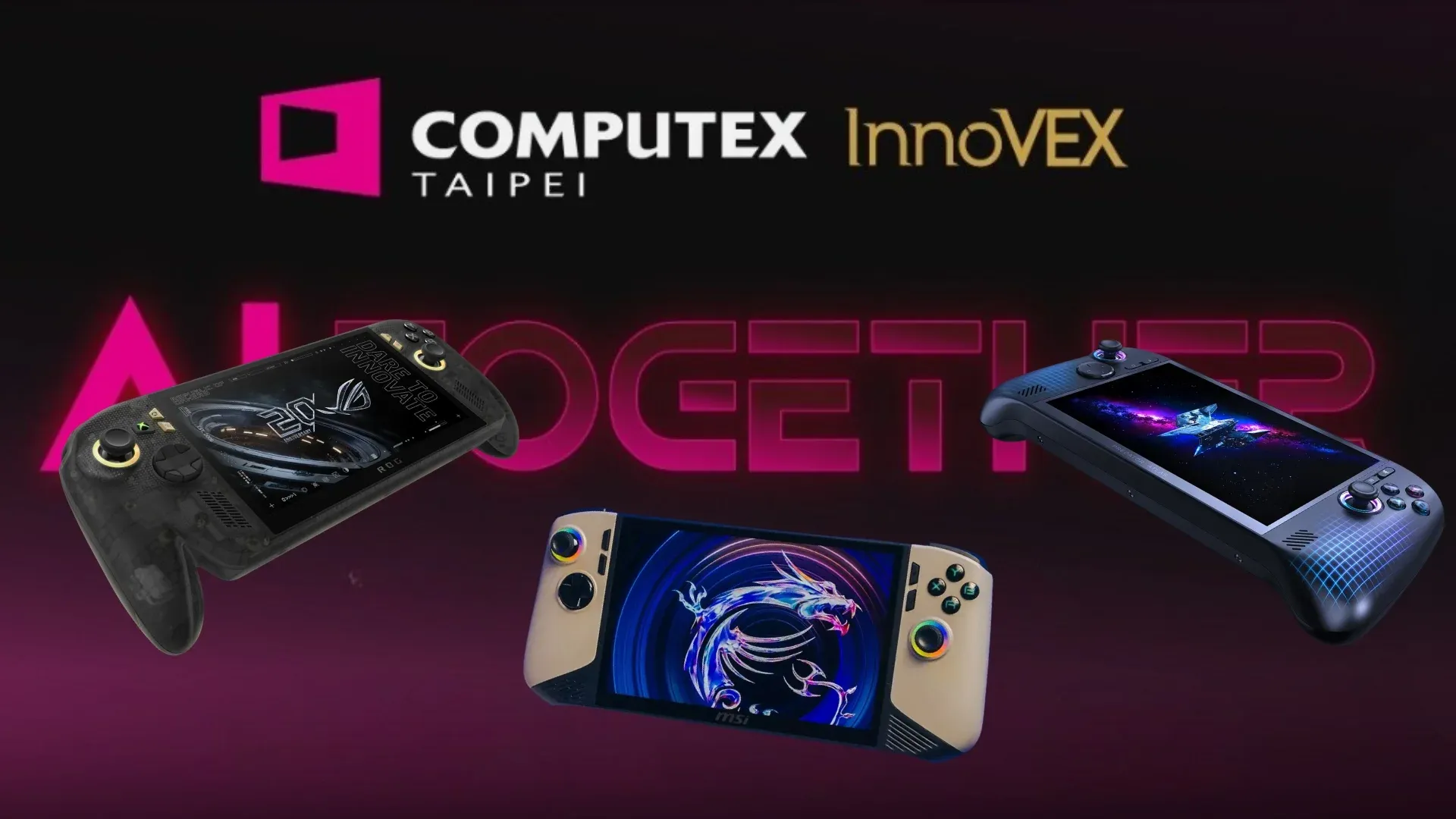
Two devices showed what that silicon looks like in practice. The MSI Claw 8 EX AI+ arrives with improved ergonomics, refined software, and an 80Wh battery that should finally address the battery life complaints that have followed every handheld PC since the Steam Deck launched. The Acer Predator Atlas 8 impressed with its 8-inch 120Hz display, a 89-blade AeroBlade cooling system, and dual-mode triggers that switch between microswitch and analog inputs depending on the game.
The ASUS ROG Xbox Ally X20 Anniversary Edition reinforced the same message from a different angle. With an OLED panel and a design collaboration that signals Microsoft's growing investment in the handheld space, it makes clear that handheld gaming PCs are no longer experimental hardware. They are a real product category with real software support behind them.
What most players miss about this generation of handhelds is that the hardware improvements are only half the story. The software ecosystems, the ergonomics, and the battery management are finally catching up to the ambition.
ARM stopped being a compromise
A few years ago, ARM on Windows meant great battery life and a long list of games that simply would not run. Computex 2026 made that conversation feel outdated.
NVIDIA's RTX Spark was the most talked-about announcement at the show. Built around a 20-core Grace CPU paired with Blackwell-based RTX graphics, it delivers up to one petaflop of local AI compute and is designed to handle large AI models directly on the device. During demos, Fortnite ran on an RTX Spark-powered system with fluid performance, and NVIDIA confirmed it is actively working with anti-cheat providers to resolve compatibility issues that have historically blocked ARM gaming on Windows.
That last point is significant. Anti-cheat incompatibility has been the single biggest practical barrier to ARM gaming adoption. If NVIDIA can solve it at the platform level, the objections to ARM gaming start to disappear one by one.
Qualcomm's Snapdragon C platform continued its push into mainstream Windows PCs with improved battery life and built-in AI acceleration, targeting the budget and mid-range laptop segments that x86 has owned for decades.
The creator laptop space told a similar story. Microsoft's Surface Laptop Ultra supports up to 128GB of unified memory and leans heavily into local AI processing for demanding creative workloads. The ASUS ProArt lineup combines OLED displays with dedicated local AI acceleration for photo and video editing. The MSI Prestige series adds a Nano Pen for natural sketching and annotation. And Dell's XPS 16 (2026) adopts Tandem OLED, borrowing the same panel technology that made the Alienware monitor so compelling.
Pro tip: if you're building a gaming PC alongside any of this new hardware and want to squeeze every frame out of your setup, our gaming guides hub covers optimization strategies across a wide range of titles and configurations.
What Computex 2026 actually means for your next purchase
Here's the thing: none of this hardware is cheap, and most of it won't be widely available until later this year. But Computex sets the direction, and the direction is clear.
OLED panels are solving their own weaknesses. Handhelds are becoming viable primary gaming devices. ARM is closing in on x86 gaming compatibility. And AI processing is moving from cloud-dependent gimmick to genuinely useful on-device tool.
The products that land later this year will reflect everything announced in Taipei. Keep an eye on pricing and availability announcements from ASUS, MSI, Alienware, Acer, and NVIDIA over the coming months, and check our game reviews to see how new hardware holds up against the titles that actually matter.