
"I'm not even looking at the money."
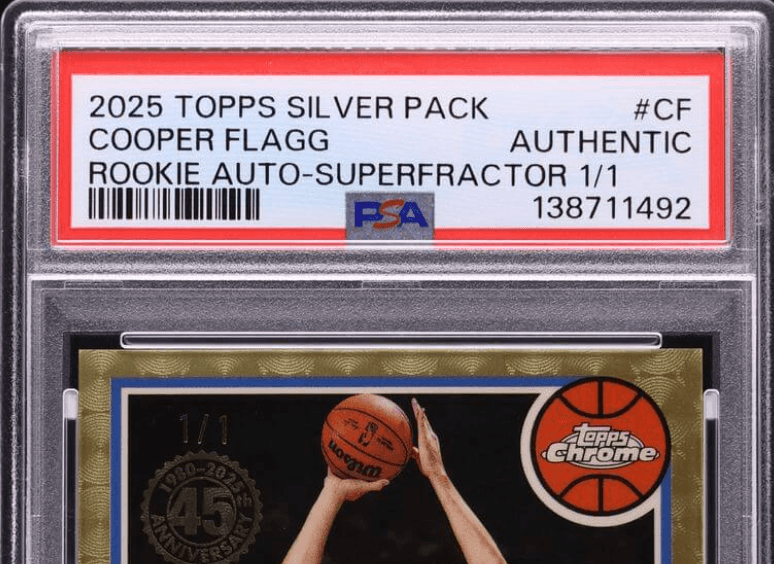
That's Jason Williams, the Rhode Island collector who spent $515 on a box break on August 10 and walked away with the most talked-about sports card of the year: the one-of-one Cooper Flagg NBA Debut Patch Autograph rookie card. Since then, the offers have piled up fast, and Williams has turned down every single one.
How a $515 box break turned into a multi-million dollar decision
Box breaks are a gamble by design. You buy into a slot, you get assigned a team, and you hope the pack gods are paying attention. Williams bought the Dallas Mavericks slot in a small, 3-box break, and when the Flagg patch auto surfaced, the reaction was immediate. Topps posted the video of the pull on August 11, and it went viral within hours.
The card had been missing from circulation since the product launched. Collectors had been hunting it, and the moment it resurfaced in a modest Rhode Island break, the sports card world collectively lost its mind.
The offers that couldn't move him
The bids came in from every direction. Ken Goldin of Goldin Auctions offered $1.5 million as an advance before the card even hits auction, with a belief it could fetch around $5 million at sale. Collectibles marketplace Alt has lined up buyers willing to pay over $3 million right now.
The Dallas Mavericks themselves got involved, offering 32 years of season tickets, a signed game-worn Flagg jersey, and a personal photo with the player. That's a genuinely compelling package for any fan, and Williams still said no.
Here's the thing: Williams told ESPN on August 14 that his reasoning has nothing to do with holding out for a bigger number. "Right now, I'm not even looking at the money. For me, I am looking forward to the experiences that I'm gonna get out of this and the things that my family and my kids are going to get to experience that are memories for a lifetime."
The card is currently in a secure location. Williams is keeping a low profile.
What the card market looks like from here
The sports card hobby has seen a serious resurgence over the past few years, with one-of-one cards sitting at the absolute top of the collector pyramid. The appeal is straightforward: there is no other copy. You either own it or you don't.
What most players in this space miss is that the value of a card like this is tied directly to the player's career arc. Right now, Flagg is a rookie with enormous expectations. If he becomes a franchise cornerstone for the Mavericks, that $5 million estimate from Goldin starts looking conservative. If the career stalls, the price follows.
Williams appears to understand this, even if his stated motivation is about memories rather than market timing. Keeping the card while Flagg's career develops is also, whether intentionally or not, the financially rational play.
The sports card world intersects heavily with digital collectibles and web3 trading games these days. If you want to understand how player card ownership and trading works in a gaming context, the NFL Rivals marketplace guide on buying NFTs breaks down how digital athlete cards operate on blockchain platforms. The mechanics of owning a one-of-one aren't so different, whether the card is physical cardboard or a minted asset.
For collectors curious about how digital card games handle minting and trading, the process of minting FIFA Rivals player cards into NFTs offers a useful parallel to how scarcity and ownership work in the physical card space.
Williams has not announced any timeline for a decision, and the offers are only going to keep coming. The next move is entirely his, and right now, he seems perfectly comfortable letting the world wait. If you want to stay across the latest in gaming and collectibles culture, the guides hub covers the digital side of the hobby in depth.