

"If you can't finish a story, but you loved it in other ways: Great, I don't care."
That's Dan Houser, co-founder of Rockstar Games and the writer behind Grand Theft Auto and Red Dead Redemption, speaking at a Tribeca Festival panel in New York City this past Saturday. It's a surprisingly candid admission from someone who spent decades crafting some of the most expensive, meticulously written narratives in gaming history. But here's the thing: he means it.
Use code TRYHARD33 at checkout to redeem this offer before code expires again.
Get 33% Off GAMES+ Subscription
The systems are the star, not the script
Houser was direct about where he thinks the real value of an open-world game actually lives. "The most fun thing about the game isn't any rubbish we write, it's the systems that we make," he said. Jumping off buildings, punching pedestrians, stealing cars and watching the chaos unfold. That emergent, physics-driven sandbox behavior is what keeps players in these worlds for hundreds of hours, not necessarily the story beats.
He framed the narrative side of Rockstar's games as "the icing on the cake," which is a remarkable thing to hear from someone who wrote Red Dead Redemption 2's emotionally devastating final act. The point isn't self-deprecation. Houser is acknowledging something most game developers won't say out loud: players are going to do what they want, and fighting that instinct is a losing battle.
"We can encourage them to play it the way we want them to play it. But we have to give them agency."
Story completion rates and what Rockstar learned from GTA 3
Houser didn't just philosophize. He pointed to actual data from Rockstar's own history. From GTA 3 onward, the studio tracked story completion numbers and deliberately worked to push them higher. "The numbers went up and up," he said, suggesting that each successive game got better at guiding players toward the credits without forcing them there.
The key here is that framing: guides, not guardrails. Rockstar's approach has always been to make the main story compelling enough that players choose to finish it, while leaving the sandbox open enough that those who don't still feel like they got their money's worth. That balance is harder to achieve than it sounds, and most open-world games still haven't cracked it.
If you're the type of player who wants to maximize your time in these kinds of worlds, our Starfield best builds guide is worth a look for another massive open-world RPG that rewards player-driven exploration.
Lazlow on Easter eggs so deep even the creators forget them
Lazlow, Houser's longtime creative collaborator and fellow Absurd Ventures co-founder, had his own angle on player freedom: hiding things so well that even years later, nobody's found them.
"Sometimes three or four years goes by, I'm like, 'Maybe this makes it too hard to find,'" Lazlow said. "And somebody finds it and then it blows up on Reddit, and we're like, 'Yay.'" That's not a hypothetical. Red Dead Redemption 2 players only recently uncovered a spiderweb mystery that had been sitting in the game for seven years since its 2018 launch. Seven years.
That kind of long-tail discovery is only possible in games that give players room to breathe and experiment. It's a design philosophy that treats the audience as curious, not just goal-oriented.
When satire stops being fiction
The panel also touched on something Lazlow called the difficulty of keeping satirical worlds ahead of reality. He recalled creating GTA 5's fictional politician Jock Cranley, an ex-stuntman running for governor of San Andreas who openly declared he hated the elderly, disabled people, and the military.
"We're like, 'Ha ha ha ha, this kind of crazy shit will never happen in real life,'" Lazlow said.
The implication was clear without needing to be spelled out. Rockstar's brand of political satire, which once felt safely exaggerated, has had a harder time staying ahead of actual events. It's a creative challenge that has only intensified as their development cycles stretch longer.
What this means for open-world design going forward
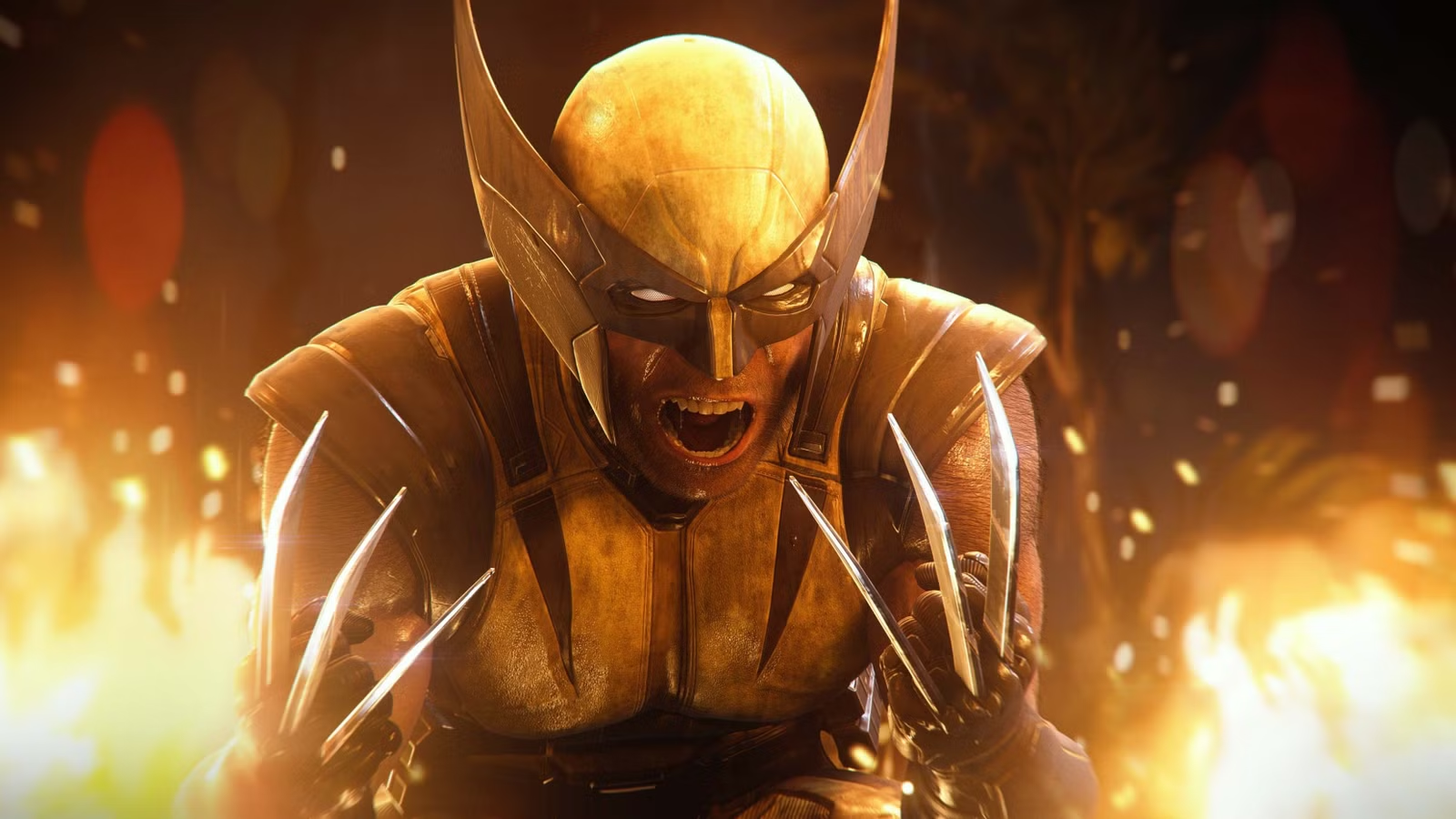
Houser's comments land at a moment when the industry is genuinely wrestling with how much structure to put around player freedom. Some studios are moving toward tighter, more linear experiences. Insomniac's approach with Marvel's Wolverine is a good example of that shift, and if you're curious how that plays out in practice, our breakdown of whether Marvel's Wolverine is an open-world game explains exactly what that means for how you'll move through the game.
Houser's position is essentially the opposite argument. The open world isn't a setting. It's the product. The story exists to give players a reason to stay, but the sandbox is what makes them want to. With GTA 6 on the horizon and Absurd Ventures building its own open-world title, his thinking on player agency is going to shape a lot of what comes next.
For players who want to get the most out of that kind of freedom, our gaming guides hub covers builds, strategies, and deep-dives across the biggest open-world games out right now.