

New research shows that single-player games still dominate player preferences worldwide. A survey of 34,000 players across 22 countries, conducted in Q2 2025, reveals that more than half of all players favor solo experiences over multiplayer titles. This holds true even as live-service games and social platforms continue to drive engagement and visibility. The survey methodology does not clarify whether mobile games were included in the data set.

Solo play still leads by a clear margin
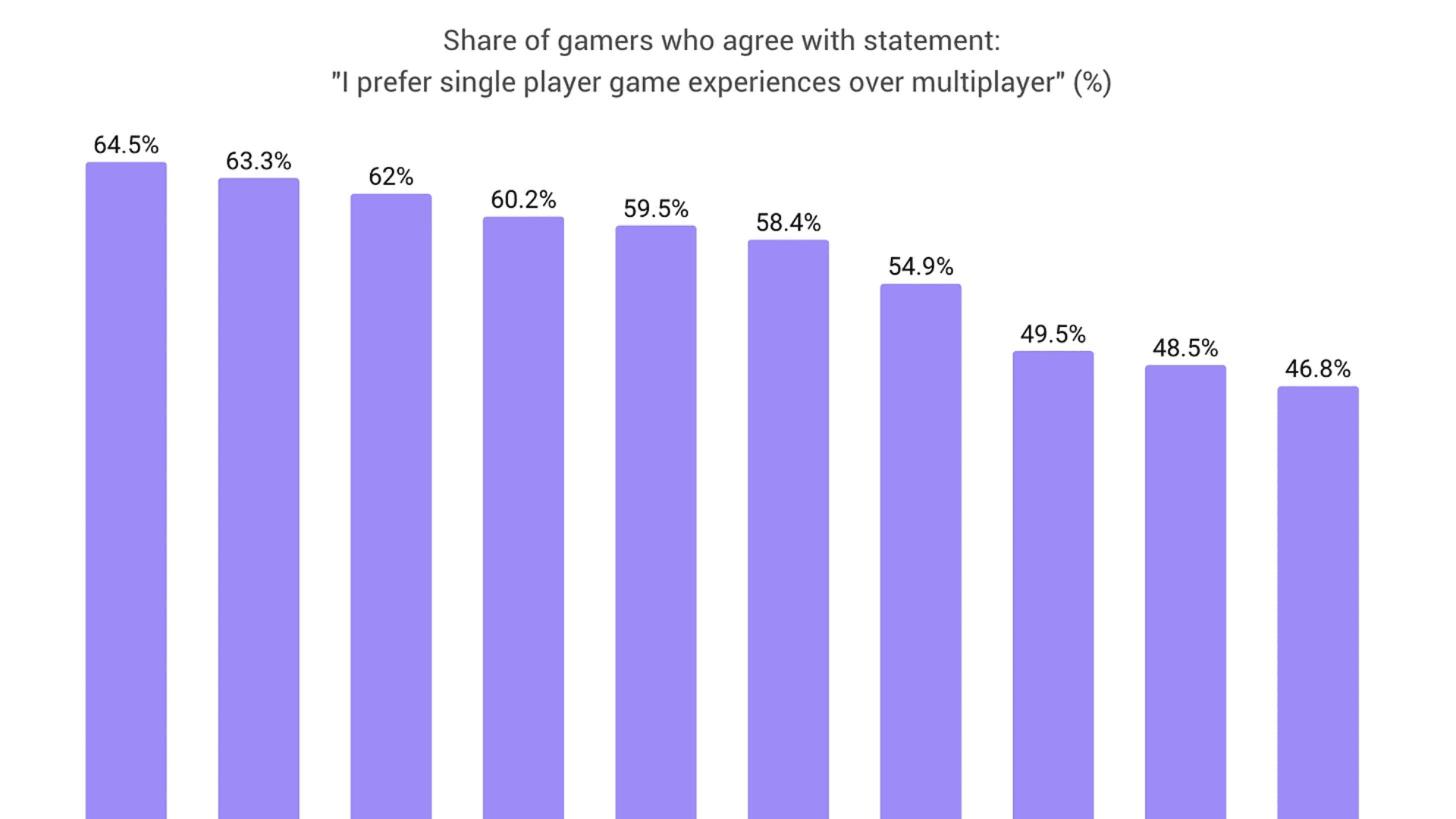
56% of players surveyed said they prefer single-player games. That figure represents a four percentage point increase over the past four years, showing a slow but steady climb in favor of solo-focused titles. While multiplayer games still dominate streaming platforms and engagement metrics, the preference data points to a different reality: many players want experiences they can enjoy alone and on their own schedule.
This trend lines up with the ongoing success of narrative-driven and mechanically dense single-player releases, especially on console and PC. The numbers suggest these games are not just holding ground but expanding their reach.
Preference holds steady across genders
The split between men and women is minimal. 55% of men and 58% of women prefer single-player games, showing only a three percentage point difference. This suggests that solo gameplay appeals broadly rather than to a specific demographic slice.
Age shows more variation. Among players aged 16 to 24, 49% prefer single-player games. That number jumps to 56% for the 25 to 34 age group, indicating stronger interest among slightly older players. This could reflect differences in available time, gaming habits, or deeper familiarity with traditional game formats.
Regional splits reveal market differences
Geography matters. In the United States, 65% of players prefer single-player games, making it one of the strongest markets for solo titles. China sits at 47%, showing a more even split between single-player and multiplayer preferences.
European markets fall closer to the global average. In the Netherlands, 50% of players favor single-player games. Sweden reports 49%. These regional differences highlight how local market trends, platform dominance, and cultural factors shape what players expect and want.
Social and creative factors still matter
Even with a strong preference for single-player games, social influence plays a role in purchase decisions. 24% of players are more likely to buy or download a game if their friends are already playing it. This shows that community visibility matters, even for games that don't require multiplayer interaction.
Creative elements also drive decisions. One quarter of players said a game's visual style influences whether they buy it. Around one third cited the soundtrack as an important factor. These findings confirm that presentation and audio design remain key to attracting players, regardless of whether a game is built around solo or shared play.
A stable core in a shifting market
The data suggests that single-player games provide a stable foundation for the industry. While multiplayer, live-service, and web3 experiments attract attention and investment, a significant portion of players still prioritize self-contained experiences. As developers and publishers plan future releases, the numbers point to sustained demand for games that focus on individual engagement rather than constant connectivity.
Source: Ampere Analysis
Make sure to check out our articles about top games to play in 2026:
Best Nintendo Switch Games for 2026
Best First-Person Shooters for 2026
Best PlayStation Indie Games for 2026
Best Multiplayer Games for 2026
Most Anticipated Games of 2026
Top Game Releases for January 2026
Frequently Asked Questions (FAQs)
Do most players still prefer single-player games?
Yes. 56% of surveyed players said they prefer single-player games over multiplayer ones.
How many players were surveyed in this report?
The survey included 34,000 players across 22 countries and was conducted in Q2 2025.
Does age affect preference for single-player games?
Yes. Players aged 25 to 34 showed a higher preference for single-player games at 56%, compared to 49% among players aged 16 to 24.
Are there regional differences in single-player game preferences?
Yes. The United States reported a 65% preference for single-player games, while China reported 47%. European countries like the Netherlands and Sweden were closer to the global average.
What other factors influence game purchases?
Social influence, visual style, and soundtrack all affect buying decisions. About 24% of players consider whether friends are playing a game, while visual design and music also play significant roles.