
A lightning bolt, a carved rune or the name Odin can tell players a lot about a game’s world before anyone explains the rules. Greek and Norse myths come with characters, conflicts and imagery that many people already recognise. For designers, that familiarity is a useful starting point.
These ancient stories appear in everything from action role-playing games (RPGs) and survival games to online slots. The formats have little in common mechanically, but they draw on the same gods and legends. So what makes Greek and Norse mythology so adaptable, and how do designers turn it into such different kinds of play?
Flawed gods make compelling characters
Greek and Norse gods are powerful, but they rarely behave like perfect heroes. Zeus is known as much for his affairs and harsh punishments as for his authority. Odin gives up an eye in pursuit of wisdom, yet also relies on deception. Thor can be courageous and impulsive in the same story.
Those contradictions give writers conflict to work with. Betrayal, rivalry and the consequences of difficult choices run throughout the original myths. Designers can build quests, enemies and relationships around them without inventing an entire mythology from scratch.
From God of War to Valheim: myth as a playable world
The original God of War, released on PlayStation 2 in March 2005, made Greek mythology central to its combat and story. Kratos’ battles against legendary creatures and Olympian gods turned familiar myths into confrontations players could control. The game didn’t simply reproduce the old stories. Instead, it rearranged them around its own protagonist.
In April 2018, God of War moved into a Norse setting and gave the series a more personal focus. An older Kratos travels through a world shaped by Norse gods and monsters, and mythology still supplies the danger and spectacle. This time, though, it also provides the backdrop for a quieter story about grief, responsibility and confronting the past.
Valheim approaches Norse influences differently. Its procedurally generated purgatory, inspired by Viking culture, is a setting for exploration, building and survival rather than a tightly scripted journey. The myths define the creatures, environments and sense of adventure, while players decide how to navigate the world.
Together, these games show that mythology can shape both what a game tells players and what it asks them to do.
The same gods, different game mechanics
The contrast becomes clearer in slot design, where mythology does a different job entirely. Online casinos lean heavily on Greek and Norse themes, and the way those themes are used says a lot about how flexible the source material is.
Spin Casino’s Canadian lobby, for example, includes Amazing Link Zeus, a Greek-themed slot from SpinPlay Games released in 2021. In this format, Zeus isn’t an enemy to defeat or a character to question. He appears as the wild symbol, set against Greek urns, golden temples and marble columns in the clouds of Mount Olympus.
Free spins are triggered by temple symbols, while the Amazing Link feature uses locked orb symbols and respins rather than battles or quests.
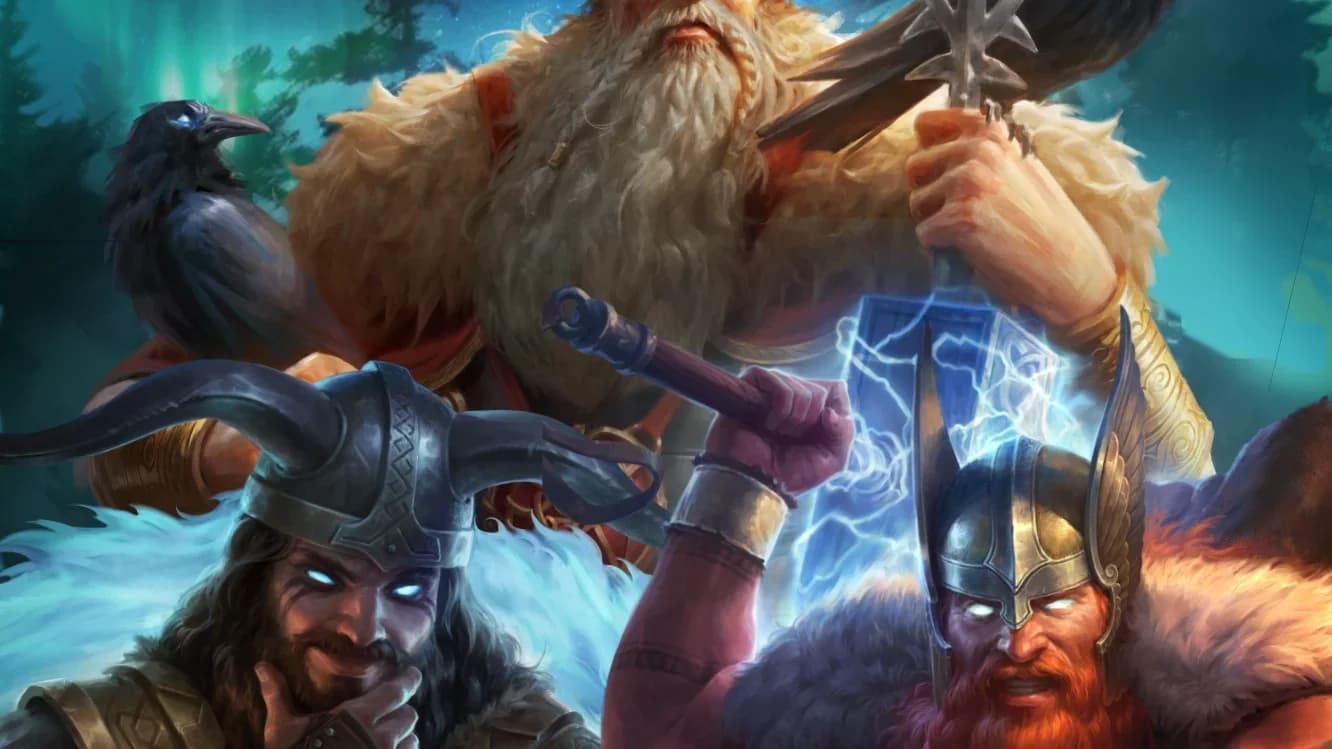
Thunderstruck II, a 2010 release from Microgaming, takes a similar approach to Norse mythology. Thor’s hammer acts as the scatter symbol, and landing three or more opens the Great Hall of Spins. That feature links its four free-spin rounds to the Valkyrie, Loki, Odin and Thor. Players unlock each in turn as they return to the feature, giving every character a different part of it to define.
The distinction matters. In an action game, mythology shapes many of a player’s choices and challenges. A slot uses the same mythology mainly to organise its appearance and communicate its features in a chance-based game. Familiar characters don’t change the underlying odds, but they can make a game’s theme easier to grasp at a glance.
Visual and audio design bring the legends together
Mythology offers more than recognisable names. It also provides a visual vocabulary. Greek-inspired games might use temples, marble columns, bronze armour and sunlit landscapes. Norse-inspired settings often draw on runes, longships, rugged mountains and stormy skies.
These are design choices rather than fixed rules, but they help establish a setting quickly. Thunderstruck II’s stone-carved symbols are a good example of a Norse look delivered in a single glance.
Sound strengthens the distinction. A game might use choral music and echoing stone halls to suggest an Olympian temple, or wind, percussion and thunder effects to establish a harsher Norse atmosphere.
Across genres, these details connect characters to their environment. A hammer, a lightning effect and a suitable soundtrack can make a mythological reference clear without a lengthy explanation.
Why designers keep returning to the myths
The continued appeal isn’t limited to two pantheons or one style of game. Hades, released in 2020 by Supergiant Games, builds a fast-paced roguelike around the Greek underworld. Its characters, conversations and repeated escape attempts give familiar figures new personalities and narrative roles. It uses the myths very differently from God of War, even though both draw on Greek stories.
That flexibility is the real advantage. Greek and Norse mythology can support dramatic combat, survival challenges, character-driven storytelling or compact visual themes. The underlying material is familiar, but the result depends on how carefully a developer connects it to the game’s purpose.
For players, recognition provides an entry point. What makes a game memorable is what its designers do beyond that first familiar image.
Final thoughts
Greek and Norse myths keep appearing on screen because their characters and symbols can be adapted to a wide range of games. Whether they shape a long adventure or the visual language of a slot, the strongest designs give those references a clear role rather than relying on familiar names alone.