
An indie game marketing roadmap works better as stages than a calendar. Your next job depends on where the game is: no Steam page, a trickle of wishlists, approaching launch, or already out.
Wishlists and launch timing, not budget, decide your stage. Each has one main risk and one main job. Find yours, work the focus list, and move on at the signal.
These stages come from the GAMES.GG Indie Game Growth Roadmap. Sources were checked in November 2026.
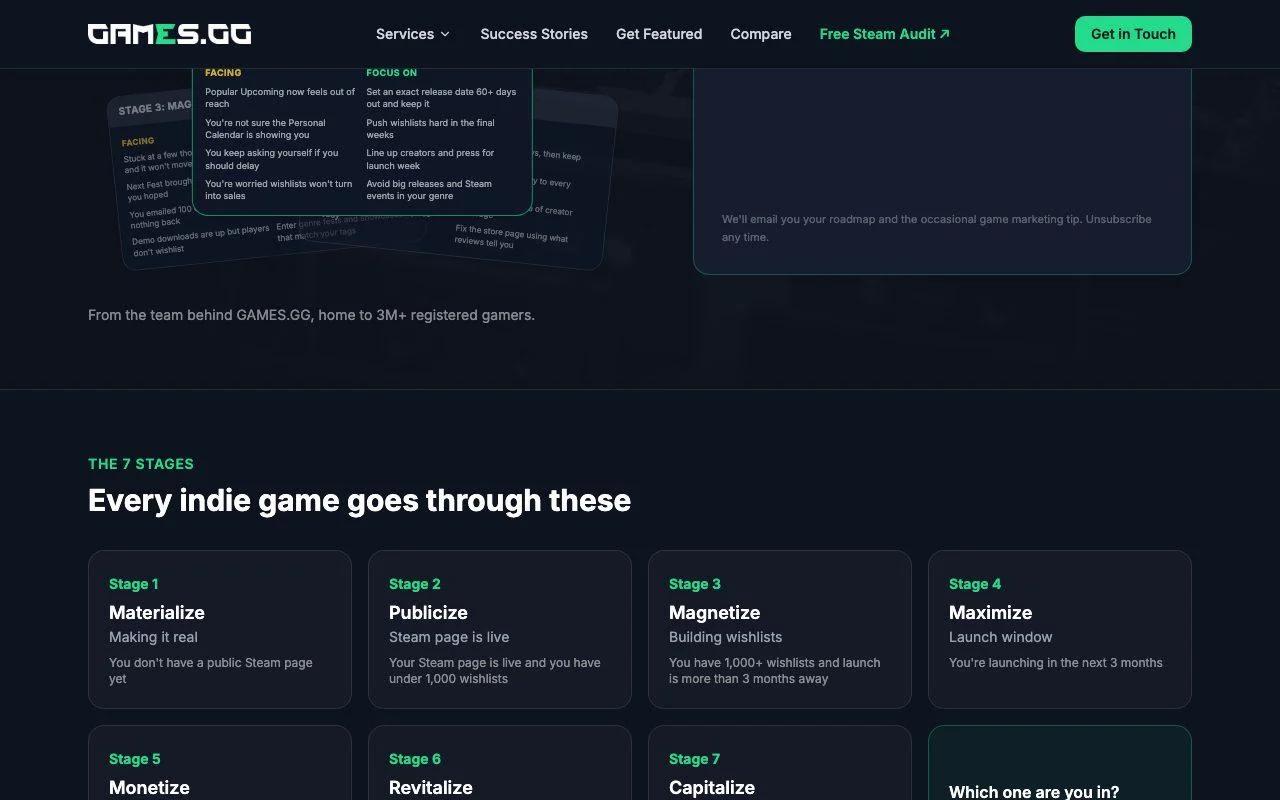
The 7 indie game marketing stages at a glance
| Stage | You're here if | Biggest risk | Focus now | Move on when |
|---|---|---|---|---|
| 1. Materialize | No public Steam page | Waiting until it looks good enough | Capsule, Coming Soon page, public progress | Steam page is live |
| 2. Publicize | Page live, under 1,000 wishlists | Blaming the game before fixing the page | Capsule, GIFs, tags, demo | You pass 1,000 wishlists |
| 3. Magnetize | 1,000+ wishlists, launch 3+ months away | Stalled growth or misplaced spending | Next Fest, creators, demo, small ad tests | Launch is under 3 months away |
| 4. Maximize | Launching within 3 months | A moved date or crowded launch week | Fixed date, wishlists, creators and press | Game releases |
| 5. Monetize | Launched within 30 days | Falling sales and stalled reviews | Reviews, patches, second creator wave | First 30 days end |
| 6. Revitalize | Older release, slower sales | Confusing game and marketing problems | Update, discount and creator push | Sales hold up and earn real money |
| 7. Capitalize | Game is a business; planning what's next | Shrinking update spikes | Update calendar, game two wishlists, ports | Ongoing stage |
Stage 1: Materialize, making it real
You're here if you have no public Steam page. Only you and a few friends have played. You've spent years waiting until it looks good enough, or is finished, while nobody knows it exists.
Focus on:
- Testing your hook against what sells in your genre. Would one line make a stranger click?
- Publishing your Coming Soon page early.
- Making a capsule that communicates your genre at thumbnail size.
- Posting progress publicly, even for five views.
- Blocking out marketing time every week.
Valve recommends publishing your Coming Soon page “as soon as you are ready to start talking publicly about your game.” A gameplay trailer is “ideally” included, not required (Steamworks docs).
Chris Zukowski's advice: lock your genre, settle the art style, get a professional capsule, then publish (How To Market A Game, 2025).
Move on when your Steam page is live.
Read when to start marketing your game and our full timing guide for planning. A free GAMES.GG game page offers a public home without a budget; it's our service, with editorial approval required. Our 23 places to list an indie game covers free and paid alternatives.
Stage 2: Publicize, Steam page is live
You're here below 1,000 wishlists. They arrive a few at a time, or not at all. A Reddit post gets thousands of views but a dozen wishlists, and you're questioning what's normal, or whether the game works.
Focus on:
- Fixing the capsule, GIFs and short description, where most visitors bounce.
- Using all 20 tags to help Steam identify your audience.
- Posting where players gather, not developer subreddits.
- Shipping a demo months before Next Fest.
- Saving Next Fest until wishlists are climbing.
In a self-reported survey of February 2026 Next Fest developers, 71 games entering with 0–999 wishlists gained a median of 322. Valve allows each title only one Next Fest (benchmarks; Steamworks).
Steam allows many tags, but only the top 20 are visible to users (Steamworks).
Move on when you pass 1,000 wishlists.
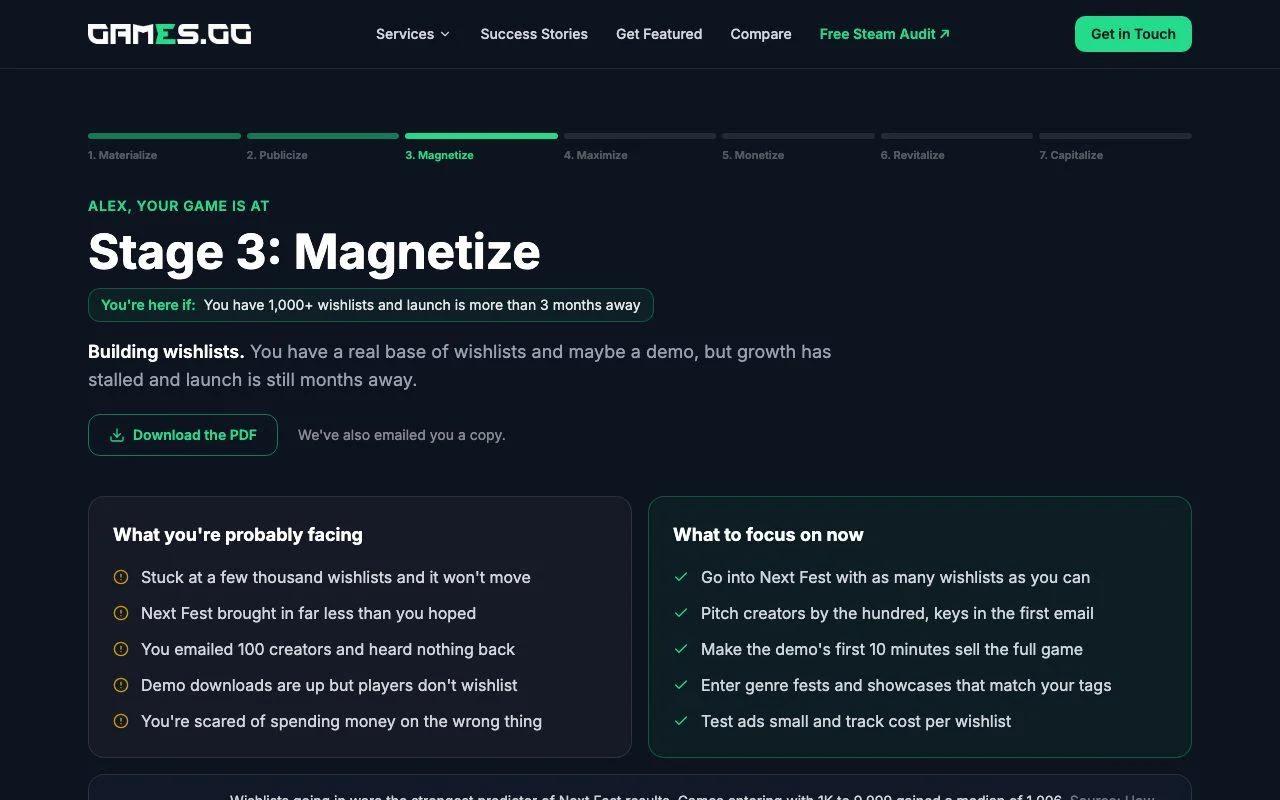
Our free SteamBuddy audit compares your page against 20,000+ Steam games and provides a fix list.
Stage 3: Magnetize, building wishlists
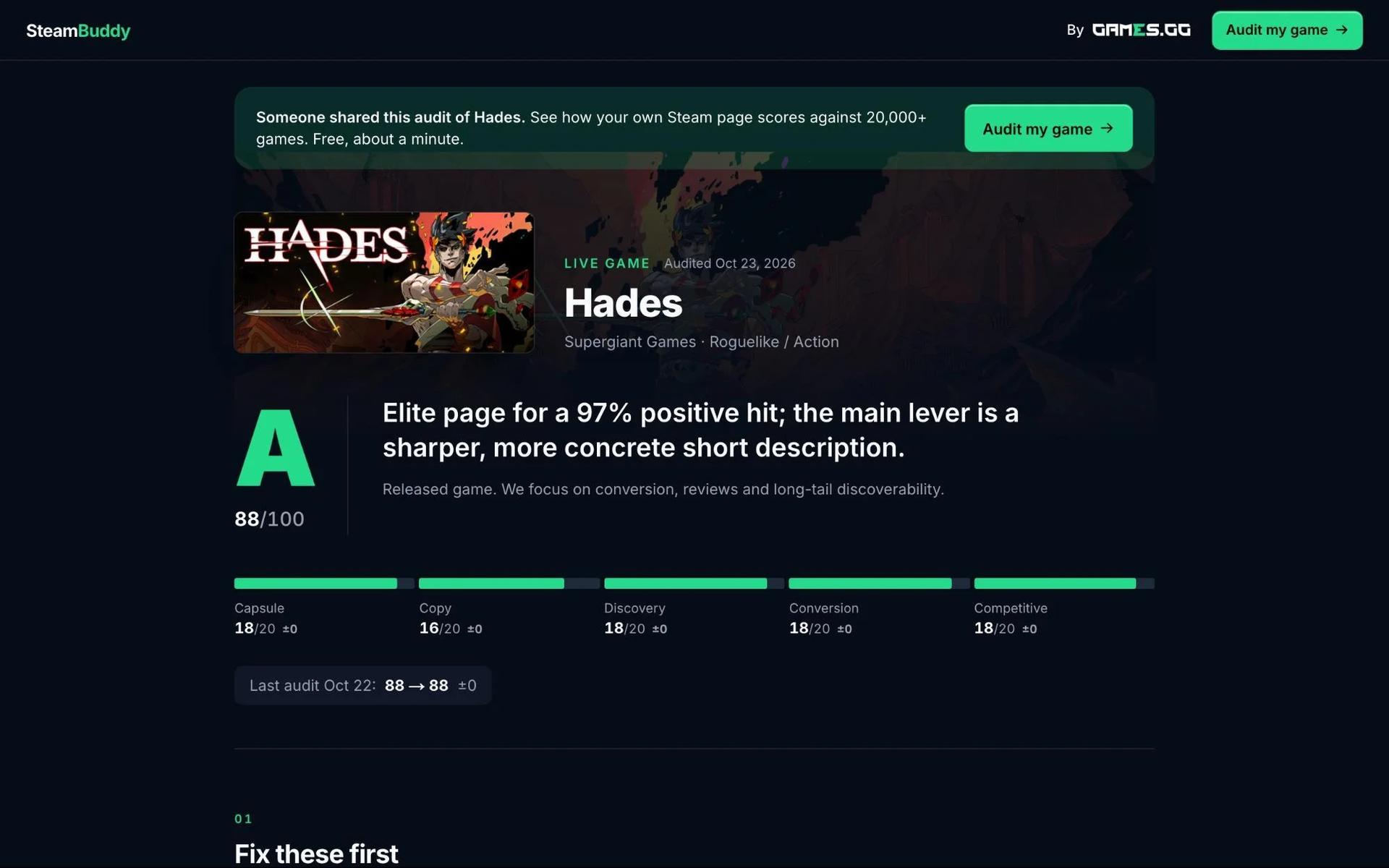
You're here with 1,000+ wishlists and launch more than three months away. Growth has flattened, Next Fest may have disappointed, and 100 creator emails got silence. Demo downloads aren't becoming wishlists, and spending feels risky.
Focus on:
- Entering Next Fest with as many wishlists as possible and the required public demo ready when it begins.
- Pitching creators by the hundred, with keys in the first email.
- Making the demo's first 10 minutes sell the full game.
- Entering genre fests and showcases matching your tags.
- Testing ads cheaply and tracking cost per wishlist before scaling.
In the same February 2026 survey, 60 games entering with 1,000–9,999 wishlists gained a median of 1,006, about three times the smaller group's gain. That's why we tell stage 2 games to wait (benchmarks).
Move on when launch is under three months away.
Run SteamBuddy again before sending substantial traffic. For zero-budget tactics, read how to market an indie game with no budget.
Stage 4: Maximize, launch window
You're launching within three months. Every wishlist and piece of coverage matters. Popular Upcoming feels distant, you're considering a delay, and pricing, discounts and wishlist conversion remain uncertain.
Focus on:
- Setting an exact release date 60+ days ahead and keeping it. That's our advice, not a Steam rule.
- Pushing wishlists in the final weeks.
- Booking launch-week creators and press.
- Avoiding major releases and Steam events in your genre.
- Planning your first 10 reviews from real buyers in week one.
Steam's Personal Calendar requires “a visible Coming Soon page with a specific release date.” Delay more than 24 hours within two weeks of launch, and your game leaves the calendar until release (Steamworks docs). The Coming Soon page must also be live at least two weeks before release (Steamworks).
There's no magic launch wishlist count: conversion depends on genre, price and audience. Wishlists aren't guaranteed sales.
Move on when the game releases.
Our GAMES.GG Indie Growth Program accepts free applications taking about two minutes. Selected games receive homepage hero and top-of-list placement, three short videos, a newsletter feature to 100K subscribers and a press release. Selection leads to a short introductory call, then a paid package at a reduced program rate. The listed round has 30 places and a December 31, 2026 application deadline.
See our game marketing budget guide for launch costs.
Stage 5: Monetize, the first 30 days
You're within 30 days of launch, when the next few weeks decide whether Steam keeps showing the game. Thousands of wishlists may have produced hundreds of sales, followed by a sharp drop. You're below 10 reviews, tempted to cut the price, and counting on this game to fund the next.
Focus on:
- Getting past 10 reviews and keeping them coming.
- Patching quickly and replying to every negative review.
- Running a second creator wave.
- Improving the store page using review feedback.
- Planning your first update and discount beats.
GameDiscoverCo found median first-week sales of 0.15x launch wishlists for games launching with over 25,000 wishlists in the year to September 2025. Results vary widely; adult and very cheap games push the median up. It's a rough benchmark, not a forecast (GameDiscoverCo, 2025).
Steam's review score counts only purchases made by the reviewing account (Steamworks). Below 10 reviews, it displays “Need more user reviews to generate a score”, a community-documented threshold, not a published Valve rule (Steam Page Analyzer).
Move on after 30 days, once you know your sales baseline.
Stage 6: Revitalize, rescue the long tail
You're here when an older release slows down. Launch disappointed, Steam seems to have stopped showing it, and you can't separate game problems from marketing problems. You're torn between updates and moving on, having earned less than the work deserved.
Focus on:
- Diagnosing the problem: strong reviews with weak traffic suggest visibility.
- Combining a real update, discount and creator push, not just one.
- Timing pushes around seasonal sales and themed Steam fests.
- Discounting at every opportunity, deepening discounts gradually.
- Setting a recovery window before shifting energy to game two.
GameDiscoverCo's April 2024 survey of Steam games released from 2020–2023 found median Year 1 revenue of 3.16x Week 1 revenue; the first two years together reached 4.2x (GameDiscoverCo, 2024). A quiet first week doesn't tell you much about the next twelve months.
Move on when sales hold up between pushes and earn real money.
With a live Steam page and players worth growing, consider our Indie Growth Program: applying is free; selected games receive a paid-package offer at a reduced rate.
Stage 7: Capitalize, turn a hit into a studio
Your game is a business, but update spikes keep shrinking. You want players to follow you to game two while weighing a sequel, DLC or something new. Publisher and port offers arrive, while support takes time from development.
Focus on:
- Planning a yearly update, sale and DLC calendar.
- Getting players onto the next game's wishlist early.
- Checking port economics before signing.
- Localizing for markets already buying.
- Keeping your IP and negotiating with your numbers.
About 22% of Hollow Knight's Steam players had bought Silksong by September 2025. It's an outlier; GameDiscoverCo cautioned that its launch offered few lessons to copy (GameDiscoverCo, 2025). Still, your existing players are the cheapest audience for your next game.
There's no stage 8. Stay here; with game two, loop back to stage 3, helped by the audience you've built.
Find your stage in 60 seconds
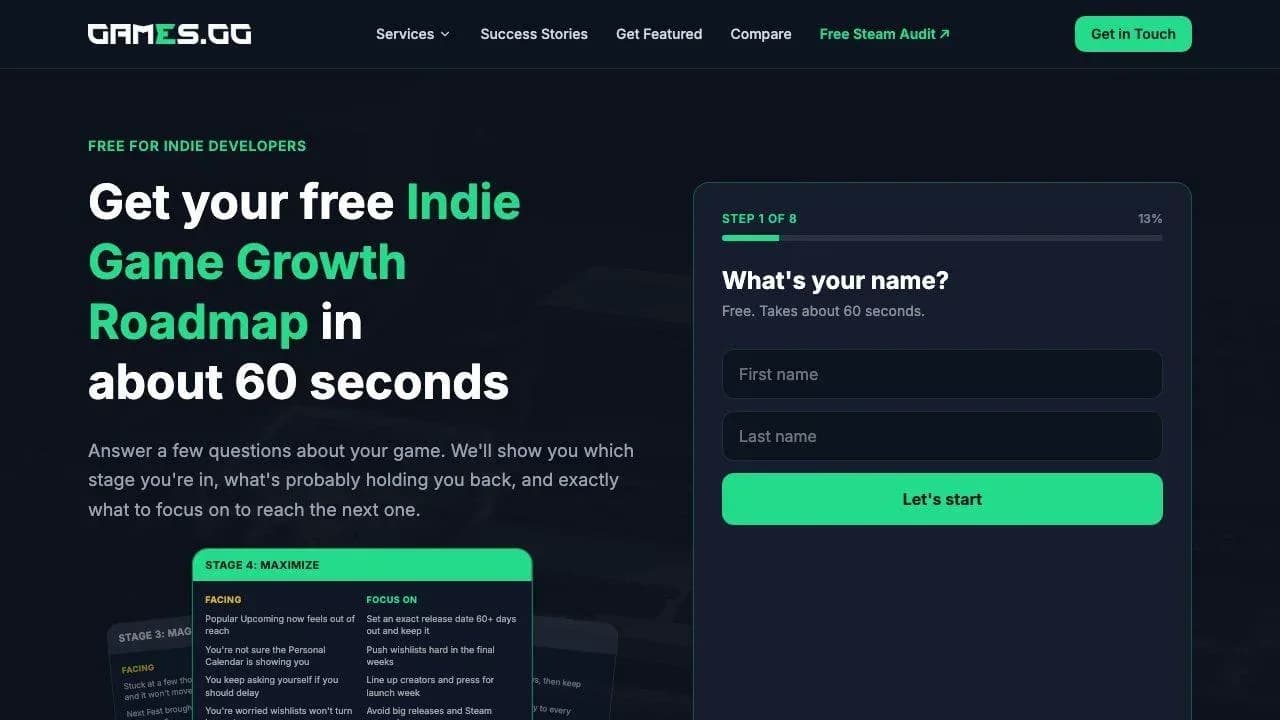
The free GAMES.GG Indie Game Growth Roadmap asks a few questions, places your game in a stage and emails a PDF with your next moves.
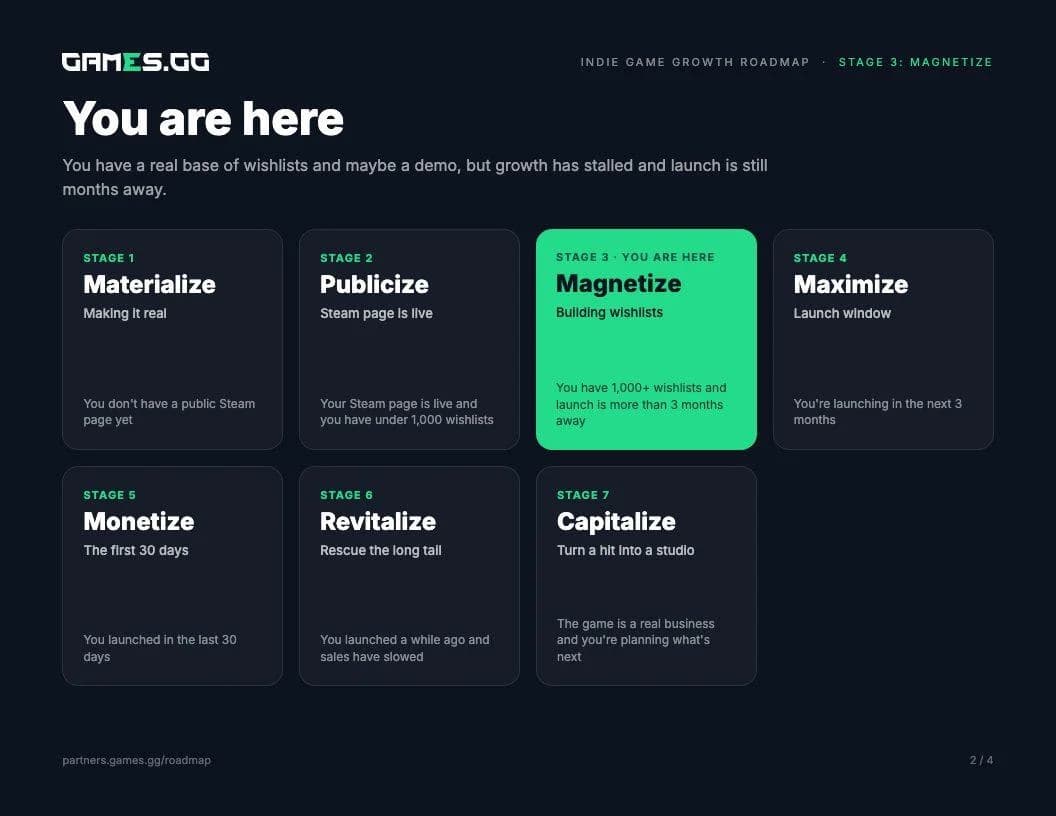
Use your stage's focus bullets as a checklist: pick three or four for this month, then reassess when wishlists or launch timing change. The 2026 game marketing guide goes deeper on tactics.
Not sure where you belong? Take the free GAMES.GG roadmap quiz. It takes about 60 seconds.