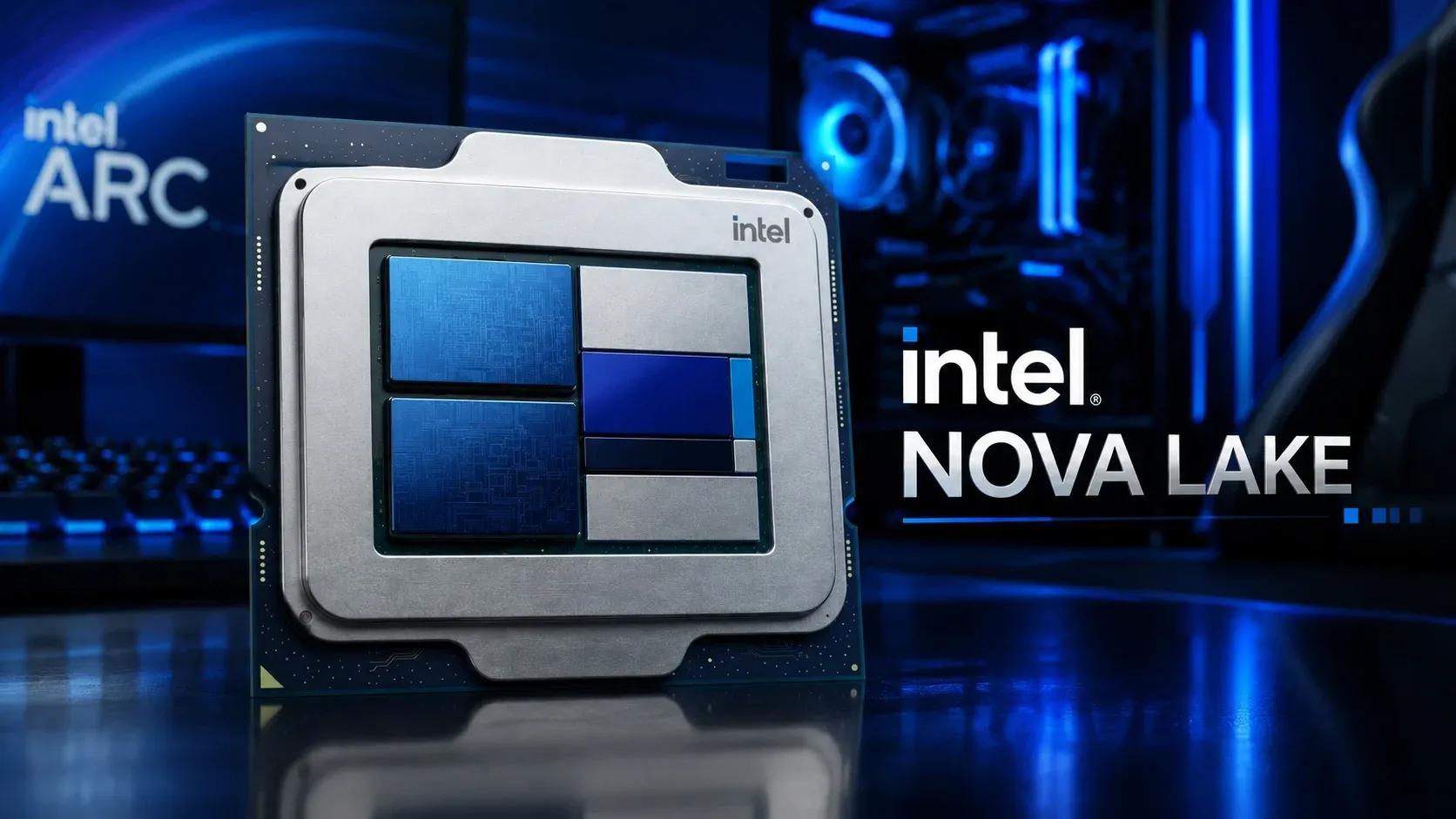


For months, Intel Nova Lake-S has existed mostly as spec sheets, shipping manifests, and motherboard schematics floating around the internet. This week, the actual chip showed up in a leaked photo posted to X by user PoTAToOOOO, and it tells us a lot about what Intel is planning for its next major desktop platform.
The image shows the pad side of the chip, labeled clearly as "NovaLake-S LGA1954." That label alone confirms two things that were previously rumored: the new socket name, and the fact that this is a clean break from everything that came before it.
Pay less for your games.
Get discounts up to 80% off
What the notch placement actually means for your current rig
Here's the thing most people will care about immediately: your existing Arrow Lake-S motherboard is useless for Nova Lake. The notch on Nova Lake-S has moved from the left side of the package (where it sits on current Arrow Lake chips) to the right side. Combined with a different overall package size, the chip physically cannot seat in any older socket. There is zero backward compatibility.
This is not a surprise, exactly. Intel had already confirmed a new LGA-1954 socket was coming. But seeing it in a physical chip photo makes the platform transition feel very real. The pad layout on the backside shows at least 35 capacitors, slightly fewer than the 36 on the current Core Ultra 9 285K, with additional contact pads spread along the edges compared to current-gen chips.
The leaker also noted that the front side of the package looks visually similar to Alder Lake (12th Gen) in terms of general layout, even though the socket has jumped from LGA-1700 to LGA-1954. The chip will support both single-lever and dual-lever ILM socket configurations, which gives motherboard makers some flexibility in how they design retention mechanisms.
If you're on an Arrow Lake or Raptor Lake build and were hoping to drop a Nova Lake chip in with a BIOS update, that is not happening. New socket means new motherboard, full stop.
Core counts, new architectures, and a massive cache bump
The physical leak is just one piece of the picture. What we already know about Core Ultra Series 4 (the branding Nova Lake-S will launch under) makes this platform genuinely interesting for PC gaming builds.
Nova Lake-S introduces two brand-new core architectures:
- Coyote Cove P-Cores (performance cores)
- Arctic Wolf E-Cores (efficiency cores)
The lineup splits into single-tile and dual-tile configurations. The single-tile variant tops out at 28 cores with 144MB of bLLC cache, while the dual-tile flagship reaches 52 cores and 288MB of cache. For context, the current Core Ultra 9 285K sits at 24 cores. Going from 24 to 52 in one generation is a significant jump, even accounting for the fact that not all of those cores are performance-focused.
Integrated graphics will use a hybrid Xe3 and Xe3P architecture. This matters for gaming PCs that run without a discrete GPU, and it also has implications for how the iGPU handles background tasks when a dedicated card is present.
The 900-series platform and what comes next
Nova Lake-S is expected to land on 900-series motherboards in early 2027. The chipset lineup already has names attached: Z990, Z970, B960, Q970, and W980. A Q970 motherboard has already appeared in a separate leak showing LGA-1954 socket support and DDR5 CUDIMM compatibility with up to 128GB capacity.
The pace of pre-launch leaks is accelerating. Socket photos, motherboard listings, and now a CPU package image have all surfaced before Intel has said a word officially. That trail of hardware evidence makes the early 2027 window feel credible.
For PC gamers thinking about a new build, the calculus here is straightforward. If you need a machine now, current-gen hardware is not going anywhere. If you can wait until mid-to-late 2027 for Nova Lake platforms to mature and for game reviews and CPU benchmarks to accumulate, the upgrade picture should be much clearer. The bLLC cache on even the single-tile chips is designed to compete with AMD's 3D V-Cache approach, which has dominated gaming CPU benchmarks for the past two years.
Keep an eye on Intel's official channels and check our gaming guides as the Nova Lake-S launch window approaches. The hardware details are filling in fast, and the formal announcement cannot be far behind.