The gaming industry is undergoing a period of significant transition. Changes in how games are discovered and monetized have reshaped the strategies of developers across mobile, PC, and console platforms. In an environment where competition is intensifying and user attention is increasingly difficult to capture, third-party intellectual property (IP) licensing is becoming a central tool for mitigating risk, improving visibility, and increasing player engagement.
IP Licensing in Gaming: Overcoming Market Saturation
Dynamics and Discoverability
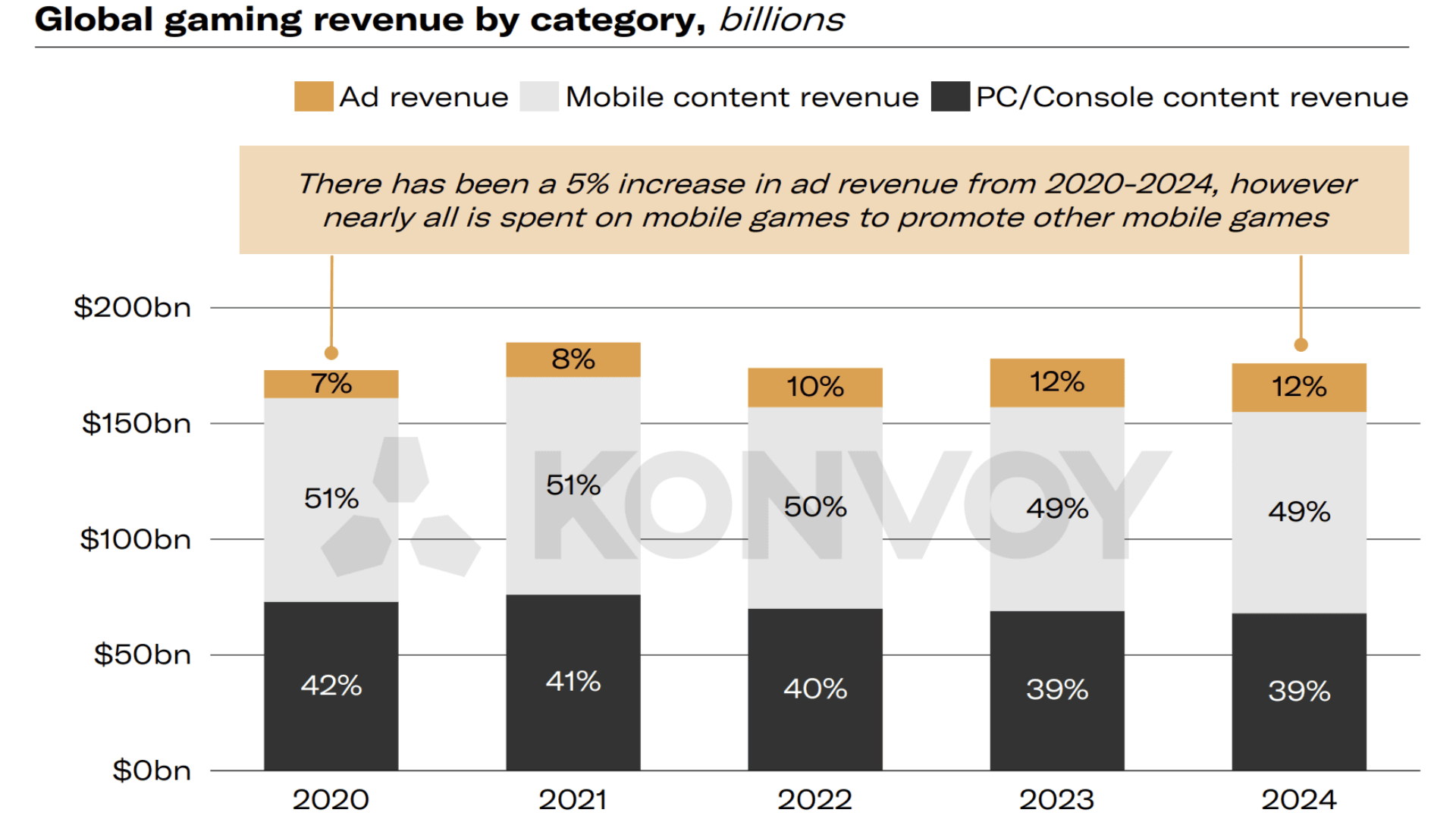
Since IDFA deprecation in 2021, mobile game developers have faced rising costs to acquire new users. Global smartphone adoption has continued climbing, yet the number of unique games on the iOS App Store has dropped sharply—from roughly 600,000 in 2016 to under 200,000 by 2024. Despite fewer titles competing for attention, developers are pouring more money into advertising than ever before. Marketing budgets have become essential for mobile games as organic reach continues to erode. Monopoly Go!, the highest-grossing mobile game of 2024, spent approximately 36 percent of its net revenue on advertising during its first eleven months.
On PC and console platforms, the challenge isn't a shrinking catalog—it's the growing impossibility of standing out. Steam sees more game releases every year, but player attention remains locked on a handful of top performers. In 2023, only 6.5 percent of player time on PC and major consoles went to games released that year. Of that slice, just 3.6 percent was spent on anything outside the top four titles. Most new releases struggle to gain any meaningful traction, forcing developers to lean harder on paid marketing just to get noticed.
Monopoly Go

Use code TRYHARD33 at checkout to redeem this offer before code expires again.
Get 33% Off GAMES+ Subscription
Familiar IP in Player Acquisition and Retention
Faced with these market conditions, developers are increasingly turning to third-party IP to improve performance across acquisition, engagement, and retention. Familiar IP helps reduce perceived risk among new players by creating an immediate connection based on recognition and pre-existing positive associations. However, IP doesn't necessarily guarantee higher organic discoverability, especially in genres that are already saturated.
The more reliable benefits show up in paid acquisition efficiency and user lifetime value. Research indicates that IP association is a notable motivator for both average and high spenders, with 11 percent and 13 percent respectively citing it as a reason for downloading a game. This connection between IP and financial performance appears in broader market data as well. In 2023, 43 percent of the top 200 grossing mobile games in the United States included third-party IP, generating approximately $16 billion in in-app purchases—21 percent of the year's total mobile IAP revenue.
Global Gaming Revenue By Category (Billions)
Case Studies in IP-Driven Development
Scopely demonstrates how a game company can build its entire strategy around licensed IP. While the company launched several original games early on, it eventually shifted to releasing exclusively IP-based titles. Games like Yahtzee With Buddies, Star Trek Fleet Command, and MONOPOLY GO! became portfolio staples. By 2023, Scopely had generated over $10 billion in lifetime revenue and was acquired for $4.9 billion. In early 2024, the company reinforced its position in licensed game development by acquiring Niantic's game division for $3.5 billion.
Lower Barriers to Content Creation
As development tools become more accessible, content creation is getting faster and less resource-intensive. Low-code and no-code platforms, alongside AI-driven asset generation tools, are enabling more developers to bring new games to market. While this supports greater experimentation, it also drives further saturation. In an environment flooded with new releases, known IP becomes a more important signal of trust and quality—a way to cut through the noise.
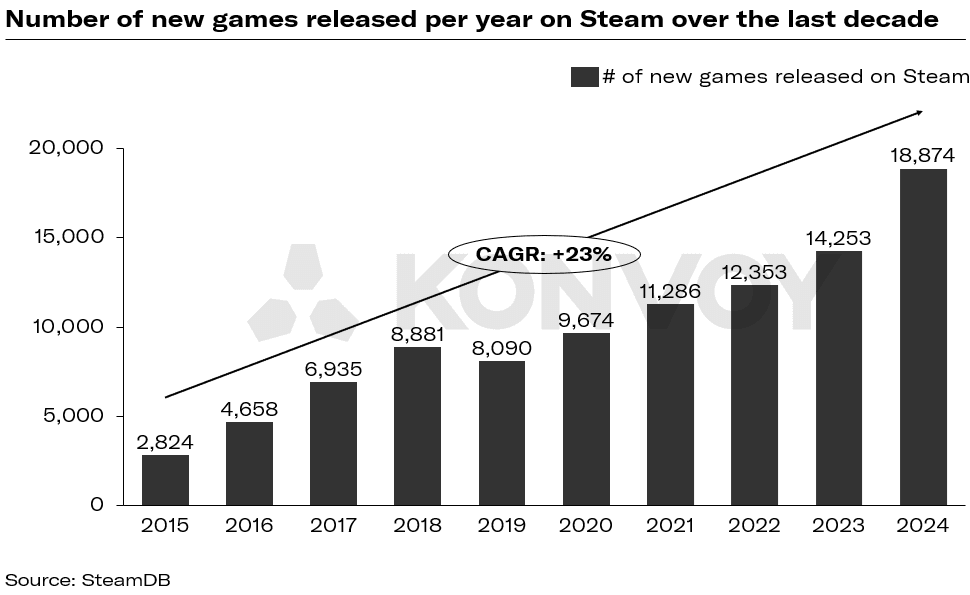
Number of New Games Release Per Year on Steam in Last Decade
IP Licensing as a Strategic Business Decision
Beyond the benefits for developers, IP licensing is gaining traction as a preferred strategy for IP holders. Maintaining in-house game development teams is expensive and carries significant operational risk, especially for companies whose core businesses lie outside gaming. Brands like Disney and LEGO have chosen to license their IP to experienced game developers rather than invest in internal studios. This approach lets them maintain a presence in gaming—one of the strongest segments of consumer entertainment—without the overhead of direct development.
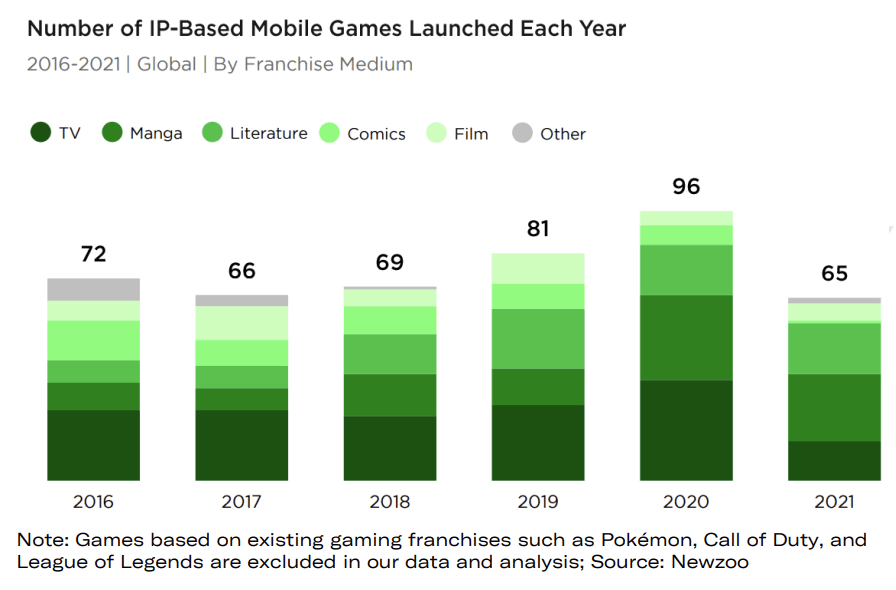
Number of IP Based Mobile Games Launched Each Year
Conclusion
Across mobile, PC, and console platforms, discoverability challenges and rising user acquisition costs are reshaping how games are developed and marketed. In this environment, third-party IP is proving valuable. It helps reduce acquisition costs, improves player engagement, and increases lifetime value, particularly among the highest spenders. As development becomes cheaper and more accessible, familiarity and trust become essential to stand out. For both developers and IP holders, licensing presents a practical, lower-risk strategy to navigate the increasingly complex and competitive gaming landscape.