In the non-fungible tokens (NFTs) and gaming space, Magic Eden has overtaken established players like OpenSea and Tensor to become the top marketplace by user count.
Data from the NFT analytics platform NFTpulse shows Magic Eden grew its marketplace user base by 36% over the past 30 days, with transaction volume exceeding 230k.
This piece covers Magic Eden's rise in the NFT gaming space, plus the early launch of its Runes platform, which lets users swap for $BTC and buy Runes and Ordinals.
TLDR on Runes
The Magic Eden team launched its Runes platform following the introduction of Runes Protocol, a new token standard for Bitcoin inscription that coincides with the Bitcoin halving event. The goal is to streamline inscriptions and cut gas fees.
Bitcoin's new fungible token standard
Magic Eden's Runes platform went live a day early on April 23rd, 2024. Zedd Yin, COO and co-founder of Magic Eden, called the launch proof of the company's commitment to becoming the go-to destination for Bitcoin.
"As pioneers in the Ordinals marketplace and fervent supporters of innovation in Bitcoin, it was imperative for us to deliver the best possible Runes experience,"Zedd Yin said.
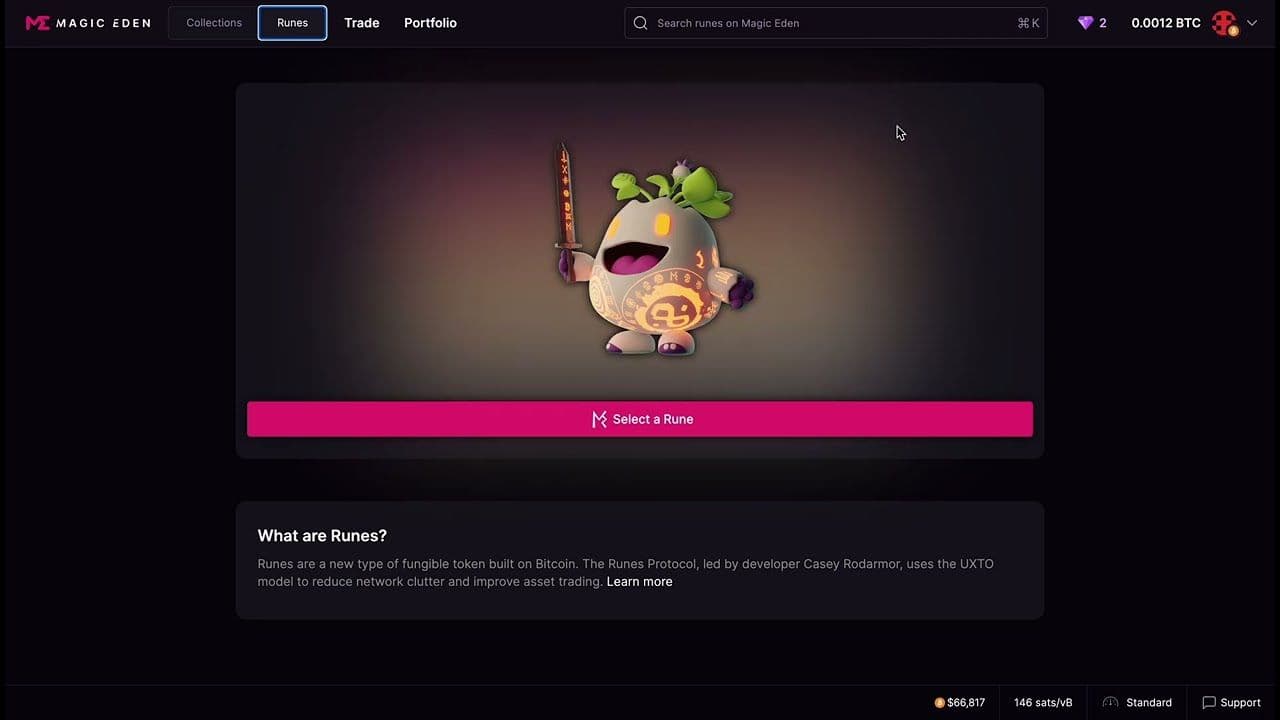
In beta, Magic Eden's Runes platform lets users swap for $BTC and buy runes and ordinals using their Magic Eden wallet. The company has expanded its support for Bitcoin innovation, moving from a non-BTC native NFT marketplace to one that embraces the leading cryptocurrency.
Over $20 million TVL
Users can preset the amount of $BTC they plan to spend on Runes during transactions, giving them more control. In a collaboration with the NFT project CyberKongz, Magic Eden launched the $BTC pre-runes collection Prometheans. The collection has locked up 316 $BTC in Total Value Locked (TVL), roughly $20.8 million, based on data from Magic Eden's Ordinals marketplace.
An overview of Runes' conception
Runes was created by developer Casey Rodarmor in September 2023. Casey also created Ordinals, a feature on the Bitcoin blockchain that allows for the creation of unique digital artifacts by inscribing data directly onto individual Satoshis, the smallest units of Bitcoin.
BRC-20s have been the current Bitcoin token standard, but they create surplus "junk" UTXOs. These can clog the network and degrade the user experience. UTXOs, or Unspent Transaction Outputs, are digital assets you've received but haven't spent yet. Bitcoin Runes attempts to clean up the network while letting traders use their meme coins on the main chain.
Why you should care
Runes has the potential to attract a wider audience. Runestone, a pre-Runes NFT project, airdropped a free Runestone to wallets that had 3 or more digital items (inscriptions) on the Bitcoin blockchain before the Runestone project launched. With a market cap of approximately $330 million, Runestone is generating excitement around what holding this Ordinal could mean for receiving Runes.
Bigger user base
Excitement isn't the only draw. Ordinals and other NFT collections typically limit their size to preserve collectibility, but Runes and similar tokens can be minted in much larger amounts. This makes it easier for more people to own them and join the community of collectors. The attention around Runes and its accessibility could drive more worldwide adoption, something core to Bitcoin's mission.

Enhanced security and stability
Runes could offer a more secure and reliable platform for token creation and transactions. By using the UTXO for on-chain data storage, it inherits Bitcoin's security model for stronger safety features and a reduced risk of vulnerabilities.
Being UTXO-based also means Runes will be more resistant to reorganizations, which happen when the Bitcoin network has to choose between two versions of its transaction history. Greater resistance to reorganizations means Runes transactions are less likely to be affected by changes in the Bitcoin network's transaction history, providing more stability.
More developers, more fun
Runes makes creating and managing new tokens simple and streamlined for developers. For users, this means more developers are willing to build, which means more tokens and more things to get excited about.
How does Runes Protocol work?
The Runes Protocol is designed for the Bitcoin network, allowing the creation and management of various types of digital tokens.
Bitcoin Runes uses a UTXO-based protocol, where each transaction starts by picking up pieces of Bitcoin that haven't been spent yet (like digital change) and uses them to create new transactions. Tracing each Bitcoin back to its creation ensures that every coin is unique and hasn't been falsely duplicated, giving you confidence that the Bitcoin you own or accept in a transaction is genuine and truly yours.
Compared to other protocols that may rely on off-chain data or special tokens, Runes utilizes Bitcoin native features for on-chain data storage. This allows for fewer of the "junk" UTXOs we mentioned earlier, which can bog down the network, causing transactions to be slower, more expensive, and less reliable.
Specifically, Bitcoin Runes' on-chain data storage is in the OP_RETURN part of a transaction. Picture jotting down a secret note on your Bitcoin transaction. OP_RETURN is that magic pen that lets you leave your mark without moving any actual Bitcoin. This keeps Bitcoin transactions neat and tidy because it doesn't add extra work for the network, which can affect the overall user experience.
You may also hear people talking about Runes having lightning compatibility. This means Runes can use the Lightning Network, a separate layer on top of Bitcoin, to enable faster and cheaper transactions. This allows Runes transactions to bypass the usual delays and high fees of the Bitcoin network by using this faster, more efficient system.
How to get ready for Runes
With the launch of the Runes Protocol, users can prepare in a few ways:
- Set up a Bitcoin wallet that's compatible with Runes (suggested: ME Wallet).
- Stay up to date on any Bitcoin Runes announcements with Casey's Twitter, the main Twitter, and their BTC account.
- Make sure to get some Bitcoin. Since Runes operates on the Bitcoin network, having some Bitcoin in your wallet is necessary for sending Runes and paying transaction fees. Note: Magic Eden's Runes-compatible wallet supports swaps. You can quickly swap your existing tokens on other chains to Bitcoin within the wallet.
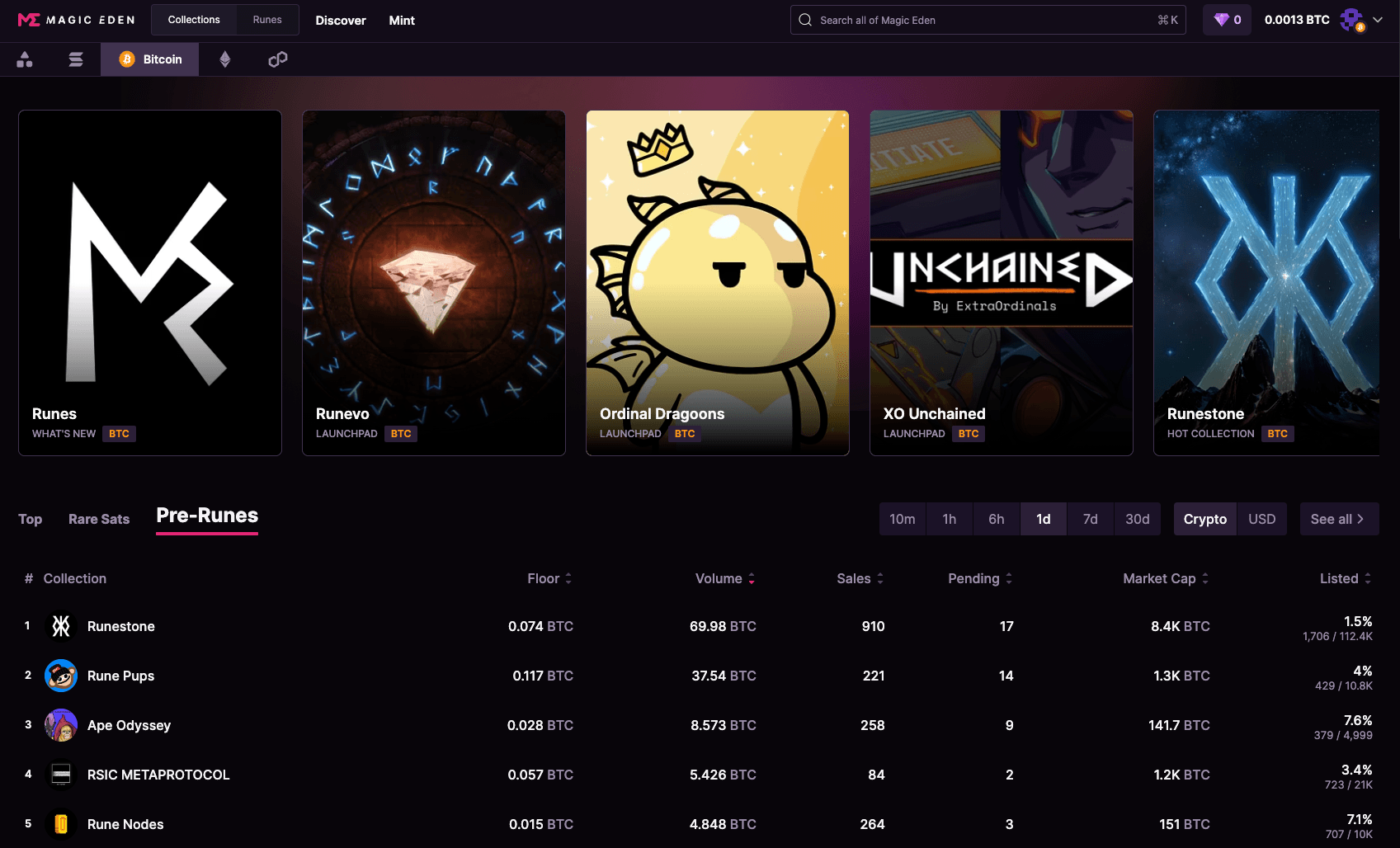
- Check out Pre-Runes, which are Ordinal collections that have said they'll be delivering Runes to holders. You can see these on Magic Eden's Pre-Runes tab, pictured below.
Final thoughts
Initially focused on the Solana NFT community, Magic Eden expanded support to Polygon NFTs in November 2022. Bitcoin and Ethereum were subsequently added as the third and fourth supported chains in March 2023.
While overtaken by Tensor and OpenSea as the top NFT marketplace by daily trading volume last year, Magic Eden currently holds the position of the first-largest marketplace for Bitcoin Ordinals NFTs, following OKX. The platform also accommodates BRC-20 tokens, an experimental standard for fungible tokens on the Bitcoin blockchain.
Magic Eden's early launch of the Runes platform marks a significant moment in the evolution of Bitcoin NFTs, promising increased accessibility and efficiency for users navigating the realm of digital assets. Magic Eden's ascent to the top spot underscores the evolving nature of the NFT market, characterized by fierce competition and shifting user preferences. With its focus on Ordinals and rapid user acquisition, Magic Eden is positioned to solidify its role as a key player in the burgeoning NFT and gaming ecosystems.
This article was inspired by an original blog post, you can read the original write-up here for more information.