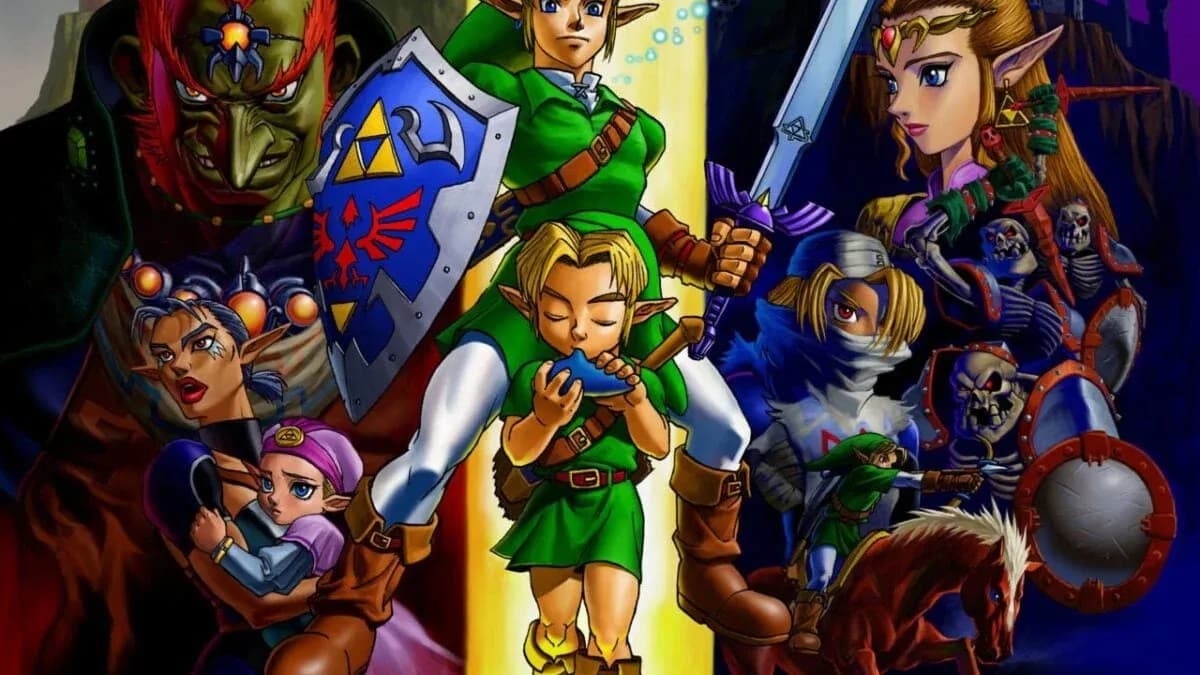

For almost 30 years, The Legend of Zelda: Ocarina of Time has held its place as one of the most celebrated games ever made. The 1998 N64 classic set the template for 3D adventure games, influenced an entire generation of designers, and still gets name-dropped by developers working on projects today. So when Nintendo confirmed a remake is in the works, the reaction was predictably enormous.
But here's the thing: the loudest conversation happening right now is not about Link's new character model, or the updated combat, or whether the dungeons will get a modern overhaul. It is about the weirdos.
Ocarina of Time is, at its core, a game absolutely packed with bizarre, unsettling, and genuinely strange characters. The kind of characters that only came out of a creative environment where nobody told the artists to pull back. Players who grew up with the game carry vivid memories of encounters that had nothing to do with Ganondorf or the Triforce, and everything to do with some inexplicable creature doing something inexplicable in a corner of Hyrule.
The fear, and it is a legitimate one, is that Nintendo's modern sensibilities will result in a cleaner, more polished product that loses exactly what made the original feel alive.
What players actually remember about Hyrule
Ask anyone who played Ocarina of Time what stuck with them, and the answers are rarely about the story beats. They remember the Happy Mask Salesman standing in his shop with that fixed grin, never fully explained across two games. They remember the Great Fairies, whose polygon-heavy designs were strange in a way that felt intentional rather than accidental. They remember Bongo Bongo, a boss with one of the darkest backstories in the entire Zelda series, who nonetheless spends his boss fight playing the arena floor like a drum set while his own name literally describes the sound.
That tension between the grim and the absurd is what gave Ocarina its texture. The Dead Hand, a pale mass of flesh covered in hands that grabs you from underground, sounds like pure horror. And it is, the first time. By the second encounter in the Shadow Temple, it has somehow become almost comedic. That shift is not a design flaw. It is a feature.
The concern is not that Nintendo will make a bad game. The concern is that Nintendo will make a very good, very polished game that happens to have filed down every rough edge that gave the original its personality.
The characters that define the risk
A few specific examples illustrate what is at stake.
The Great Fairy is perhaps the clearest test case. Her original design was angular, loud, and deliberately uncomfortable. She does not look like a fairy from a children's book. She looks like something that crawled out of a fever dream, and that is exactly why players remember her. A modern redesign that softens her into something conventionally appealing would technically be an improvement by most graphical standards, and a complete loss by every other measure.
Koume and Kotake, Ganondorf's twin guardian figures, operate in a similar space. Their dynamic is genuinely strange, their dialogue is strange, and their visual presentation is strange. They are the kind of characters that a focus group would probably flag as needing adjustment.
Then there is the entire population of Kakariko Village, which contains at least one NPC whose entire existence is to sit under a tree and complain about how disgusting everyone around him is. No quest attached. No reward. Just a weird little guy doing his thing.
Why this matters beyond nostalgia
This is not just fans being precious about childhood memories. The argument has real creative substance behind it.
The weirdness in Ocarina of Time was not accidental. It reflected a development culture at Nintendo in the late 1990s where individual artists had significant latitude to push characters into strange territory. The result was a game world that felt genuinely populated, where even minor NPCs had a distinct presence. That is harder to achieve in a large-scale modern production where visual consistency and broad audience appeal are constant pressures.
Remakes have a mixed record on this front. Some preserve the original spirit with care. Others produce something technically superior that somehow feels emptier. The difference often comes down to whether the team understood why the strange choices were made in the first place, not just what they looked like.
For players who want to revisit the original while they wait, check out our game reviews covering classic Zelda titles and modern remakes across the series. And if you want to go deeper on Hyrule's history before the remake lands, our gaming guides section has you covered.
Nintendo has not given a release window for the Ocarina of Time remake beyond confirming its existence. The next major reveal, whenever it comes, will tell players a lot about which direction the studio chose.