
Anyone who has played a match-3 puzzle, like the Candy Crush game pictured in Beata Dudová'sPexels photo, understands the thrill of a game board clearing itself. You make a move, candies vanish, new ones drop in, and sometimes the new arrivals line up without any help. Slot designers noticed that thrill and recreated it as a reel mechanic.
Let's explore how the falling-symbol, clear-and-refill loop from Candy Crush crossed into slots as tumbling reels, with Sweet Bonanza as an example.
Sweet Bonanza: Where the cascade lives now
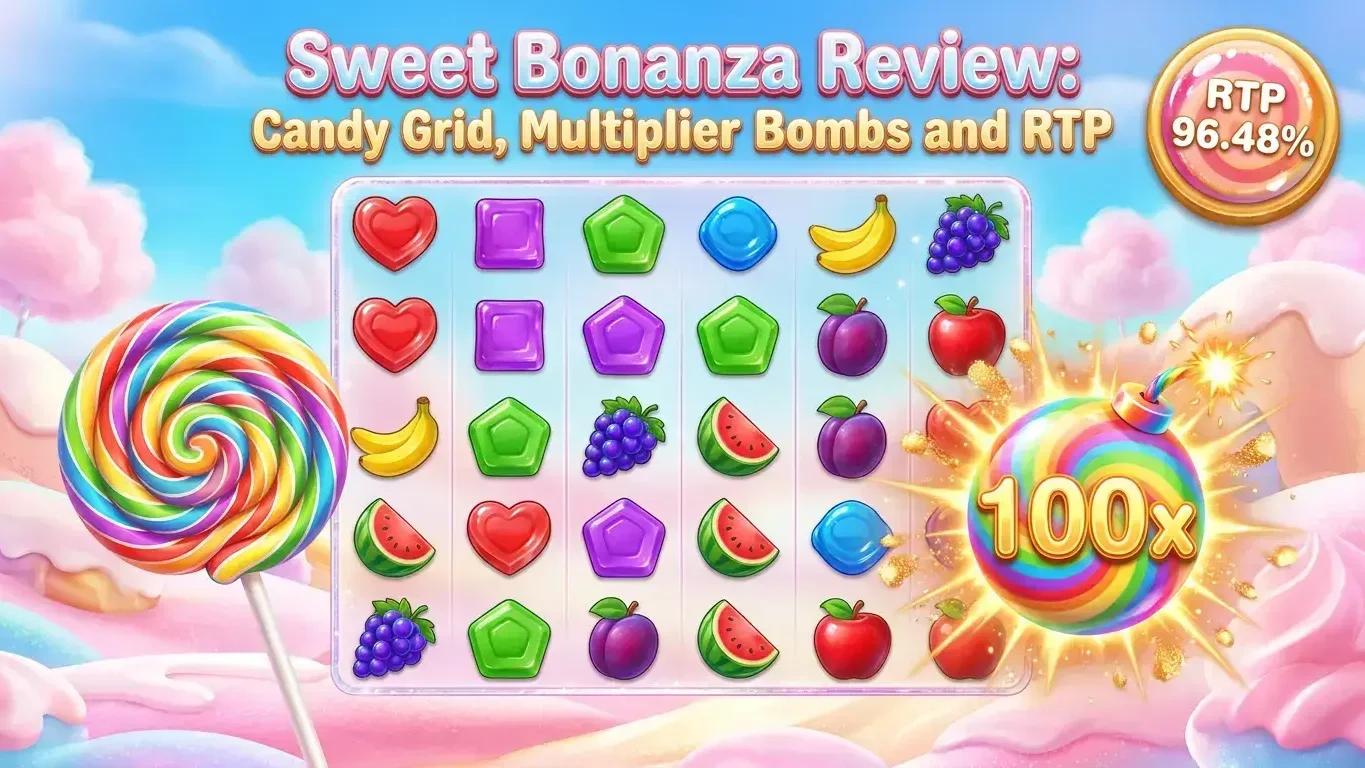
Pragmatic Play released Sweet Bonanza in 2019, and it remains one of the best-known tumbling pokies around. It swaps paylines for a 6x5 grid where eight or more matching symbols anywhere on screen count as a win.
For anyone browsing popular pokies in NZ lobbies, that candy-and-fruit grid is easy to spot, and Sweet Bonanza sits among SpinBet's most popular pokies. What makes it worth a closer look is not where you find it, but what it borrowed to get there.
Where match-3 and the cascade trick came from
Candy Crush Saga launched in 2012 from King, and its roots run straight back to Bejeweled. The concept came from Miner Speed, an early King title that borrowed gameplay elements from Bejeweled before the studio reskinned the idea in candy.
Our overview of Candy Crush Saga describes matches that eliminate candies and cause "new ones to cascade down and potentially trigger chain reactions". That clear-and-refill loop is foundational enough to open Game Developer's catalogue of match-3 mechanics, where the first entry is dropping: items move down when matches free up the space underneath them.
You'll notice that cascade is a design term before it is a slot term. Match-3 designers learned that a board refilling itself creates moments the player did not plan, and those moments feel like a bonus for a single swap.
King's catalogue is built around refining that cascading loop with boosters. It also tells us something about screen sizes. Candy Crush arrived when casual players had a phone in a pocket and a few minutes to spare. Its short, satisfying match-3 cascade suited the small screen. Slots followed the same small screen, and a mechanic that reads in a second travels well.
How Sweet Bonanza turns a spin into a chain reaction
In Candy Crush, matching candies disappear and make space for new ones to fall. Sweet Bonanza takes that idea into a slot game, but you don't swap sweets. When you spin, the reels fill with colourful symbols.
If you land eight or more matching symbols anywhere on the grid, those symbols vanish to make room for new ones. If the new symbols form another winning group, they disappear too. This cycle repeats until no further win lands. The rounds of clearing and refilling are called a tumble.
The familiar puzzle design comes from the way the board works. Sweet Bonanza uses a pay-anywhere system, so matching symbols don't need to line up on traditional paylines. Winning groups can form anywhere on the grid, and you can watch the whole board come alive.
During free spins, multiplier bombs can land on the grid and add a multiplier to the payout from a winning tumble. When several tumbles build on one another, the suspense comes from watching those multipliers accumulate.
| Design element | Match-3 puzzle | Sweet Bonanza |
|---|---|---|
| Input | Swap two adjacent pieces | Press spin |
| Match rule | Three or more in a line | Eight or more anywhere on the grid |
| Clear and refill | Matched pieces vanish, new ones fall | Winning symbols vanish, new ones fall |
| Chain reactions | Can be set up with planning | Shown in stages after the spin |
| Player agency | Skill shapes the cascade | None; the result is already decided |
| Boosters | Striped and wrapped candies | Multiplier bombs in the bonus round |
In a puzzle, you shape the board by matching items. Pokies, however, use RNG to determine the outcome, and the cascade simply reveals it in steps. The changing animation improves the visual effect, not the underlying result. A flashy chain says nothing about what the next spin will do.
Why designers keep the chain
A tumble in Sweet Bonanza stretches a spin into a short sequence. This keeps players watching for longer than a game with a single reveal. With every drop, players can feel the anticipation. Puzzle designers have long called this kind of constant visual feedback juice, and slot designers have borrowed it.
Pragmatic Play reused the same clear-and-refill logic in Sugar Rush 1000 and Gates of Olympus 1000. That shared design is part of why a player who enjoys one candy-coloured tumbler usually recognises the next one on sight. The grammar of the mechanic has become a genre of its own.
The design crossover from match-3 to cascade reveals four principles:
- A small input should trigger a larger visible response.
- Clear feedback keeps a chain readable at speed.
- A booster gives players something to anticipate.
- A familiar grid lowers the learning curve for newcomers.
Sweet Bonanza's adoption of the match-3 playbook is impressive
The candy theme, the falling pieces and the booster-style bombs all come straight from the puzzle playbook, while the rules underneath belong to a slot. Gamers who enjoy design will find plenty to admire in how neatly the loop crossed over. The pace and pageantry of the tumble are the main attraction.
For designers, the open question is how much of the puzzle feeling can cross over without borrowing its promise of control. The best tumbling slots keep the choreography and leave the control behind. That trade-off is the thing worth watching the next time a new tumbler turns up.