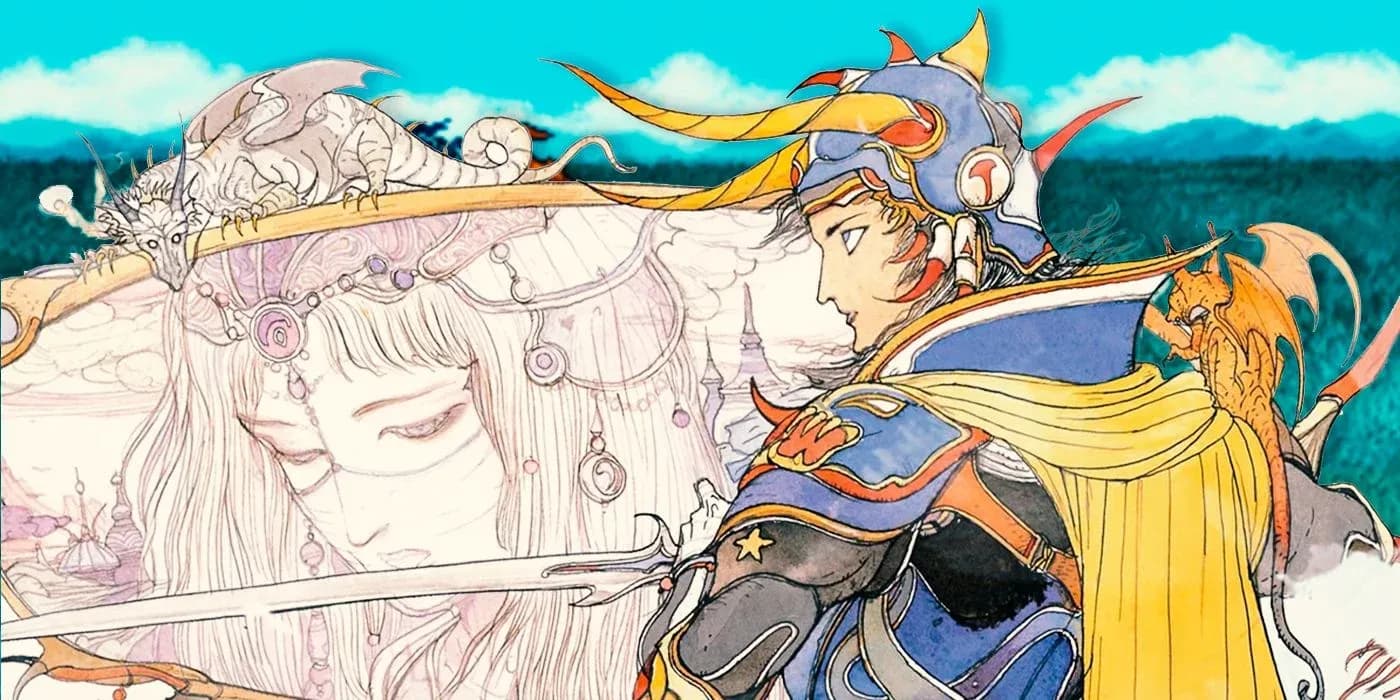

Yoshitaka Amano has spent decades defining what Final Fantasy looks like in the imagination. His work on Final Fantasy X and across the broader series gave the franchise its dreamlike visual identity, those weightless figures caught between elegance and violence. So when Amano speaks about where art is heading, it carries weight that goes well beyond nostalgia.
At Anime Expo this week, Amano sat down for a rare interview and delivered one of the clearest statements any major creative figure has made about AI and art: “AI cannot create zero to one.”
What "zero to one" actually means
Amano was not dismissing AI outright. He framed it as a tool, not a threat. "Only humans can create the original," he said through a translator. "Maybe AI can make zero and one in the future, like maybe 100 years." The distinction he is drawing matters: AI can iterate, combine, and accelerate, but the initial spark, the moment before anything exists, still belongs to people.
Here's the thing: that framing reframes the entire debate. Most conversations about AI and art get stuck on quality or speed. Amano is pointing at something else entirely, the origin of an idea. Generative tools work from existing material. They remix. The question of where the first mark comes from is one they cannot answer.
ZAN and the deliberate choice to draw by hand
Amano's comments came in the context of ZAN, his new animated project developed with a Los Angeles production office and a Japanese animation studio. Based on his 2013 illustrated novel Deva Zan, the project began as an art book, evolved into manga, and is now moving into animation. Amano described it as "completely original," giving him freedom he did not have on franchise work.
The production is largely hand-drawn, which is a meaningful choice in 2026 when digital workflows are faster and cheaper at scale. Amano acknowledged those realities but pushed back with a market observation: "There's a high demand for hand-drawn animation currently." Yoshitaka Amano Inc. CEO Hiroaki Ikegami confirmed that ZAN will be a limited miniseries, with a timeline of roughly two to three years before completion. That is consistent with how long serious hand-drawn productions take. Akira took approximately three years. Redline, with over 100,000 individual drawings, required seven.
Imperfection as proof of humanity
What most players miss when they think about Amano's art is how much the imperfections are the point. Asked about preserving the irregular quality of hand-drawn work, Amano said those imperfections are "part of what makes us human." They are not errors waiting to be corrected. They are evidence that a person was present.
That philosophy extends to how he thinks about younger audiences. Amano suggested that many viewers encountering traditional hand-drawn animation for the first time are not experiencing nostalgia. For them, it is genuinely new. "It is a new media for them," he said. That reframes the argument for hand-drawn work entirely. It is not a retreat to the past. For a generation raised on digital production, it can arrive as discovery.
Amano also reflected on adaptation, using Berserk as a reference point. His position was that every adaptation transforms its source. A story completed in one medium does not need to become another, but if it does, "the nature of the original manga, or the original concept, has to change in order to fit the new medium." Adaptation is transformation, not replication.
The creative process Amano actually uses
Perhaps the most telling detail from the interview was how Amano described his own creative habits. He does not closely follow what other artists are doing. His interpreter shared an anecdote about Amano spontaneously drawing on a napkin at dinner. Inspiration is not something he pursues. It arrives through constant creation.
He was equally direct about his intentions for ZAN. He does not want to teach audiences anything or push them toward any particular conclusion. He is "expressing" and "drawing art," leaving viewers to form their own responses. For a creator of his stature, that restraint is its own kind of statement.
The key here is that Amano is not positioning hand-drawn animation as a rejection of technology. He is arguing that some qualities, hesitation, texture, irregularity, the visible trace of a person making marks, are precisely what technology tends to eliminate. And those are the qualities worth defending.
For fans who grew up with his character work across the Final Fantasy series, the Final Fantasy X guides and broader gaming guides cover the games his art helped define, while ZAN represents where that same creative vision is heading next.