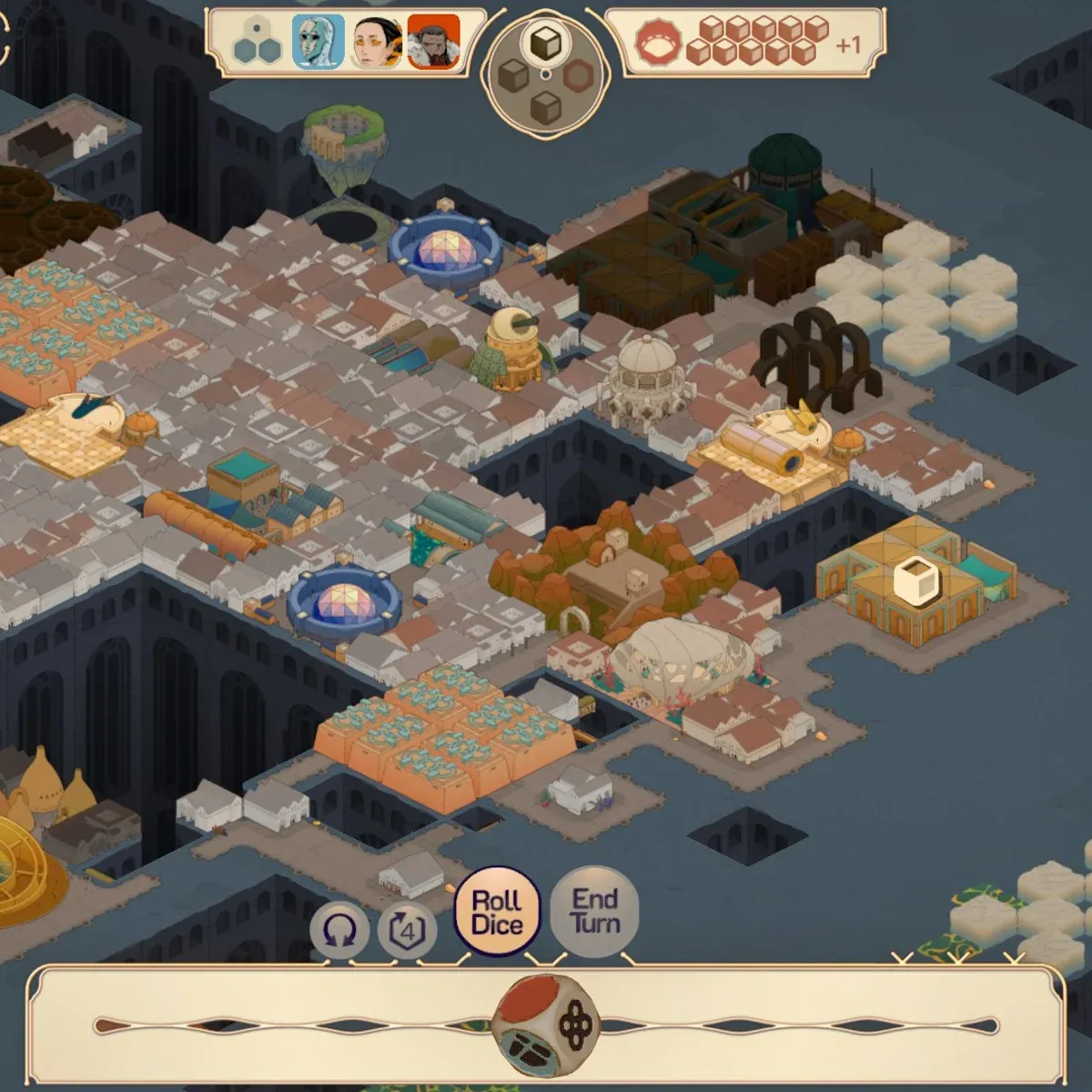


Most city builders let you play god with a clean conscience. Drop a road here, zone some residential there, watch the population tick upward. Amberspire is not that game. From the first turn, it makes clear that every expansion comes at a cost, and the dice sitting at the center of its systems are less a randomness mechanic and more a philosophical statement about how urban growth actually works: chaotic, contested, and almost never reversible.
The game draws on what its developers describe as "ecopoetics," a framework that treats the city not as a neutral grid to be optimized but as an organism with its own pressures and resistances. That framing sounds academic, but it plays out in ways that feel immediately tangible.
How the dice actually work
Here's the thing about Amberspire's dice system: it does not exist to punish you randomly. Each die roll represents competing stakeholder interests, environmental variables, and infrastructure stress factors that the game models in aggregate. Roll low on a development phase and your new district might sprawl inefficiently, eating into green corridors. Roll high and you get a clean build, but the surrounding neighborhoods absorb the density pressure instead.
The key here is that no outcome is purely good or bad. A high-density commercial zone that succeeds on the dice might spike your tax revenue by 30%, but it also accelerates what the game calls "thermal creep," a slow degradation of ambient conditions that compounds over roughly 15 to 20 turns. Players who ignore that meter in the early game tend to find themselves in a genuine crisis by mid-campaign, scrambling to retrofit parks and transit corridors into a city that was never designed to absorb them.
What most players miss on a first run is that the dice pool itself changes based on your prior decisions. Build heavy industry near a river and your environmental dice get weighted toward negative outcomes for the next several turns. Invest early in permeable infrastructure and you bank reroll tokens that can soften later crises. The system rewards thinking three turns ahead, not just the current phase.
The ecopoetics angle is more than window dressing
Amberspire sits in an interesting space for strategy fans. It shares mechanical DNA with games like Islanders and the heavier end of the city-builder genre, but its explicit ecological focus gives it a distinct identity. The game is not trying to simulate a real city. It is trying to model the logic of urban expansion, the way growth creates its own momentum and the way that momentum tends to outrun the planning that was supposed to contain it.
That makes it feel closer to a puzzle game at times than a traditional strategy title. Each map presents a specific configuration of terrain, existing settlements, and ecological zones that constrain your options in ways a blank grid never would. You are not building the city you want. You are negotiating with the city the map already implies.
For fans of adventure games and genre-bending strategy, that negotiation is where Amberspire earns its reputation. The tension between what you need to build and what the land can absorb without consequence is genuinely engaging across a full campaign.
Who this is actually for
Amberspire is not a relaxed city builder. There is no sandbox mode where consequences stay optional. The campaign structure is tight, the maps are designed with specific pressure points in mind, and the dice system means that even experienced players will hit runs where the math simply does not cooperate.
Players who bounced off Frostpunk for being too punishing might find Amberspire similarly demanding. But the game earns its difficulty honestly. Every bad outcome traces back to a decision you made, even if the connection is three turns deep and not immediately obvious. That clarity of causation is what separates a well-designed hard game from one that just feels unfair.
The comparison to Ember Sword is worth making in one specific sense: both games ask players to engage with systems that have long feedback loops, where the consequences of early choices only become visible much later. If you find that kind of deferred accountability satisfying rather than frustrating, Amberspire is built for you.
For a deeper breakdown of how its systems connect, our Ember Sword review offers useful context on how games with layered progression mechanics tend to reward patience over raw optimization. The structural parallels are real, even if the genres differ.
Amberspire is available now on PC. If the ecopoetics framing intrigues you, the first two maps function as a genuine tutorial for the dice logic before the campaign starts applying real pressure.