As web3 gaming continues to evolve, a growing concern is casting a shadow over its promise of fairness, ownership, and decentralized participation. Cheating—particularly through bots, macros, and other automation tools—is no longer just a fringe problem. It is becoming one of the most pressing challenges to the credibility and sustainability of blockchain-based games like MapleStory N, Pixels, and MIR4.
These games often feature play-to-earn elements or asset ownership models that tie in-game progress to real-world value. As a result, the incentive to cheat has shifted from competitive advantage to direct financial gain. This fundamental change introduces both new risks and new responsibilities, not just for developers, but for players as well.

Cheating in Web3 Games Threatens Sustainability
Growing Crisis in MapleStory N
Recent enforcement data from the MapleStory N team reveals that over 6,000 accounts were sanctioned in just one 24-hour period. The studio attributes these actions to a spike in hack and macro activity, which is now being addressed through layered detection systems and manual review. These include monitoring for mass logins, rapid character creation, and unusual trading behavior.
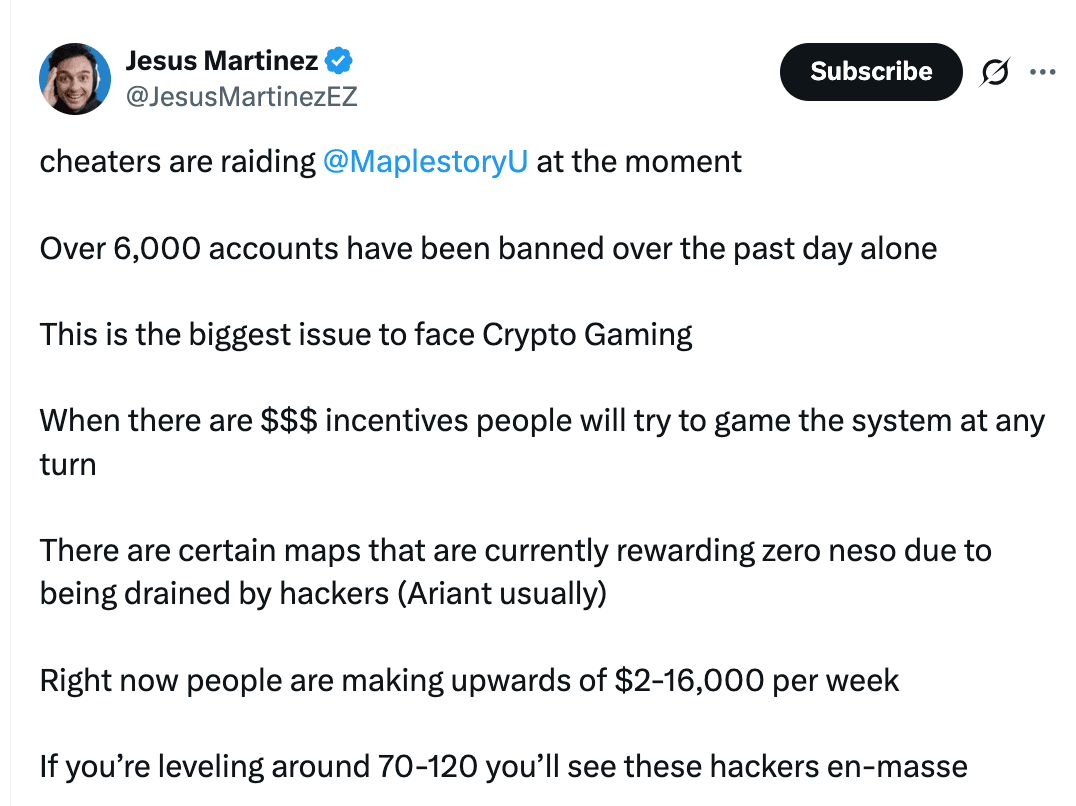
But the scale of the issue extends beyond what system logs can capture. Content creator Jesus Martinez recently commented on the state of the game, stating, “Cheaters are raiding MapleStory at the moment. Over 6,000 accounts have been banned over the past day alone. This is the biggest issue to face crypto gaming. When there are $$$ incentives people will try to game the system at any turn.”
He also pointed out that “there are certain maps that are currently rewarding zero Neso due to being drained by hackers (Ariant usually). Right now people are making upwards of $2,000 to $16,000 per week. If you’re leveling around 70–120 you’ll see these hackers en masse.”
This direct financial motivation is what separates cheating in web3 games from traditional gaming. When players can automate earnings in a system tied to cryptocurrency or digital tokens, it introduces a systemic vulnerability that damages both gameplay and the underlying economy.
Cheating in Web3 Games Threatens Sustainability
Real Consequences in Virtual Economies
The broader impact of these behaviors is felt most by legitimate players. As bots overrun maps, drain resources, and monopolize progression, real players are left with fewer opportunities, less meaningful achievements, and diminishing trust in the value of their time and effort. The situation has reached a point where some areas of the game yield little to no rewards for ordinary players simply because automated accounts have already extracted everything of value.
This issue has also become particularly relevant in Pixels, another web3 title that has seen rapid growth. As the game’s economy and player base have expanded, reports of botting have grown alongside it. Many community members have voiced frustration across social channels and forums, noting how automated accounts are inflating the market, crowding out legitimate gameplay loops, and skewing competition for on-chain rewards. This kind of activity creates tension within the community and can alienate players who are trying to engage fairly with the game’s systems.
This imbalance creates a feedback loop. As honest players leave or disengage, the proportion of exploitative accounts rises, further weakening community dynamics. Developers are forced to spend more time policing behavior instead of creating new content or features, while the reputation of the game—and blockchain gaming as a whole—suffers.

Cheating in Web3 Games Threatens Sustainability


Ethical Play and the Future of Web3 Gaming
The appeal of web3 games lies in their decentralized systems, player-owned economies, and the idea that time spent in these worlds has tangible value. But that promise depends entirely on fairness and trust. Once automation and cheating become normalized, those ideals begin to collapse. There’s no simple fix. Developers must continue to refine detection systems and issue timely sanctions, but they cannot do it alone.
Players also play a vital role in preserving the health of the ecosystem by reporting suspicious behavior, avoiding third-party tools, and upholding ethical standards of play. As the space matures, community norms will become just as important as technological solutions. A sustainable future for web3 gaming requires shared responsibility—between teams, creators, and players alike. Cheating doesn’t just break the rules of a game. In web3, it breaks the very system that gives games value in the first place.