

The 2025 InGameJob and Values Value Games Industry Employment Survey offers a detailed examination of compensation structures, workplace conditions, and professional trajectories throughout Europe. Running from March through June 2025, the research compiled responses from more than 1,650 industry professionals across 85 countries, establishing it as one of the year's most extensive industry analyses. Researchers split European participants into two groups: 709 respondents from EU nations plus the UK and Switzerland, and 543 from non-EU European territories. The participant pool ranged from entry-level positions through executive leadership, providing comprehensive visibility into pay scales, workplace satisfaction, and sector developments.
Use code TRYHARD33 at checkout to redeem this offer before code expires again.
Get 33% Off GAMES+ Subscription
Demographics and Professional Experience
The survey's gender breakdown showed 56% men, 25% women, and 19% who chose not to specify. Experience distribution revealed 8% junior professionals, 24% mid-level contributors, 35% senior personnel, and 29% in top management positions. While this spread captures multiple career stages, veteran employees constitute the larger share of participants.
Regional Compensation Differences
Pay structures across Europe reveal stark geographic contrasts. Within EU-aligned territories (including the UK and Switzerland), senior specialists command median gross compensation ranging from €43,500 for artists and designers up to €92,500 for executive management. Mid-tier professionals in these same markets earn median salaries around €41,000, with product and project managers leading compensation brackets. Non-EU European markets show dramatically lower figures—often approximately half the EU-aligned rates. This divide hits hardest in HR, recruitment, and marketing functions, while QA specialists consistently occupy the lowest pay tier at a median of €16,935 in non-EU regions. The progression gap between junior and senior compensation is tighter in EU-aligned nations compared to non-EU countries, where starting positions frequently pay under €1,000 monthly.
How Business Models and Content Types Affect Pay
Organizations focused on social platforms, streaming services, and web infrastructure report the highest median compensation, driven by major global tech corporations. Publishers and product-centric businesses maintain competitive pay structures, while marketing agencies and advertising technology firms lag behind. PC development shows comparatively modest salaries, likely reflecting the high concentration of independent studios in the sample. Genre also influences earnings. Hypercasual and midcore titles deliver the strongest compensation, whereas educational and children's content ranks lowest. Among genres, professionals working on fighting games, MMO, MMORPG, tower defense, and hidden-object projects typically earn the most, while AR developers receive the weakest pay.
Compensation Changes and Artificial Intelligence Integration
Over the past three years in EU, UK, and Swiss markets, senior marketing specialists and top management have seen the strongest salary increases. Developer compensation, particularly for Unity programmers, has contracted due to heightened competition and reduced job availability. Non-EU European salaries remain largely flat or declining, with mid-level professionals experiencing drops across most disciplines. Artists and QA professionals buck this trend in EU-aligned countries, where their median pay has risen. AI tool usage in daily workflows has doubled over two years, reaching 63% adoption in EU-aligned countries and 69% in non-EU territories. Analysts, HR personnel, recruiters, and executives use these tools most frequently, while artists and QA specialists adopt them less often. AI integration is reshaping productivity standards and expectations, particularly in web3-related projects, with specialists in AI-adjacent roles currently experiencing salary growth.
Compensation Satisfaction and Workplace Conditions
Pay satisfaction dropped universally in 2025. Junior artists alongside mid-level and senior QA specialists express the lowest satisfaction with their compensation, while junior and mid-level programmers and marketers in EU-aligned countries report higher contentment. Gender pay disparities persist, especially at senior levels and in project management, though women out-earn men in specific marketing, business development, sales, and QA positions. Differences in salary expectations partially account for these variations. Paid sick leave and annual bonuses represent the most prevalent benefits, though under half of respondents receive paid leave. Profit-sharing arrangements, stock options, royalties, and performance bonuses strengthen employee loyalty, which declined overall in 2025. Hybrid work arrangements correlate with higher loyalty, while fully office-based positions show weaker commitment. Remote work has become the dominant arrangement, especially outside the EU, though many professionals prefer hybrid setups.
Employment Transitions and Talent Movement
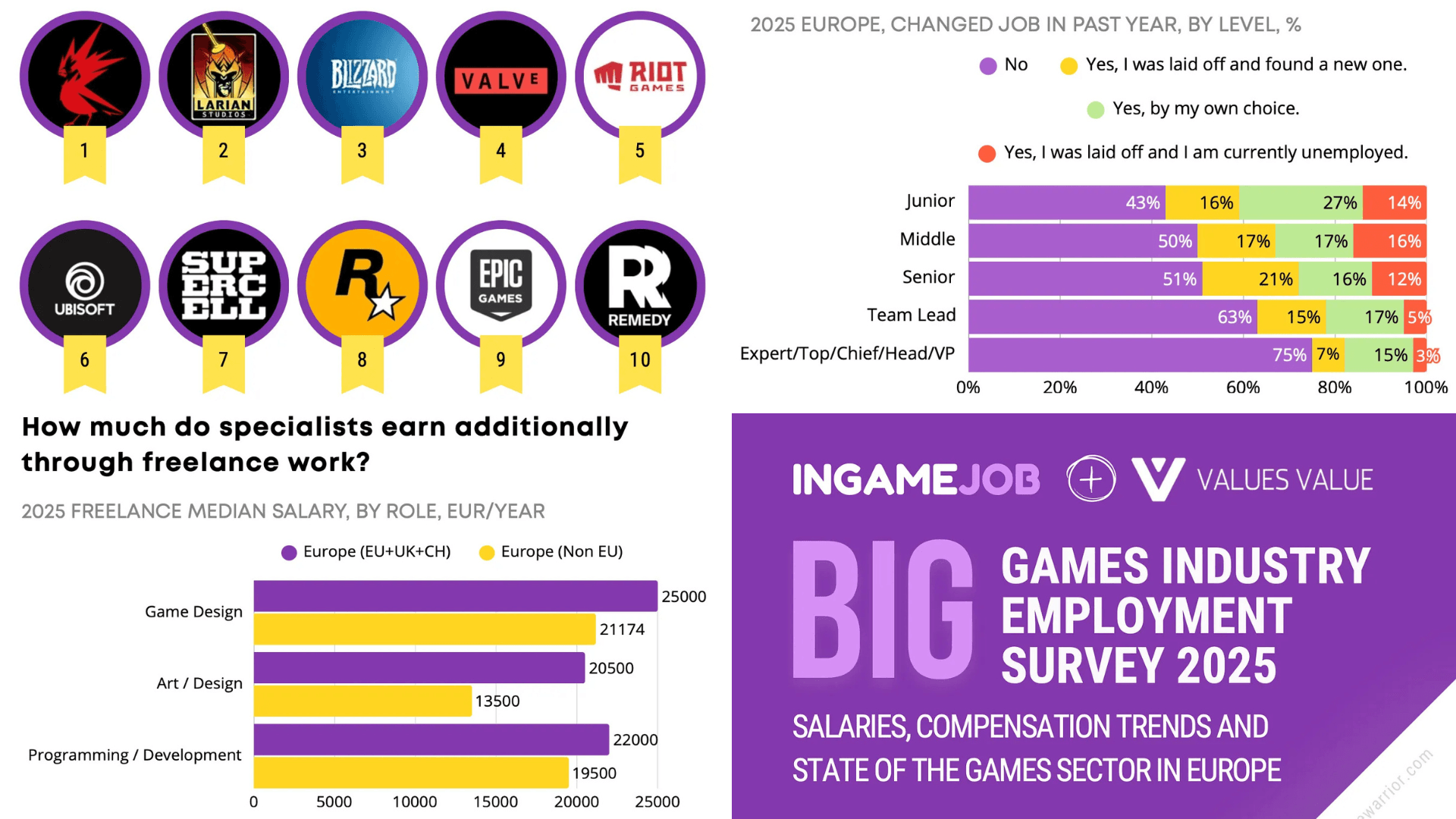
Voluntary job transitions fell to 17.5% in 2025 from 23.2% the prior year. Layoffs impacted over 10% of participants, and mobility decreases with seniority. HR and recruitment professionals change roles most actively, while artists, designers, and project or product managers face layoffs most frequently. Compensation remains the primary driver for changing employers, with company mission or social impact ranking as secondary considerations. Job searches can extend up to a year, with junior specialists encountering the greatest obstacles—nearly 38% of junior employees exit the industry after unsuccessful position searches.
Independent Work and Additional Income
Freelance engagements and supplementary projects are prevalent, particularly among artists and developers. Median earnings from side work span from €13,500 for artists in non-EU countries to €25,000 for designers in EU-aligned markets. Senior-level employees more commonly maintain side projects, while top managers concentrate on primary responsibilities due to bonus structures and royalty arrangements.
Work Hours, Wellness, and Skill Development
Extended hours are commonplace, with nearly one-third of respondents working overtime weekly, while 46% report occasional extra hours. Managers and top management face the heaviest overtime burden, followed by mid-level specialists. Professional burnout, ineffective leadership, and team conflicts emerge as primary workplace concerns. Professional development remains limited—55% received no training over the past year, and many smaller organizations lack structured advancement programs.
Employer Preferences and Future Outlook
Respondents express strongest preference for employers like CD Projekt RED, Larian Studios, and Blizzard Entertainment. Many professionals aspire to work on large-scale RPGs, even when their current positions don't align with these preferences. Anxiety about future stability intensified in 2025, particularly among support personnel, PR professionals, community managers, and audio specialists, while higher-ranking employees demonstrate greater confidence in industry prospects.
Frequently Asked Questions (FAQs)
What is the average salary in the European games industry?
Salaries vary widely by region and role. In EU-aligned countries, senior specialists earn between €43,500 and €92,500, while non-EU countries report lower median salaries, often around half that range.
Which game genres offer the highest salaries?
Employees working in hypercasual, midcore, fighting games, MMOs, MMORPGs, tower defense, and hidden-object titles generally earn the highest salaries, while educational and children's games and AR development offer lower pay.
How is AI affecting the games industry?
AI adoption has doubled in recent years, with analysts, HR, recruiters, and top managers using AI most frequently. AI tools are influencing productivity expectations and salary trends, particularly in web3 and development roles.
What are the most common employee benefits?
Paid sick leave and annual bonuses are most common, along with health insurance, sports programs, corporate events, and occasional office perks. Profit-sharing, stock options, and performance bonuses increase loyalty.
Are women paid less than men in the games industry?
Yes, a gender pay gap persists, especially in top management and project management roles. However, women earn more than men in some marketing, sales, business development, and QA positions.
Which companies are most desired by professionals?
CD Projekt RED, Larian Studios, and Blizzard Entertainment are the top preferred employers, with many employees aiming to work on large-scale RPGs.
How has job mobility changed in 2025?
Voluntary job changes decreased to 17.5%, with layoffs affecting over 10% of employees. Junior specialists face the longest job searches, and many leave the industry if unable to find better positions.