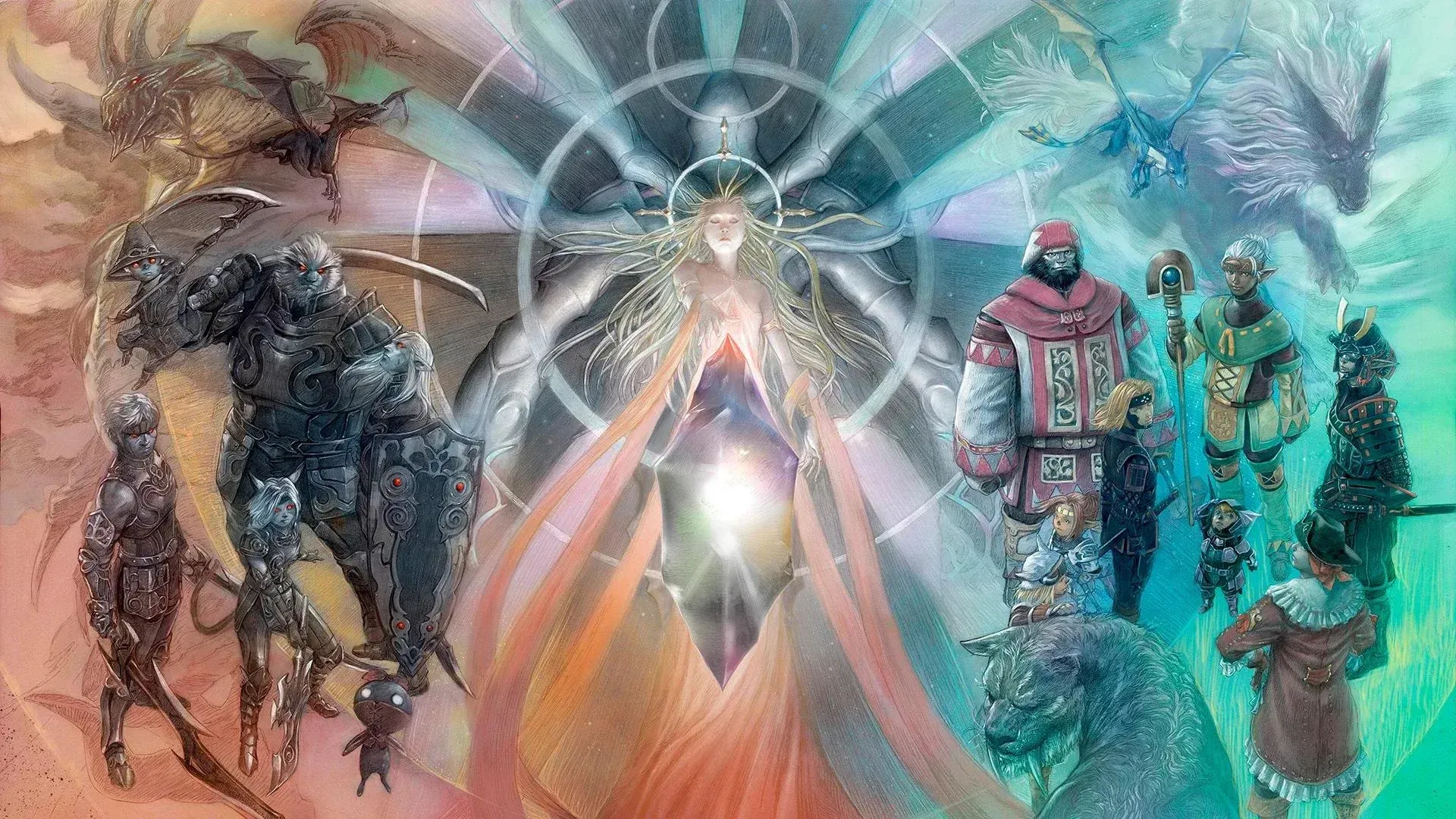


24 years old, still running, and possibly getting a new expansion. Most MMOs don't survive a decade, let alone two. Final Fantasy XI is built different, and the gaming community is finally talking about it again.
For players who live in Final Fantasy XIV Online, Square Enix's current MMO juggernaut, it's easy to forget that XIV wasn't the franchise's first shot at the genre. XI got there first, launching back in 2002, and it did things that still feel bold by today's standards.
The job system that XIV still hasn't fully matched
Here's the thing: Final Fantasy XI's job system is one of the most elegant class designs in MMO history. You don't roll a new character every time you want to try a different playstyle. You just switch jobs, level it up, and keep going. All 22 jobs are accessible on a single character.
That flexibility goes even further once you hit a certain level threshold. At that point, you can equip a secondary job and pull abilities from it to augment your main role. A Dark Knight borrowing healing spells from White Mage. A Ninja supplementing utility from Ranger. The theory-crafting depth that opens up is genuinely impressive for a game from 2002.
Final Fantasy XIV iterated on this concept with its own job system, but XI's execution of the sub-job mechanic still has no real equivalent in modern MMOs. What most players miss is how much that single design decision shaped the entire social fabric of the game. Because builds mattered so much, players actually talked to each other about them.
Built for cooperation before cooperation was cool
Final Fantasy XI was designed from the ground up around group play. Solo progression wasn't just difficult, it was practically impossible for most of the game's early years. Every significant piece of content assumed you had a party, and that assumption pushed players into genuine social interaction at a time when most MMOs were already starting to trend toward solo-friendly design.
The result was a community that formed deep bonds out of necessity. Linkshells (XI's version of guilds) weren't just a feature, they were survival infrastructure. You knew your party members by name because you'd spent hours grinding the same camp with them.
Square Enix has since added Trust NPCs, AI-controlled party members that let solo players clear content that once required six real people. It's a practical concession to a smaller playerbase, and it works. But it does change the texture of the experience in ways that are hard to ignore.
Why the slow pace was actually the point
Modern MMOs are terrified of your time. Every system is optimized to minimize friction, deliver rewards faster, and keep you from bouncing to a competitor. Final Fantasy XI operated on entirely different logic.
Travel took real time. Quest chains sent you back and forth across zones repeatedly. Trading items with another player required more button presses than felt reasonable. None of this was accidental. The friction was the design. Slowing players down forced them to inhabit the world of Vana'diel rather than sprint through it.
That pacing still holds a strange appeal today, precisely because it's so rare. There's a reason players who return to XI after years away describe it as settling back into something, rather than picking up where they left off.
The shadow it cast on Final Fantasy XIV
Final Fantasy XIV's complete reinvention as A Realm Reborn is well documented, but the DNA of XI runs through it more than most players realize. The job-switching system, the emphasis on story-driven content, the tight community identity, all of it traces back to ideas that XI proved could work.
XIV has since evolved into something far more accessible, and Patch 7.4 pushed that evolution further with content overhauls across raids, dungeons, and systems. You can get the full breakdown in the FFXIV Patch 7.4 Into the Mist complete content guide if you want to see how far the franchise has come.
But accessibility has a cost. The version of Final Fantasy that made you earn every level, coordinate with strangers, and navigate a world that didn't hold your hand? That was XI. And the fact that it's still running, still updating, and still attracting returning players 24 years later says more about its design than any retrospective can.
What a potential new expansion would mean
The idea that Final Fantasy XI could receive a new expansion in 2026 is not something anyone would have predicted five years ago. The game's player numbers were expected to drop sharply after its crossover campaign with Final Fantasy XIV ended. They didn't.
That retention is the story here. A player base that was supposed to move on chose to stay. Square Enix noticed. Whatever comes next for Vana'diel, the fact that it's even a conversation is a direct result of a community that refused to let the game fade out quietly.
For players curious about where the Final Fantasy MMO franchise stands right now, the Final Fantasy XIV Online guides collection covers everything from current patch content to endgame systems, and it's worth bookmarking as XIV's own roadmap continues to develop through the rest of the year.