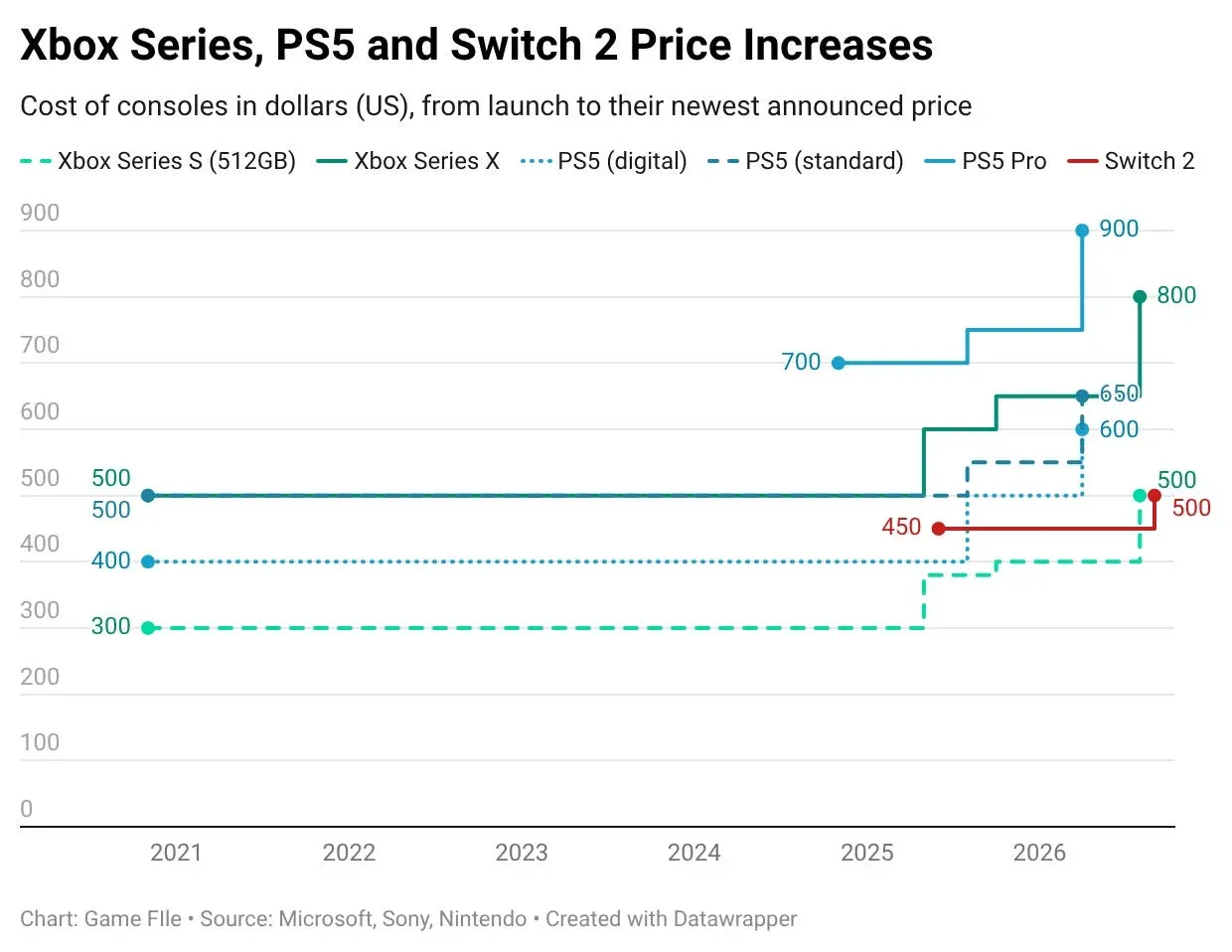


The price hikes didn't happen overnight. First, the PS5 launched at $499 back in late 2020. Then memory costs started climbing. Xbox Series X got a price bump. Then another one. The Nintendo Switch 2 followed suit. Valve's Steam Machine arrived at a jaw-dropping $1,049 or more, with Valve engineers openly admitting the device could have cost around $300 less if global RAM shortages weren't hammering component costs. Now, electronics giant Lenovo has put a rough timeline on when any of this might ease up, and the answer is not encouraging.

Use code TRYHARD33 at checkout to redeem this offer before code expires again.
Get 33% Off GAMES+ Subscription
What Lenovo actually said at ISC 2026
At the ISC 2026 conference, Lenovo executive director Martin Hiegl told attendees that the current state of DRAM and NAND pricing should be treated as a new baseline, not a temporary spike. The core of his argument: yes, DRAM manufacturers are expanding production capacity, but that expanded output is not going to translate into lower prices at the consumer level. At least not anytime soon.
Hiegl's position is that inflated memory prices will remain the new normal until at least 2030. That's four more years of every hardware manufacturer, from console makers to PC builders, paying elevated rates for the components that sit inside every piece of gaming hardware you want to buy.
The console price domino effect players are already living through
Here's the thing: this isn't abstract industry talk. Gamers are already absorbing these costs directly. Microsoft announced yet another Xbox Series X|S price increase, with the company stating that storage and memory prices have risen by more than 2.5x, with another doubling expected by fall 2027. The Xbox Series X now sits at $600 for the 512GB model, up $100 from its previous price.
Sony raised PS5 prices earlier this year, citing broad global economic conditions. A PS5 Pro now pushes close to $900. The Nintendo Switch 2 is also getting more expensive across multiple regions.
Valve has been unusually transparent about the situation. The company has publicly stated it cannot effectively negotiate with RAM suppliers because the leverage simply isn't there. Their exact framing was blunt: if they say no to pricing, suppliers stop talking to them entirely. The Steam Machine's $1,049+ price tag is the direct result.
Why AI demand is making this worse for gamers
The memory shortage isn't just a gaming problem, which is exactly why gaming can't solve it. AI infrastructure buildouts are consuming DRAM and NAND at a scale that dwarfs consumer electronics demand. Data centers need massive quantities of high-bandwidth memory, and manufacturers are prioritizing those contracts. Console makers and PC component suppliers are competing for whatever's left.
Micron's CEO has separately indicated that RAM shortages are unlikely to ease before 2028, which aligns closely with Lenovo's 2030 outlook for price normalization. The gap between those two dates, 2028 for supply stabilization and 2030 for prices to settle, suggests that even when supply improves, manufacturers won't rush to pass savings on to buyers.
What most players miss is that this affects the entire chain. It's not just the console you buy. Games running on hardware-intensive engines need more memory headroom, which pushes recommended PC specs higher. If you're checking Control Resonant PC system requirements ahead of its September launch, you'll notice how quickly minimum specs have crept upward compared to titles from just two years ago.
What this actually means for your next hardware purchase
The practical read here is straightforward. If you're waiting for a price drop before buying a PS5, Xbox Series X, or Steam Machine, that drop is not coming before 2030. The best-case scenario is that prices plateau rather than continue climbing, but even that depends on whether AI infrastructure demand stabilizes.
For players planning builds or upgrades, the spec requirements on upcoming titles are worth tracking closely. Performance optimization guides like Nova Roma best settings for PC and PS5 are going to matter more when squeezing performance out of hardware you can't afford to replace.
The broader picture for gaming hardware is that the $500 console generation is over. The question now is whether $600 to $700 becomes the new floor, or whether prices keep moving upward as the next console generation arrives into the same constrained memory market. For a full breakdown of what's coming and what to budget for, the gaming guides hub has ongoing coverage of specs and hardware requirements across major upcoming releases.