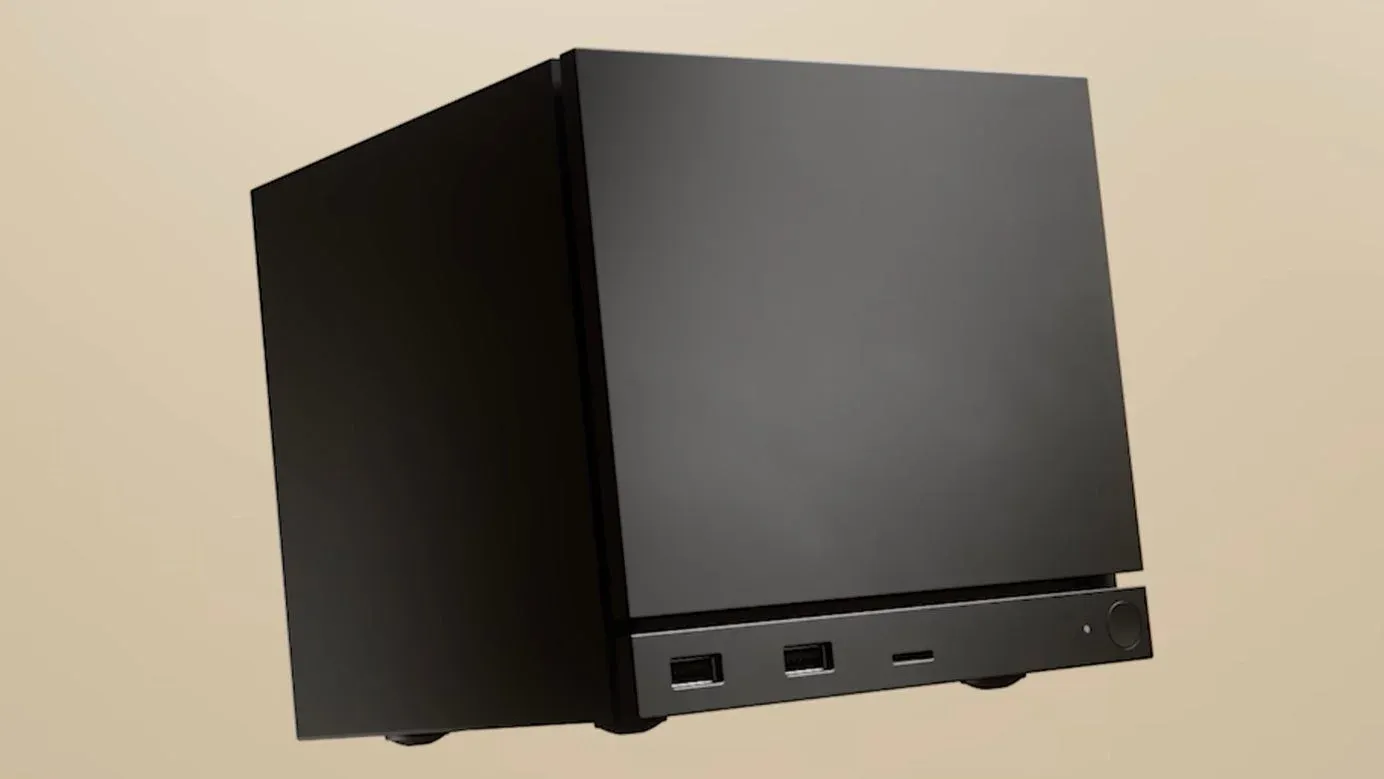


"North of a grand is the floor." That blunt assessment from Aldora CEO Joost van Dreunen is now rattling around the gaming industry after Valve confirmed pricing for the Steam Machine this week: $1,049 for the 500GB model and $1,349 for the 2TB version. Valve itself admitted the price is "significantly more" than it wanted to charge, citing component costs secured over the past 6 months as the reason.
The Steam Machine's pricing has become a flashpoint for a bigger question. If a compact PC-for-TV device from Valve costs four digits, what does that mean for the PlayStation 6 and Xbox Project Helix?

Use code TRYHARD33 at checkout to redeem this offer before code expires again.
Get 33% Off GAMES+ Subscription
What the Steam Machine price actually signals
The component cost problem is not a Valve-specific issue. Sony, Microsoft, and Nintendo have all already pushed through price increases on current-gen hardware. The PS5 Pro sits at $899 after two hikes inside a year, and the distance between that and $1,000 is short enough that analysts are treating it as a near-certainty for premium next-gen tiers.
Van Dreunen put it plainly: "At this rate, the next generation may not even release until 2028, and when it does, north of a grand is the floor. Even existing devices are getting marked up." He pointed to memory manufacturers Samsung, SK Hynix, and Micron having shifted to what he calls a "post-consumer" posture, meaning gaming hardware is no longer their priority customer segment, and prices reflect that.
Xbox CEO Asha Sharma has already said publicly that Project Helix will need new business models and hardware partners just to ship, and that storage and memory costs could be five times higher by holiday 2027 compared to 2024 levels. That's not a small number.
Where analysts actually disagree
Not everyone is ready to call $1,000 a certainty for base console models. Circana senior director Mat Piscatella told industry press he thinks four-digit pricing is possible, even likely, but stopped short of treating it as a done deal. "Given the chaos in the world of components, the future here is beyond cloudy," he said.
Newzoo market intelligence director Manu Rosier offered the most specific take. He believes Sony and Microsoft will try to hold at least one base SKU under $999, even if only for the psychological effect of staying in three-digit territory. "Base next-generation models are likely to hold under $999 for psychological and marketing reasons," he said, while acknowledging that premium tiers are a separate conversation entirely.
Here's the thing though: $999 is still $999. That's a 43% jump over the PS5's original $699 Pro launch price, and a massive ask for a base console.
Why Sony and Microsoft have more room to maneuver than Valve
Ampere Analysis head of games research Piers Harding-Rolls made the case that Sony and Microsoft aren't in the same position as Valve. The key difference is scale and supply chain relationships. Valve needs to turn a profit on every Steam Machine unit sold. Sony and Microsoft have decades of entrenched manufacturer relationships and broader electronics businesses that give them more flexibility on hardware margins.
"Next-gen consoles will likely be more expensive, but they have different levers that can be pulled to offset hardware costs," Harding-Rolls explained. He also flagged that component inventories may stabilize closer to a late 2028 launch window, which is now looking like the most realistic timeline for both platforms.
The PS5 Pro's current $899 price tag makes the $1,000 conversation feel less abstract than it did even a year ago. For context, the original PS5 launched at $499 in 2020. The trajectory over one console generation is stark.
What this means for players planning ahead
The honest read here is that next-gen console pricing is heading somewhere uncomfortable regardless of whether it clears $1,000. Even a $799 base PS6 would be a record launch price for a Sony console. The debate over whether it hits $999 or $1,049 is almost secondary to the fact that the floor has risen significantly.
For players thinking about what to budget for next-gen, the current PS5 exclusive feature set gives a useful benchmark for what Sony's hardware investment actually delivers. Check out our breakdown of GTA 6 PS5 exclusive features to see how Sony's current hardware is being pushed, and what next-gen will need to surpass.
Pre-orders for Grand Theft Auto VI are now open, you can pre-order here.
The analyst consensus points to a late 2028 window for both PS6 and Project Helix. That gives Sony and Microsoft roughly two years to watch how consumers respond to the Steam Machine's price point, negotiate with component suppliers, and figure out whether a sub-$1,000 launch is actually achievable. Whether they can pull it off depends almost entirely on factors none of them fully control. For more context on how publishers are already pricing premium gaming content, the GTA 6 Ultimate Edition breakdown is worth a read alongside our broader gaming guides covering next-gen hardware and releases.