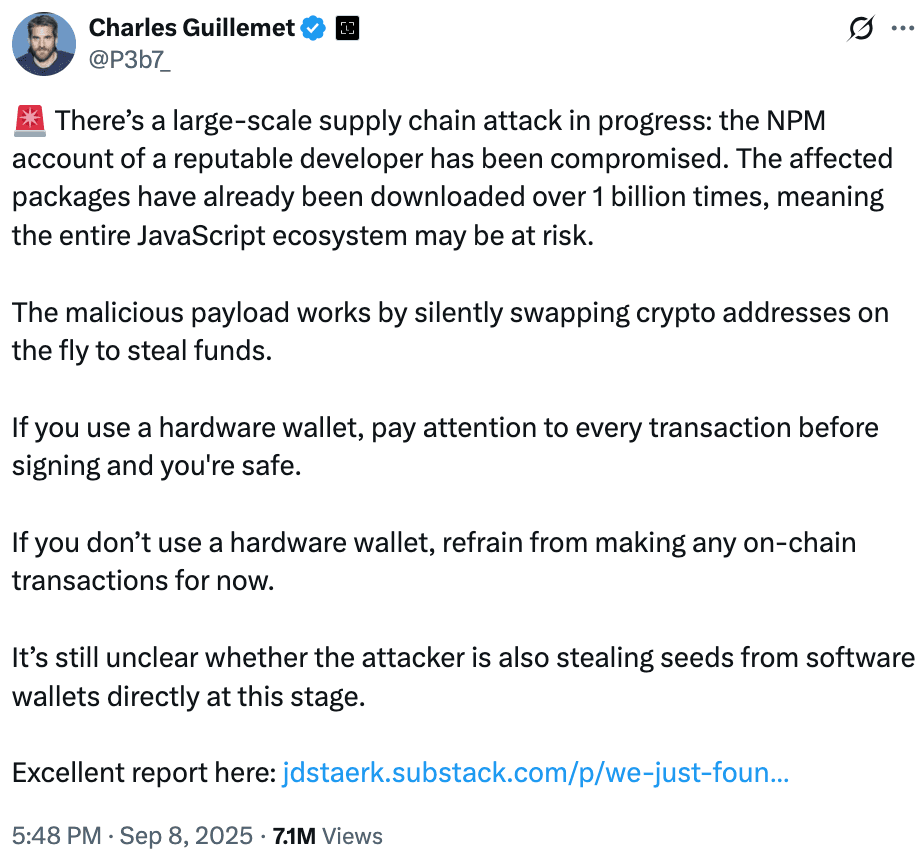
On September 8, a major software supply chain attack hit the NPM ecosystem, compromising several widely used JavaScript libraries. The breach first surfaced when Charles Guillemet, Chief Technology Officer of Ledger, warned that a trusted developer's Node Package Manager account had been hijacked. Initial estimates put exposure at over one billion downloads, but further analysis revealed the compromised packages actually represent more than 2.6 billion weekly downloads.

Supply Chain Attack Exposes Over 2 Billion
Supply Chain Attack Exposes Over 2 Billion
The attack targeted the account of a developer known as "qix," who maintains several popular JavaScript libraries including chalk, strip-ansi, color-convert, and debug. These libraries appear in countless projects spanning both server-side and front-end environments. Attackers gained access through a fake support email and pushed malicious updates to roughly 18 packages. Automated dependency installs allowed the malware to spread rapidly within hours.
Guillemet explained that the malicious code silently replaced cryptocurrency wallet addresses during transactions. Users relying on software wallets faced the risk of losing funds if they approved transactions without noticing the altered recipient address.
Malware Crypto Clipper and MetaMask
Security researchers classified the malware as a "crypto clipper." It replaces wallet addresses at various stages of a transaction. When no wallet is detected, the malware modifies outgoing data within decentralized applications by hooking into browser functions like fetch and XMLHttpRequest, scanning and altering addresses within application data.
If a wallet extension like MetaMask is present, the malware intercepts the transaction before signing. It modifies the wallet address in memory so the fraudulent address appears when the user reviews the transaction. The malware uses the Levenshtein algorithm to generate addresses that closely resemble the original, making alterations harder to spot.
Supply Chain Attack Exposes Over 2 Billion
First Signs of the Attack
Developers first noticed the attack when build systems returned an unexpected error message. Inspection of a dependency called error-ex revealed obfuscated code containing a suspicious function named checkethereumw, indicating Ethereum wallet targeting. Analysts confirmed the malware contained references to wallet addresses across several blockchains, including Bitcoin, Ethereum, Solana, Tron, Litecoin, and Bitcoin Cash.
The affected packages include some of the most widely used in the JavaScript ecosystem. Chalk receives more than 300 million weekly downloads, debug more than 350 million, and strip-ansi more than 260 million. Combined, the compromised libraries see more than 2.6 billion downloads each week, showing the scale of impact across the developer community.
Hardware vs Software Wallets
Many of the infected libraries aren't directly linked to cryptocurrency projects, but their integration into dependency chains means even unrelated applications may have been exposed. Projects that interact with cryptocurrency wallets and decentralized applications face the highest level of risk.
Guillemet noted that users of hardware wallets with clear-signing features remain safe because these devices allow verification of every transaction before approval. Software wallet users face greater exposure and should exercise extreme caution until dependencies have been fully reviewed and secured.
Finding the Attacker and Funds Stolen
The attacker's cryptocurrency addresses have been identified and are being actively monitored through public blockchain transparency. A primary Ethereum address linked to the operation is 0xFc4a4858bafef54D1b1d7697bfb5c52F4c166976, along with several backup addresses. At the time of reporting, the stolen funds had not been moved. This monitoring enables ongoing analysis, though the full scope of stolen assets remains unclear.

Supply Chain Attack Exposes Over 2 Billion
JavaScript and Community Role
The JavaScript and web3 communities moved quickly to contain the incident. Malicious versions of the compromised packages have largely been removed from the registry, but risks remain for projects that may still rely on outdated versions within their lockfiles. Developers are being urged to audit their dependencies, lock safe versions, and reinstall clean builds to prevent further exposure.
Security professionals recommend that developers rotate credentials, enforce two-factor authentication on accounts like NPM and GitHub, and use deterministic installation methods like npm ci to maintain strict version control. Users should carefully verify all cryptocurrency transactions, particularly when relying on software wallets.
Final Thoughts
This incident ranks as one of the most extensive breaches to hit the NPM ecosystem. While the community response was relatively swift, the attack exposes the fragility of modern software supply chains and the risks created by widespread reliance on open-source components.
As Guillemet emphasized, reviewing every transaction before signing remains essential. The breach demonstrates that even small libraries embedded deep within application infrastructure can become significant attack vectors when compromised. For developers and users alike, ongoing vigilance is now a critical part of maintaining security in the web3 and software development ecosystems.