
Media consumption across digital platforms follows predictable patterns driven by power laws, where a small fraction of content captures the majority of attention while most releases struggle to find an audience. These dynamics shape how games, streaming content, and other media perform in an increasingly crowded marketplace.
Popularity on platforms like Steam and Twitch tends to be self-reinforcing. When a game gains traction, players interpret its success as a signal of quality or cultural relevance, which drives further engagement. This creates a characteristic distribution: a handful of blockbuster hits dominate the top, a narrow band of moderate performers occupies the middle, and a vast number of titles receive minimal attention in the long tail.
Understanding Power Laws in Gaming
How Platforms Amplify Popularity
Network effects at the platform level contribute substantially to these outcomes. Once a platform establishes momentum, early successes get amplified through visibility mechanics and algorithmic recommendations. Looking at Steam's top 1,000 titles ranked by concurrent players reveals that the most-played games command a massively disproportionate share of player attention.
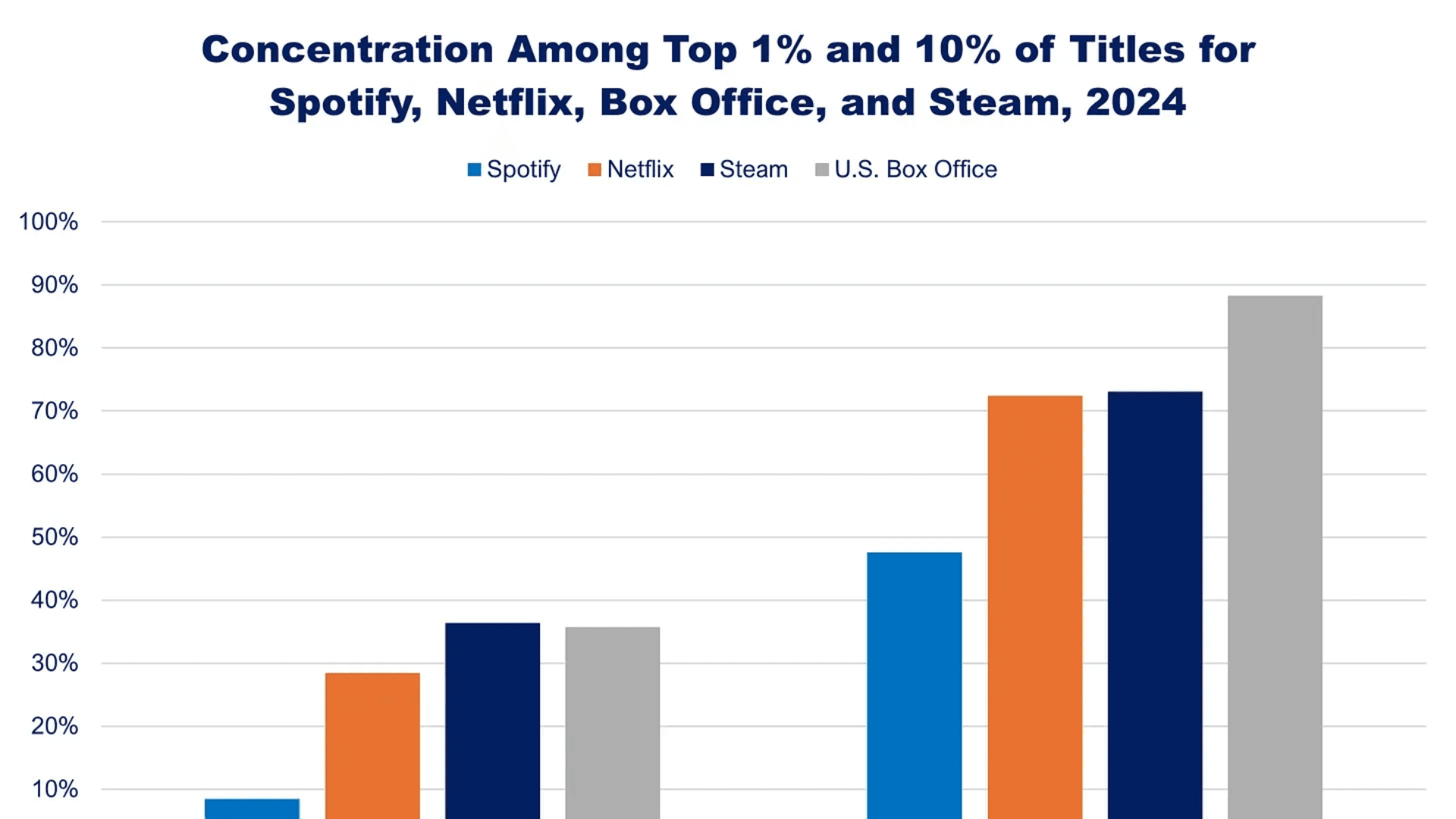
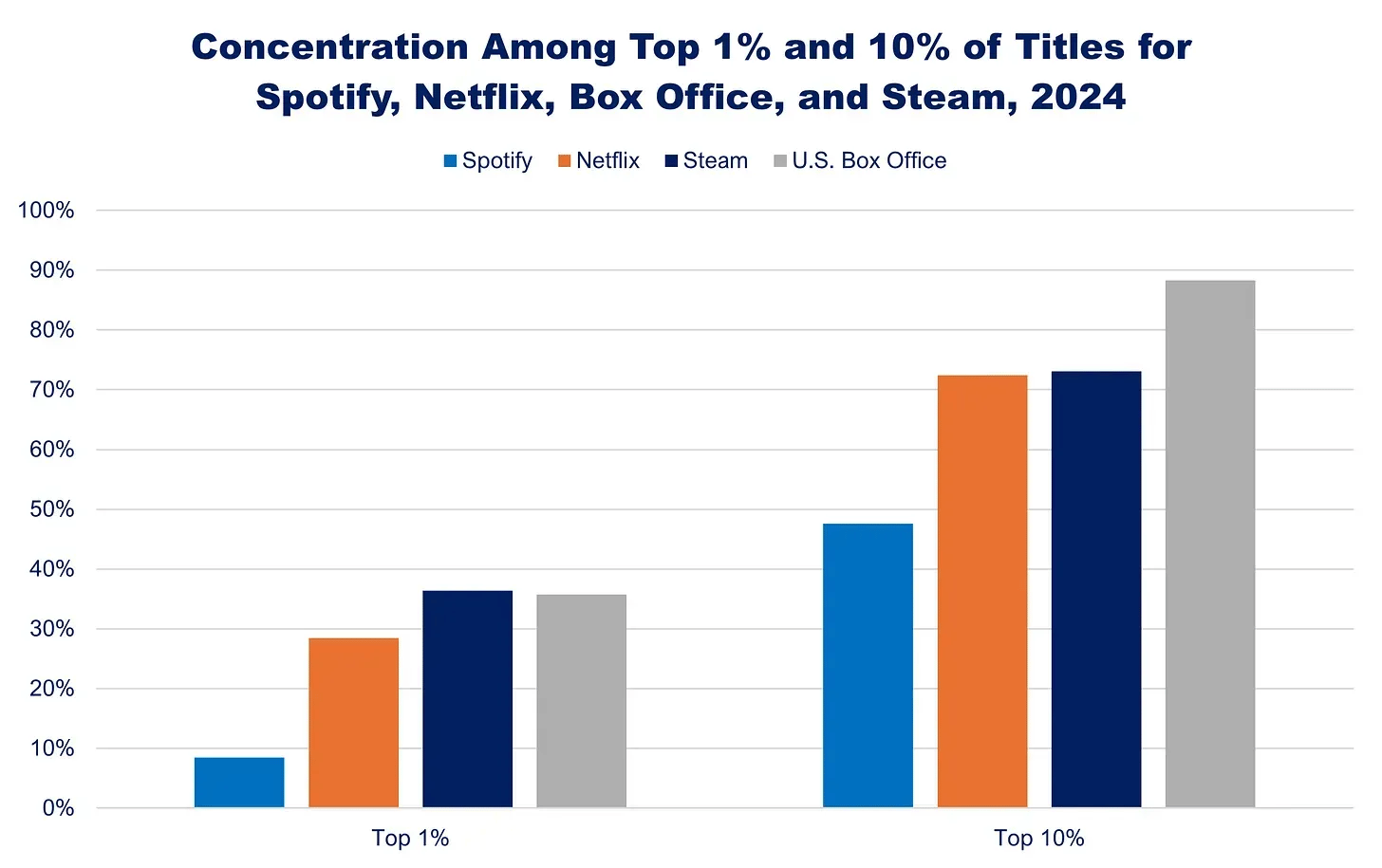
This pattern repeats across Spotify, Netflix, and theatrical releases. The top 1% of content accounts for roughly 30% of total consumption, while the top 10% captures between 50% and 80% of audience engagement. Digital distribution simultaneously fragments choice and concentrates viewership around a small number of winners.
Power Laws in the Gaming Market
The gaming industry demonstrates these hit-driven dynamics clearly. In 2025, among 14,700 new Steam releases that sold over 10,000 copies, only 11 games grossed more than $100 million. Just 58 titles surpassed $10 million in revenue, and approximately 235 crossed the $1 million threshold.
The middle tier consists primarily of sequels and releases from established studios, leaving minimal space for new entrants to break through. This "skinny middle" effect means a few dominant titles capture most revenue and player time while the vast majority of launches remain relatively unknown.
The Role of Social and Visual Media
Platforms like YouTube, Twitch, and TikTok accelerate power-law patterns through viral mechanics. Content that gains early momentum gets amplified via shares, algorithmic promotion, and organic word-of-mouth, allowing breakout hits to reach massive audiences rapidly.
These dynamics apply across games, streaming series, music, and other digital media. While consumers have access to an enormous variety of content, the most popular titles consistently capture the largest portion of total engagement.
Implications for Developers and Media Creators
Understanding power laws matters for anyone building or releasing content. Recognizing that only a tiny fraction of releases will achieve major commercial success should inform decisions around marketing spend, launch timing, and platform selection. The positive feedback loops created by platforms and social networks make early traction critical, while most content will need to find sustainability through niche audiences or gradual long-tail discovery.
Frequently Asked Questions (FAQs)
What are power laws in media? Power laws describe distributions where a small number of titles capture most attention while the majority receive limited engagement. This pattern appears consistently across games, music, movies, and online content.
Why do some games perform so much better than others? Hits create self-reinforcing cycles. Popularity signals quality or cultural relevance, and platform algorithms amplify exposure, creating momentum where early success attracts exponentially more attention.
How do platforms like Steam and Netflix affect power-law outcomes? Platforms generate network effects. Early successes gain visibility through trending lists and recommendations, which drives more consumption. Social sharing and algorithmic curation concentrate attention on a few titles.
Does this mean most games won't succeed? Many games reach modest audiences, but only a small fraction become major hits. Success concentrates among established developers, sequels, or releases that achieve viral momentum.
Can social media change these dynamics? Social platforms like YouTube, Twitch, and TikTok can accelerate a hit's rise through viral sharing, but the fundamental power-law pattern remains: a few titles dominate attention while most occupy the long tail.