
Thralls are the backbone of any serious Conan Exiles playthrough. Skip them and you are doing everything the hard way: slower crafting, weaker defenses, and no one to carry your loot. Get them right and your base runs like a machine while named fighters tank bosses you would never survive alone. This guide covers everything from knocking out your first enemy to squeezing the best stats out of a tier 4 named thrall.
How do you get thralls in Conan Exiles?
Thralls enter your service through five distinct paths as of 2026: capturing hostile NPCs, freeing prisoners from cages scattered across the map, recruiting at taverns, purchasing from merchants, and completing companion quests. Each method has its own cost and time investment.
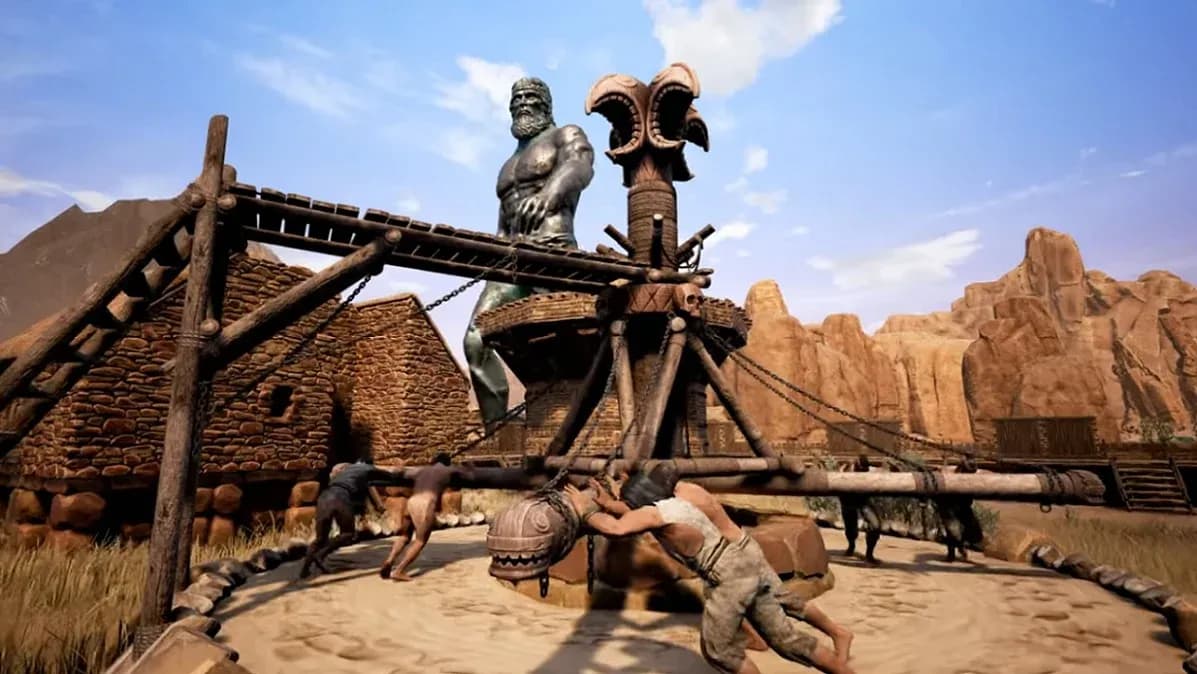
Capturing remains the most common approach and offers the widest selection throughout the game. The process is direct: knock an enemy unconscious, bind them with rope, haul them back to a Wheel of Pain, and supply the wheel with food until conversion completes.

Knocking out enemies
Thralls are captured by depleting a thin white bar that sits above their health bar. This bar only responds to concussive damage, not regular weapon damage. Use the wrong weapon and you will kill the NPC instead of capturing them.
Concussive weapons range from basic wooden clubs to specialized legendary gear. Here are the most relevant options:
| Weapon | Light Concussive | Heavy Concussive | Level Required |
|---|---|---|---|
| Truncheon | 15 | 20 | 10 |
| Iron Truncheon | 25 | 30 | 30 |
| Steel Truncheon | 35 | 40 | 50 |
| Blunted Arrow | 55 | 55 | 35 |
| The Tiger's Truncheon | 90 | 120 | Purchased |
The Tiger's Truncheon delivers the fastest knockdowns in the game at 90 light and 120 heavy concussive damage. You purchase it with Ancient Obolus currency. For mid-game players without access to premium gear, the Steel Truncheon at level 50 handles most targets reliably.
You can push these numbers higher with several stacking bonuses. The Advanced Blunted Weapon Fitting adds +30 light and +60 heavy concussive damage. Eating Savory Feast gives +15% concussion damage for 1 hour. Drinking a Hunter's Potion adds +50% concussion damage. The Hyrkanian Raider armor set and the Slaver's Hood both provide armor bonuses to concussion damage as well.
Transporting your captive
With the NPC unconscious, equip a binding item and interact with them to drag them. Fiber Bindings work for short distances but only have 300 durability. Chain Bindings and Whip Bindings both offer 3,600 durability, making them far better for longer runs. The Bindings of the Dead are the lightest option at 0.63 weight with 15,000 durability.
You can drag thralls on foot or on horseback, and swimming works too. Avoid using the Map-Room teleport or elevators while dragging, as both mechanics are bugged and can cause thrall loss.
Converting at the Wheel of Pain
Place the bound thrall into any Wheel of Pain variant and add food as fuel. Gruel works fine and is cheap to produce. The conversion time depends on the thrall's tier and whether you have a Taskmaster assigned to the wheel.
A named (tier 4) thrall takes 3,600 seconds (1 hour) with no Taskmaster. Assign a named Taskmaster and that drops to 1,440 seconds (24 minutes), a +150% speed bonus. Tier 1 thralls take just 900 seconds baseline and only 360 seconds with a named Taskmaster.
What are the thrall tiers and why do they matter?
Every thrall profession has four tiers. Tiers 1 through 3 typically have plain red health bars and generic names like "Fighter I" or "Armorer III." Tier 4 thralls have unique names, usually a gold-framed health bar, and often unlock additional crafting recipes when placed at their workstation.
For combat thralls, tier directly affects health and armor. Fighters and Archers gain more health and armor at each tier, while their damage output scales with the weapon they carry and their corresponding attribute (Strength for fighters, Accuracy for archers).
For crafter thralls, tier affects crafting speed, resource requirements, and fuel efficiency. Tier 3 and tier 4 crafters can also grant access to additional recipes that are otherwise unavailable.
Hiring thralls at a tavern costs gold based on tier: 10 gold for tier 1, 50 for tier 2, 100 for tier 3, and 500 for tier 4. Buying from Zeina the Vixen at Buccaneer Bay costs 50 gold per Alchemist or Fighter with a 5% chance of getting a tier 4. Weeba Shamrock, also at Buccaneer Bay, sells Archers and Performers for 100 gold each with the same 5% tier 4 chance.
Thrall professions: which type do you actually need?
Thralls split into two broad categories: combat thralls and crafter thralls. Both are worth pursuing, but they serve completely different purposes.
Combat thralls include Fighters, Archers, Bearers, and Performers. Fighters and Archers guard your base and follow you into combat. Bearers have an expanded inventory, making them excellent pack mules. Performers remove corruption and provide a health regeneration buff when placed in your base.
Crafter thralls are placed at workstations to unlock bonuses. Here is a quick reference for the most commonly sought professions:
| Profession | Workstation | Key Benefit |
|---|---|---|
| Blacksmith | Blacksmith's Bench | Weapon damage, armor penetration, or durability |
| Armorer | Armorer's Bench | Armor value, weight reduction, or durability |
| Carpenter | Carpenter's Bench | Bow damage, arrow penetration, or durability |
| Taskmaster | Wheel of Pain | Faster thrall conversion |
| Smelter | Furnace | Metal processing |
| Alchemist | Alchemist's Bench | Orb recipes and alchemical items |
| Cook | Campfire or Stove | Food recipes |
Tier 4 Blacksmiths, Armorers, and Carpenters also have specializations that determine which stat they boost. A Bladesmith blacksmith maximizes weapon damage. An Edgesmith maximizes armor penetration. A Tempersmith maximizes weapon durability. The same logic applies to Armorers (Shieldwright for armor value, Scoutwright for weight reduction, Temperwright for durability) and Carpenters (Bowmaker for damage, Fletcher for penetration, Builder for durability).
For Taskmasters, a Driver specialization increases concussion damage on crafted items, while an Overseer increases durability.
The two companion thralls added in the Age of Heroes update, Freya (Nordheimer fighter, 1,532 base health, 15 Strength, 30 Vitality) and Liu Fei (Khitan fighter, 1,365 base health, 30 Strength), are obtained through companion quests rather than capture.
For a deeper look at how specific thrall types interact with the world, the thrall enslavement and crafting guide on Video Game Data Bank covers the mechanical details of the conversion process in detail.
How do thrall attributes and leveling work?
Thralls start at level zero and cap at level 20. Experience is earned only when the thrall is actively following you, not while on guard duty. Each kill by you or the thrall contributes experience, with harder targets giving more.
Every thrall has fixed starting attributes. A Cimmerian Berserker always starts with 15 Strength and 30 Vitality. These numbers do not vary between individual Cimmerian Berserkers. What does vary is how those attributes grow at each level, because the growth chances are randomized within a range specific to each thrall type.
At each level up, each attribute has a percentage chance to increase by 1 point. The Cimmerian Berserker's total growth chance across all attributes sums to 295%, while Beastmaster Teimos sums to 356-357%. A higher total means more stat points on average over 20 levels.
Food placed in a thrall's inventory affects these growth chances while the thrall levels. These buffs do not stack, so pick one food type based on which attribute you want to prioritize:
| Food | Strength Bonus | Agility Bonus | Vitality Bonus | Grit Bonus | Healing |
|---|---|---|---|---|---|
| Gruel | +14% | — | — | — | 6 hp/sec |
| Cooked Fish | — | +14% | — | — | 3 hp/sec |
| Grilled Steak | — | — | +14% | — | 2 hp/sec |
| Shredded Roast | — | — | — | +14% | 1 hp/sec |
| Cooked Pork Rinds | +7% | — | — | +7% | 1 hp/sec |
Cooked Pork Rinds also provide a 25% damage buff while active, compared to the 10% damage buff provided by every other food on the list. The practical approach is to feed Cooked Pork Rinds first for the damage buff, then switch to a higher-healing food like Gruel or Exotic Feast once the buff is applied.
At levels 10, 15, and 20, thralls receive randomly assigned perks from the Follower Perks pool. These can add or subtract attributes. If you are playing in single-player mode, you can reload a save to reroll unfavorable perks. In any mode, the Elixir of Rebirth re-rolls all three perks at an affordable cost.
How many thralls can you have?
On official multiplayer servers, a solo player has a base limit of 50 followers. Each clan member adds 15 more slots. A 5-member clan has a soft cap of 125 followers (50 base plus 75 from members). Beyond the soft cap, no new followers can be placed. The hard cap sits at the soft cap plus 100, so that same 5-member clan would start losing thralls to automatic deletion only if they somehow exceeded 225.
A 10-member clan has a soft cap of 200 and a hard cap of 300. In singleplayer mode, the thrall cap is disabled by default but can be enabled through admin settings.
Deploying and commanding thralls in combat
To deploy a thrall, move it to your hotbar and place it like any building piece. Combat thralls can be placed inside your base or out in the open world.
On PvP servers, leaving a combat thrall exposed is risky since other players can snipe them with bows. Inside a building structure, thralls still provide full protection. Combat thralls on official PvP servers only attack other players during raid windows (for example, 5 pm to 11 pm PST on official servers).
If a thrall's health reaches zero, they enter a Down But Not Out (DBNO) state. A gray bar replaces their health bar and slowly depletes. Interact with the downed thrall to perform a rallying cry and revive them. This cry also revives any other downed thralls within 15 meters. Each time a thrall is downed they gain a strike, up to three. A fourth knockdown results in permanent death. All strikes expire after 15 minutes if no new strikes are received.
Thralls gain strikes from being downed, not from taking damage, so a thrall with good armor can absorb enormous punishment before accumulating strikes.
For follow and combat behavior, the thrall inventory screen gives you precise control over three distance settings:
- Follow distance: how far behind you the thrall stays outside of combat
- Attack distance: the radius within which the thrall will engage enemies
- Chase distance: how far the thrall will pursue a fleeing enemy
The Stop Following command is one of the most useful tools in the system. You can park a thrall almost anywhere and they will hold position without wandering. Command them to Follow again to resume normal behavior. Thralls do not earn experience while stopped, and they will return to their last guard position after roughly 15 minutes of inactivity if you leave the area or log out.
Thrall special characteristics worth knowing
Several thrall properties are easy to overlook but matter for how you equip and manage them:
- Thralls do not suffer from hunger, thirst, heat, or cold. Temperature-appropriate armor is irrelevant for them.
- Thralls are immune to corruption.
- Thrall gear does not lose durability. You can give them legendary weapons that cannot be repaired or damaged armor you cannot currently fix, and they will use both indefinitely.
- Archer thralls have unlimited basic Flinthead Arrows and only consume other arrow types you manually place in their inventory.
The gear-durability point is genuinely useful. Legendary weapons that drop from world bosses are often unrepairable. Handing them to a fighter thrall turns a one-time weapon into a permanent combat tool.
For a full breakdown of the creatures and NPCs you will encounter while hunting for thralls, the Conan Exiles thralls, wildlife, and monsters reference on Video Game Data Bank covers faction and creature details across both the Exiled Lands and Isle of Siptah.
Building a thrall army takes time, but the payoff compounds quickly. A named Taskmaster cuts your conversion times in half. A named Blacksmith with the right specialization makes better weapons than you could craft alone. A pair of Cimmerian Berserkers positioned at your base entrance handles most raid threats while you are offline. Start with whatever tier you can capture, work toward named thralls in the factions near your base, and browse more guides on GAMES.GG for the rest of your Conan Exiles build.