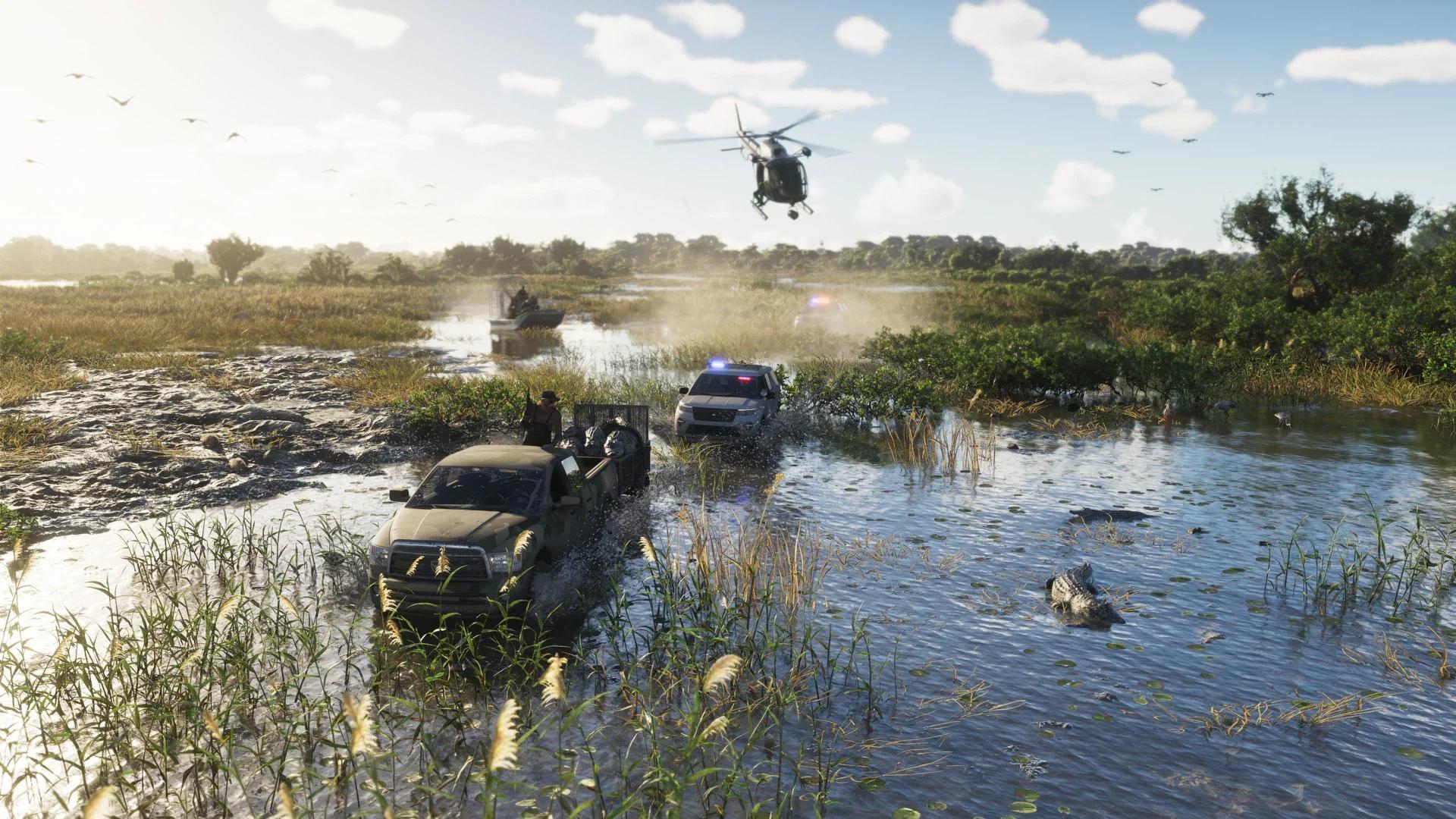

Look for alligators in Grassrivers, the swamp region of Grand Theft Auto 6. Start with its waterways, but do not mistake a regional habitat for a guaranteed spawn point. Exact coordinates, attack triggers, and hunting rewards remain unconfirmed. Use the landscape and visible animals to guide your search, and avoid planning around a fixed respawn loop or assuming the game uses Red Dead Redemption 2’s hunting rules.
Where to find alligators


Start with Grassrivers’ waterways
Rockstar’s official Grassrivers imagery shows large alligators around an airboat. The boat is a useful reference for the type of environment to search: swamp waterways surrounded by wetland vegetation. It does not establish a named landing, a vehicle requirement, or a repeatable encounter location.
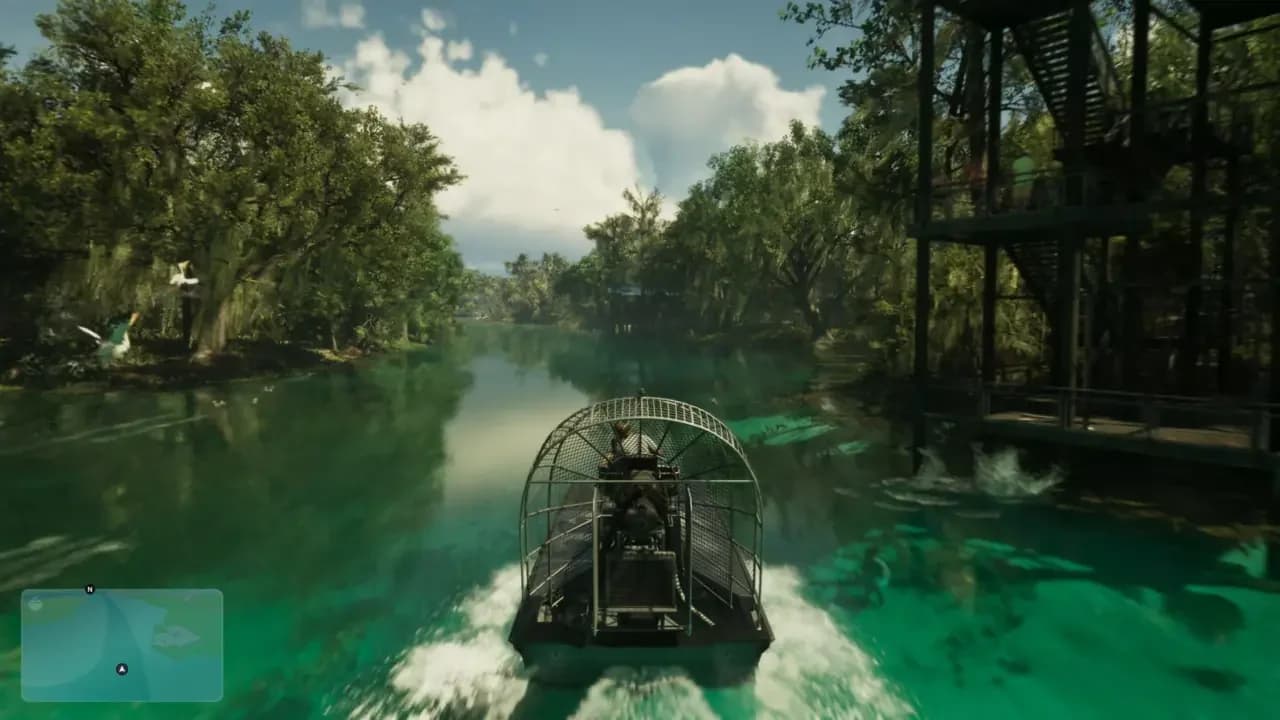
An airboat in Grassrivers
Begin by checking the water along your route, then inspect the edges where vegetation makes individual shapes harder to distinguish. These are visual search suggestions, not a claim that every bank or channel contains an animal.
Grassrivers versus Mount Kalaga
When choosing between Grand Theft Auto 6’s revealed locations, separate a region associated with alligators from one promoted more broadly for outdoor activities.
| Region | What Rockstar’s regional description establishes | How to use it for your search |
|---|---|---|
| Grassrivers | Wetlands and mangroves, with alligators named as a regional attraction | Prioritize this region for finding gators |
| Mount Kalaga | Hunting, fishing, and off-road trails | Treat it as another wildlife destination, not a confirmed alligator location |
Rockstar also shows a Florida panther near deer in wooded undergrowth. That scene supports the broader wildlife angle, but a predator sighting is not evidence that every wilderness region contains the same animals.
Do not substitute a real-world Florida wildlife map for an in-game route. Leonida takes inspiration from Florida, but that does not establish where individual animals appear within its fictional regions.
How to spot alligators
Check the surface, not just the shore
The depicted alligators are partly submerged. Scan for a recognizable portion of an animal at the surface instead of waiting to see an entire body on dry ground.
Use a simple visual checklist:
- Look across the water first. A shoreline-only search can miss an animal farther into a channel.
- Check breaks in the vegetation. Inspect separate patches of visible water instead of treating the whole bank as one clear view.
- Confirm the shape before moving closer. An indistinct object is not yet an alligator sighting.
Mangrove vegetation can interrupt your view of the water. Choose a position with a clearer view before deciding that a stretch of wetland is empty; entering the water is not necessary just to investigate an uncertain shape.
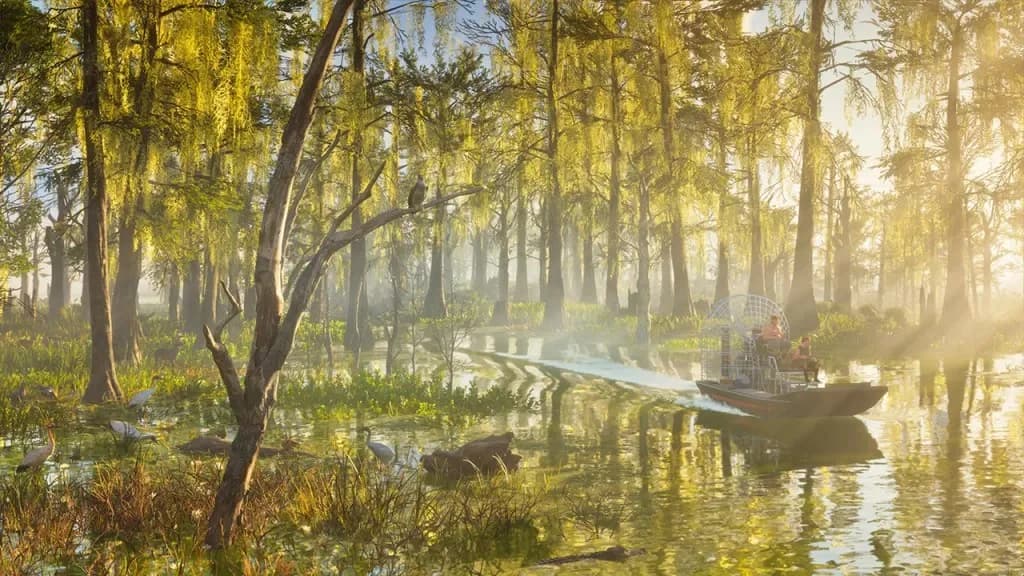
Grassrivers’ mangrove habitat
Record sightings without inventing spawn rules
If you are keeping personal route notes, record the nearby landmark and what you actually saw. A simple seen or not seen entry is more useful than labeling a location a guaranteed spawn after one visit.
A sighting identifies a place where an animal appeared. It does not establish a respawn timer, a time-of-day requirement, or a weather condition. Keep those assumptions out of your route until they can be checked through repeat encounters.
How to approach or avoid alligators
Keep the first encounter observational
If your goal is simply to find an alligator, observe it from a distance. Avoid swimming toward a suspected animal for a closer look, and keep a clear route back from the water’s edge. These are cautious choices, not a guaranteed escape method.
An airboat appearing beside alligators does not make the vehicle a confirmed safe zone. Do not build an approach around supposed boat immunity, a precise safe distance, or a warning animation that has not been established.
If avoiding an encounter is the priority, choose a route that does not require entering the swamp water. Move away from a visible animal instead of closing the distance to test whether it reacts.
Finding an alligator and hunting one are separate goals. For a location search, a clear visual identification is enough: record the sighting, note the nearby landmark, and leave without testing its attack behavior.