Search games, articles, guides...CtrlK
Sign InGet Started

Learn how Ranked works in League of Legends, from the different rank tiers and divisions to LP, MMR, Ranked seasons and the Solo/Duo queues.

Written by Rafael Silva
Content Creator
See more GAMES.GG guides on Google
Add us as a preferred source and our guides show up first in your results.

League of Legends Classic: Every Confirmed Champion and Item
All 60 confirmed champions, classic items, and summoner spells coming to LoL Classic, Riot's Season 3 throwback mode.

League of Legends Beginner's Guide: Best Champions to Climb Every Rank
Discover the best champions to climb with in League of Legends, with recommendations for every rank from Iron to Master.

League of Legends Beginner's Guide: Summoner's Rift Objectives
Learn how every major Summoner's Rift objective works in League of Legends Season 2026, from jungle monsters like Dragon and Rift Herald to structures such as turrets and inhibitors.
Ranked is League of Legends' competitive game mode, where you play to climb the ranked ladder and track your progress as you improve. If you're new to Ranked, there are a few things you need to understand before jumping in. This guide covers how ranks and divisions work, what LP and MMR mean, how Ranked seasons work, and how the different Ranked queues operate.
Before you can play Ranked, there are a few requirements that you need to meet. You must be level 30, own at least 20 champions and have played 10 Swiftplay or Draft games on Summoner's Rift.
Ranked has two separate queues, each with its own rank and end-of-season rewards: Solo/Duo, where you can play alone or with one other player, and Flex, where you can queue with any sized party, except parties of four.
When you first enter Ranked, you have to play 5 placement games, without any LP loss, that determine your starting position on the Ranked ladder. Once your placements are complete, you receive your initial rank and can begin progressing through the ladder.

Victorius Twisted Fate Splash Art
In League of Legends, the Ranked system is divided into competitive years, each one comprised of multiple seasons.
At the start of each year, your rank resets and you need to play new placement games to get your initial standing. This happens once per year, so even as seasons change, you keep your rank and continue your climb.
Seasons usually last for 4 months and at the end of each one, you get a profile icon and banner based on the highest rank you achieved during that time. Additionally, if you win at least 15 Ranked games, you receive a Victorious skin as well as a chroma and a Loading Screen border.
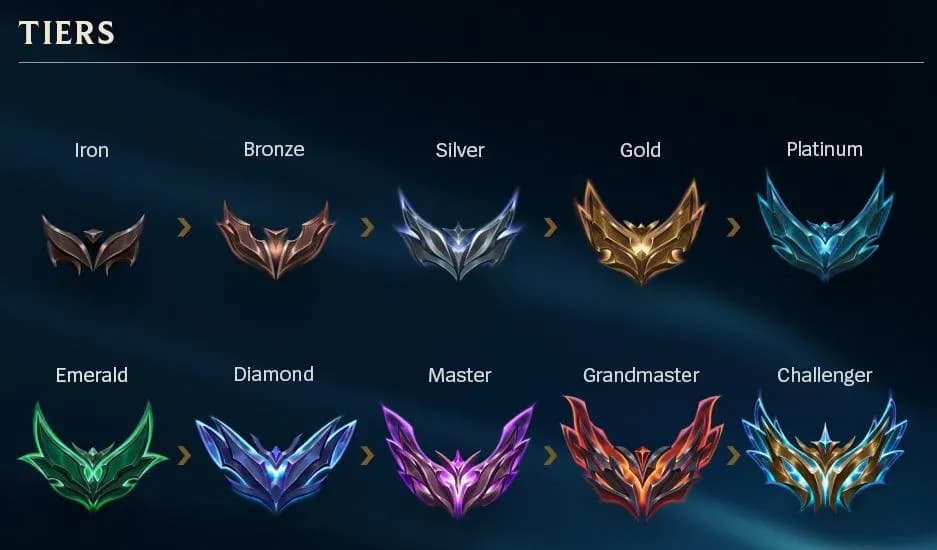
The different tiers in League of Legends
League of Legends has 10 Ranked tiers representing your position on the ladder. From lowest to highest:
Iron → Bronze → Silver → Gold → Platinum → Emerald → Diamond → Master → Grandmaster → Challenger
The first seven tiers , Iron through Diamond , are each split into four divisions: IV, III, II, and I, with IV being the lowest and I the highest.
Master, Grandmaster, and Challenger are known as the Apex tiers and work differently. They have no divisions and instead use a shared leaderboard for all players within each tier.
Your progress through the Ranked ladder is measured with LP. You gain LP by winning Ranked games and lose LP when you lose, with your current total shown alongside your rank.
Each division starts with 0 LP and once you reach 100 you move into the next division. This continues through the divisions until you reach Division I. At this point, reaching 100 LP moves you into the next tier, with any LP above 100 carrying over.
When you lose more LP than what you have, for example, you have 12 LP and lose 25 after a defeat, you get demoted and move to the tier or division below your current one. However, there is a safety net. Before you get demoted to a lower tier, the game gives you protection for a certain number of games. This means that, for example, if you are at Silver IV with 5 LP and lose 10 LP, instead of dropping down to Bronze I, you will stay at Silver IV but at 0 LP.
The number of games that you can play without being demoted and the amount of LP that you gain or lose varies based on your MMR.
MMR is a hidden rating that determines how much LP you gain and lose. If your MMR is higher than the average for your rank, you gain more LP for a win and lose less for a defeat, but if it's lower, you gain less LP for a win and lose more for a defeat. These gains and losses are also influenced, to a smaller degree, by heavy disparities between the average ranks of each team.
Despite being an "invisible" stat, MMR is extremely useful because it gives insight into your skill level. By seeing how much LP you are gaining and losing, you can determine if you are playing above, below or at your current level.

Dev Update Banner
Ranked is a long-term climb, so don't expect your rank to increase after every session. Losses are part of the process, and understanding how the system works makes it easier to put them into perspective. Focus on playing consistently, learn from your mistakes and let your rank reflect your improvement over time.