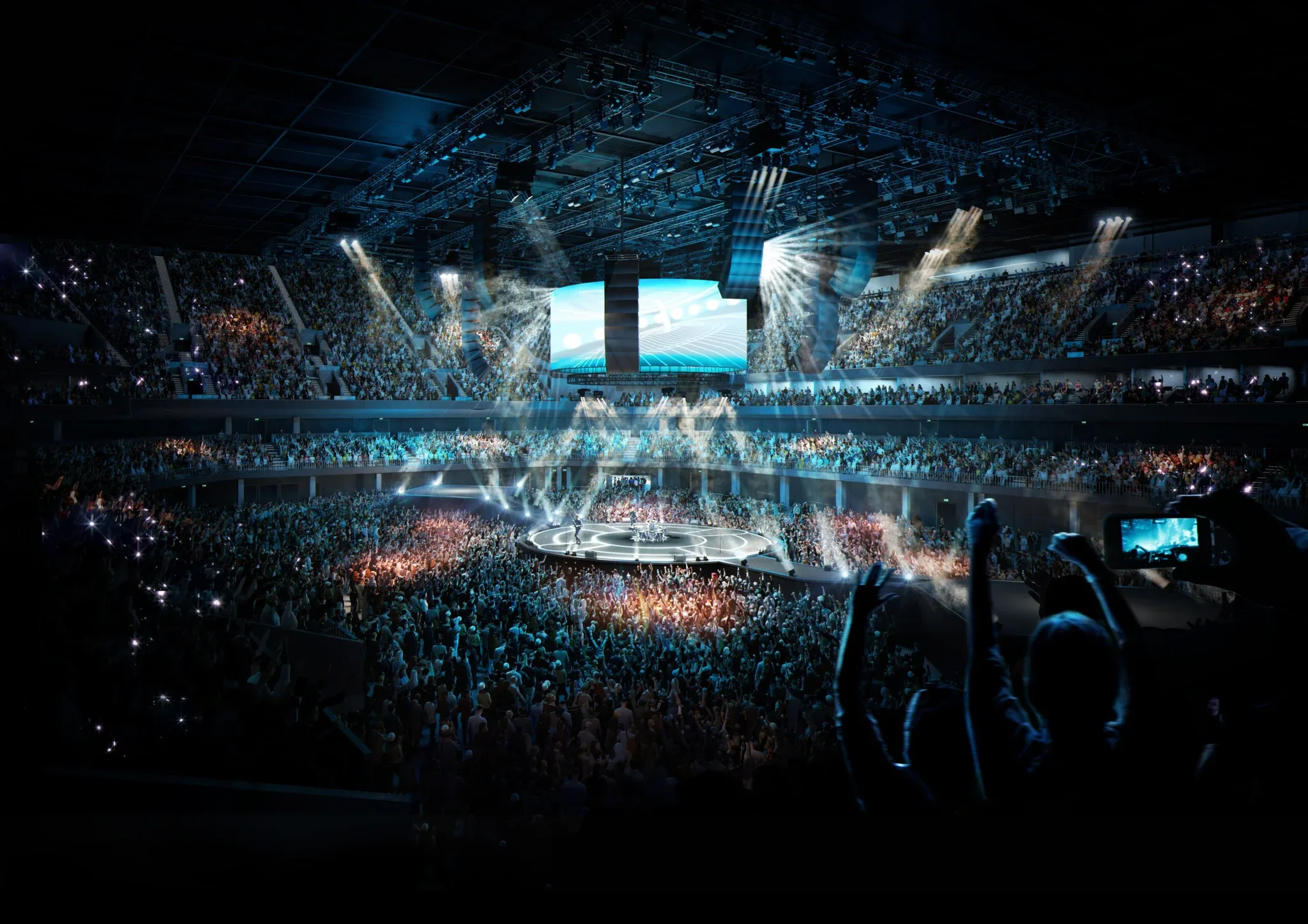


"Every single time I walk into a stadium, it's a proof point that what we believed 25 years ago became reality."
That's Ralf Reichert, CEO of the Esports Foundation, speaking from the VIP embassy of Paris' Expo Porte de Versailles during the closing weeks of the Esports World Cup 2026. The man who co-founded SK Gaming with his brothers and built ESL into a billion-dollar operation isn't reflecting on streaming numbers or sponsorship deals. He's talking about the crowd.
That instinct tells you everything about where competitive gaming's real power lives.
Use code TRYHARD33 at checkout to redeem this offer before code expires again.
Get 33% Off GAMES+ Subscription
From rented buses to 20,000-seat arenas
Reichert's first tournament trip to Paris involved a rented bus, six teammates, and a stack of CRT monitors. That was 1999. Fast forward to this September, and the same city hosted a 20,000-person Counter-Strike final at the Accor Arena, where Team Spirit from Serbia upset Turkey's FUT Esports in a match lit by lasers and punctuated by fireworks.
The contrast isn't just nostalgic. It's the entire argument for why live esports events hit differently than anything a stream can replicate.
"The core feeling is community," Reichert says. "You go to a place where hundreds, sometimes thousands, of people come for the same reason, for the same purpose, for the same passion. You feel like a pioneer."
Here's the thing: that feeling isn't something you can manufacture through a Twitch chat. The 2026 Esports World Cup sold 175,000 competitive event tickets across its seven-week Paris run, drawing fans from over 100 countries to watch 2,000 players compete across 24 games for a $75 million prize pool. Those aren't streaming stats. Those are bodies in seats.
The moment skeptics became believers
Reichert traces the turning point to 2013, when 8,000 people showed up in person to a Counter-Strike tournament in Katowice, Poland. Before that, the broader public remained unconvinced that esports could function as a spectator sport at scale.
"People remained skeptical, that is, until they set foot in an arena," Reichert notes.
That pattern has repeated itself at every major milestone. Early ESL events started at 50 attendees, then 100, then 500, then broke into the thousands at trade fairs. Each jump in attendance shifted the conversation. Online viewership validated interest, but physical presence converted skeptics.
The pandemic briefly scrambled that equation. Esports was uniquely positioned to survive lockdowns, with Reichert noting that his industry had been "training for 25 years" to operate remotely. Online-only competition kept the scene alive. But the return to live events didn't just restore the old model; it accelerated it. The Esports World Cup is the most direct expression of that acceleration.
What online competition still can't replace
Reichert built the early ESL infrastructure around making esports a spectator sport, not just a participatory one. The distinction matters. Back in the early 2000s, competitive gaming was primarily something you did, not something you watched. Building an audience required convincing people that watching someone else play was worth their time.
"What ESL brought was an unwavering focus on making this a spectator sport," he says.
Streaming platforms like Twitch and YouTube eventually solved the distribution problem, but they introduced a different one: scale without atmosphere. You can watch a match from your couch, but you can't feel the arena shift when a team pulls off an upset. The 20,000 people at the Accor Arena Counter-Strike final experienced something fundamentally different from the millions watching at home.
What most players miss is that the live event isn't just a viewing format. It's the mechanism that assigns cultural weight to competitive gaming. It's what makes a player a star rather than just a username.
The next chapter: nations, flags, and 1.5 million qualifiers
With ESL sold to the Savvy Gaming Group in 2022 for over $1 billion, Reichert's current focus is scaling the live-event model even further through the Esports Foundation. The Esports Nations Cup launches next year, shifting from a club-based model to a national team format across more than 150 countries.
The key here is reach. The existing Esports World Cup already drew a Tekken winner from Pakistan through its qualifier system, with 1.5 million people participating directly in qualifiers for the 2026 edition. A national team format gives governments a tangible way to engage with esports, and gives fans in countries without established esports clubs something concrete to rally behind.
"If you give each country a club to rally behind, you engage a much larger part of the world's population," Reichert says.
With 3.6 billion gamers globally, that's roughly 40 percent of the planet's population as the target audience. The live event infrastructure Reichert spent 25 years building is now the foundation for something considerably larger.
For gamers who want to sharpen their own competitive skills while following the pro scene, the gaming guides cover everything from beginner strategies to advanced tactics across the titles you care about. If web3-native competitive games are your lane, check out the Illuvium Overworld beginner strategies guide or the Undead Blocks survival guide to get up to speed before the next wave of competitive events arrives.



![Walking in GTA V - Los Santos International Airport [ 4K Ultra - Natural Vision Evolved ]](https://assets.games.gg/gta_5_flights_v_mod_airports_hero_1af1376cf2.webp)