

You know that feeling when you walk into a room that should be full of people but isn't? That specific, stomach-dropping unease has a name: kenopsia. And no game on Steam weaponizes it quite like Fatum Betula, a solo-developed horror adventure from Bryce Bucher that launched in 2020 and, nearly six years later, remains one of the most quietly disturbing things you can download right now.
The premise sounds simple enough. Nourish an ancient birch tree that holds the fate of the world in its roots. What that actually involves is wandering a melancholic low-poly world, striking disturbing bargains with uncanny figures, and making choices that ripple across 10 distinct endings. The narrative isn't linear so much as it is feverish, a web of cause and consequence that plays more like a lucid nightmare than a campaign.

Use code TRYHARD33 at checkout to redeem this offer before code expires again.
Get 33% Off GAMES+ Subscription
What PS1 graphics actually do to your brain
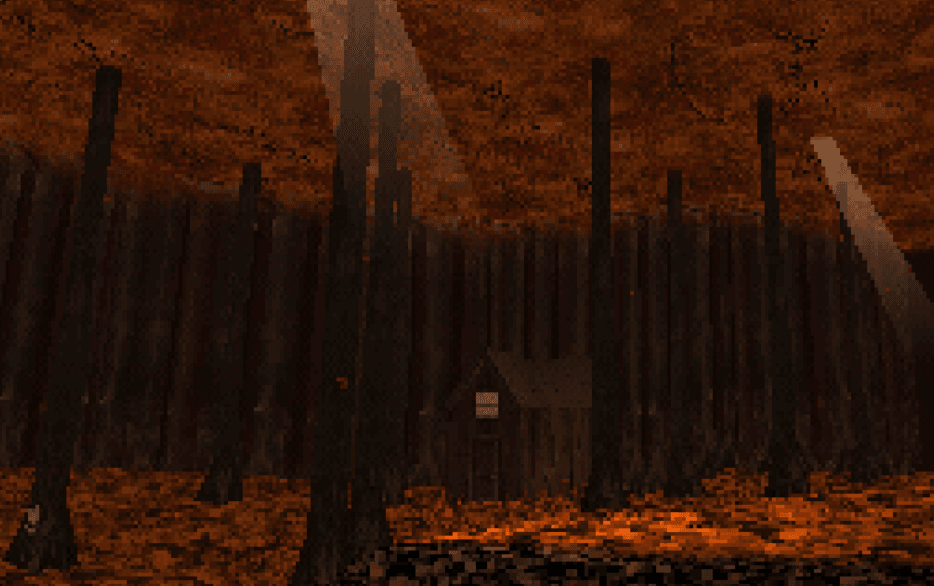
Here's the thing: blocky textures and jittering polygons aren't just an aesthetic choice in Fatum Betula. They're doing real psychological work. Bucher said in a 2021 interview that the fifth-generation aesthetic "lends itself well to creating environments that force the player to engage with them rather than just being set dressing." That philosophy is felt in every corner of the game.
When a space is visually incomplete, your brain fills in the gaps. The crude geometry of a PS1-style room doesn't give you enough information to feel safe, so your imagination quietly starts populating the silence with something worse than any monster designer could render. Silent Hill understood this instinctively back in 1999. Fatum Betula takes that same principle and builds an entire adventure around it.
The result is a game where a furnished suburban living room sitting impossibly at the bottom of a dead ocean floor is more unsettling than any jump scare. Carpeted floors, patterned wallpaper, the warm static glow of an old television, all rendered in low-poly geometry that makes the familiarity feel just slightly wrong.
The Backrooms connection that predates the Backrooms
Fatum Betula launched in 2020, before the Backrooms fully exploded into mainstream internet horror culture. The parallels are striking anyway. Both tap into the same primal unease: ordinary architecture stripped of its original purpose, spaces that look like they should make sense but somehow don't, the creeping suspicion that something is wrong with a room you can't quite name.
The Backrooms gave that feeling a name and a fandom. Fatum Betula built a game around it first. If you've spent any time with Kane Parsons' found-footage take on the concept or burned hours in Exit 8's looping Japanese metro, the DNA here will feel immediately familiar.
The key here is that Fatum Betula doesn't just use liminal spaces as backdrop. It makes you search them. Deciphering what's wrong with each location, finding the item or the figure or the secret that moves the story forward, is the core loop. Wandering an eerie residential home looking for clues to the world's survival turns the mundane into something genuinely threatening.
The missing link between LSD Dream Emulator and modern liminal horror
The closest spiritual ancestor to Fatum Betula is probably LSD: Dream Emulator, the 1998 PlayStation game that turned Sony's hardware into a kind of dream machine, throwing players through disconnected environments where the rules of reality shifted without warning. Both games share that quality of spaces that exist for no logical reason, architecture that follows dream logic rather than physics.
But where LSD was content to let players wander its bizarre dreamscapes passively, Fatum Betula builds an adventure around the disorientation. The environments are pieces of a larger puzzle. Characters, items, and secrets slowly reveal a world far stranger than it first appears. You might offer poisonous fruit to a gluttonous beast, or plunge through a dead ocean floor to harvest blood from your own doppelganger. The weirdness has stakes.
That combination, surreal exploration with actual consequences, is what separates Fatum Betula from the dozens of PS1-aesthetic horror games that have followed in its wake.
Why this still matters for horror fans in 2026
Liminal horror has had a genuine cultural moment over the past few years. The Backrooms spawned a subculture. Games like Hollowbody brought fixed-camera survival horror back to modern consoles (check out the Hollowbody before you buy guide if that's on your radar). The horror genre broadly has been in a strong stretch, from bite-sized anthology experiences like the ones covered in our Creepshow game first impressions to ghost-hunting staples like Phasmophobia, which keeps expanding its feature set with updates like the Quality of Life Part 2 patch.
Fatum Betula sits apart from all of it. It's a 2020 solo release that costs a few dollars on Steam and runs on hardware from a decade ago, yet it does something that most horror games with full studio budgets never manage: it makes the empty spaces scarier than anything that could jump out of them.
Pro tip: go in knowing as little as possible. The ten endings are shaped entirely by your choices, and the first playthrough hits hardest when the world's logic is still completely opaque. If you want horror that gets under your skin rather than in your face, Fatum Betula is worth your evening.