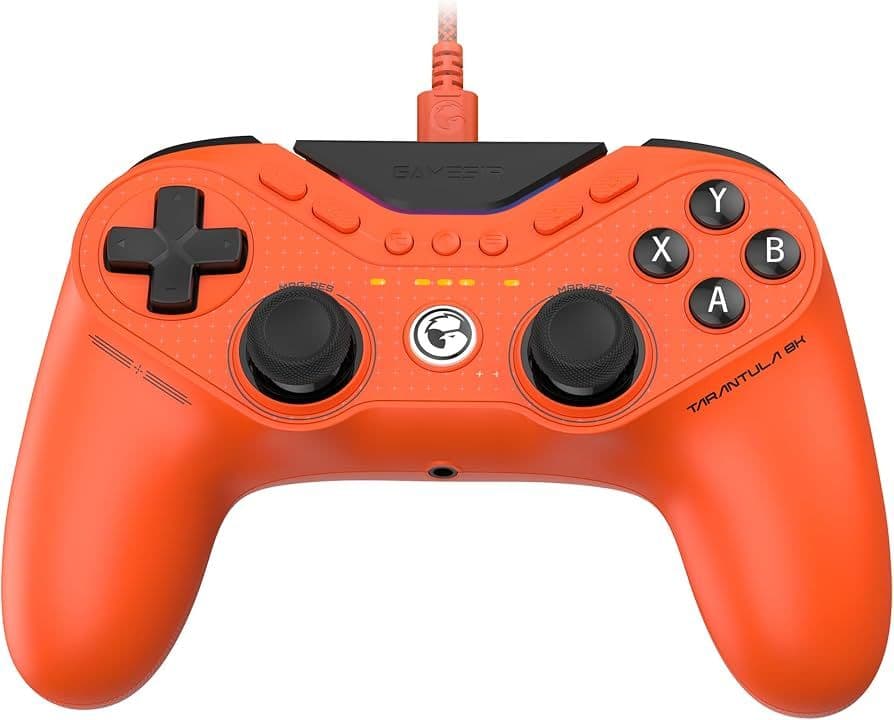

The GameSir Tarantula 8K is a strong contender in the competitive PC gaming controller market, offering features typically associated with considerably more expensive models. With an 8,000 Hz polling rate, second-generation TMR thumbsticks, Hall Effect triggers, mechanical face buttons, and extensive customization options, it delivers a compelling package for players who want greater precision and control without spending a fortune.
Priced at around $70 in the US and £79.99 in the UK, the Tarantula 8K positions itself as an affordable alternative to premium controllers from established brands such as Razer and Scuf. It is a wired PC controller rather than an all-purpose console accessory, but its performance and feature set make that a reasonable compromise for its target audience.
The controller is not without shortcomings. Its textured plastic grip could offer more traction, some additional buttons are positioned too close to the standard controls, and the orange finish is the only color option available in the supplied review information. It also lacks vibration and rumble functionality entirely.
Nevertheless, the GameSir Tarantula 8K makes an excellent first impression. For competitive players who prioritize responsiveness, precision, and customization, it offers a level of hardware that is difficult to overlook at this price.
GameSir Tarantula 8K Specifications
- Connectivity: Wired USB-C
- Polling rate: Up to 8,000 Hz
- Compatibility: Windows 10 and Windows 11 PC
- Thumbsticks: GameSir Mag-Res TMR Gen 2
- Triggers: Hall Effect analog triggers with micro-switch hair-trigger mode
- Face buttons: Mechanical micro-switch ABXY buttons
- D-pad: Tactile mechanical D-pad
- Additional controls: Nine remappable buttons
- Gyroscope: Six-axis
- Lighting: Customizable RGB strip
- Weight: 180g
- Software: GameSir Connect
- Color: Orange
Design and Build Quality: Lightweight and Comfortable
The GameSir Tarantula 8K adopts a symmetrical, PlayStation-style layout, with both analog sticks positioned alongside each other. Players accustomed to the offset sticks of an Xbox controller may need time to adjust, but the design works particularly well for those who prefer a DualShock-style arrangement.
Its overall shape is comfortable, especially for users with smaller hands. The main controls are easy to reach, and the rear buttons sit in convenient positions that allow players to access additional inputs without significantly changing their grip.
The controller also includes locking switches for the rear buttons. These allow users to disable unwanted inputs physically, reducing the risk of accidentally pressing a remapped button during an intense match. Multiple profiles are supported, making it possible to configure different layouts for different games or play styles.
At just 180g, the Tarantula 8K is notably lightweight. Much of this can be attributed to the absence of vibration motors and rumble hardware. While that decision means players miss out on tactile feedback in games that support it, it also makes the controller comfortable to hold for extended sessions.
For competitive shooters, where vibration is often disabled anyway, this is a sensible design choice. Players who enjoy racing games, action adventures, or other titles that make effective use of rumble should consider whether its absence is a deal-breaker.
The main design drawback is the surface texture. Although the plastic has a slight texture, it does not provide the secure, grippy feel offered by some premium alternatives. The surface can also accumulate visible grime through regular use. The triggers and bumpers have similar texturing, which does little to improve traction.
These are relatively minor complaints in an otherwise comfortable design, but a more substantial grip finish would make the Tarantula 8K feel even more premium.
Performance: 8,000 Hz Polling and TMR Thumbsticks
The standout feature of the GameSir Tarantula 8K is its 8,000 Hz polling rate. This determines how frequently the controller reports its inputs to the connected PC, with higher rates offering the potential for lower input latency.
The controller also supports 250 Hz, 1,000 Hz, and 4,000 Hz polling modes, allowing users to select a setting that suits their setup. Although 8,000 Hz sounds impressive, the practical difference between the highest settings may be difficult to notice in everyday gameplay. System configuration, game engine behavior, and other factors also influence the overall experience.
In testing, the controller reportedly delivered performance comparable to the considerably more expensive Razer Wolverine V3 Pro 8K. It also performed well in Gamepadla's polling-rate tests, reaching or coming close to the advertised 8,000 Hz when connected to a USB 3.2 port on the motherboard.
That last detail is worth considering. Players looking to maximize polling performance on a desktop PC should connect the controller directly to a suitable motherboard USB port. Front-panel ports may not consistently deliver the same results, even when they advertise similar USB specifications.
The Tarantula 8K's second-generation GameSir Mag-Res TMR thumbsticks are another major selling point. TMR, or tunnel magnetoresistance, technology uses magnetic sensing to detect stick movement, avoiding the conventional contact-based sensing associated with traditional potentiometer sticks. This helps reduce the risk of stick drift caused by mechanical wear.
Although no stick technology makes every possible form of drift impossible, TMR sticks offer a compelling solution for players concerned about long-term accuracy and reliability.
In practice, the sticks feel smooth and responsive. Their thumbcaps feature raised, textured edges surrounding a slightly convex surface, creating a hybrid design that provides a comfortable balance between control and movement.
For competitive games such as Call of Duty, responsive thumbsticks can make precise aiming and rapid directional adjustments feel more consistent. Combined with the controller's high polling rate, they help establish the Tarantula 8K as a serious option for players who value input responsiveness.
Mechanical Buttons and Hall Effect Triggers
The controller's face buttons use mechanical micro-switches, providing a distinct, clicky response when pressed. The tactile feedback makes inputs feel deliberate, while the short, responsive action is well suited to games that require frequent button presses.
The D-pad also uses a tactile mechanical design, providing clear feedback for directional inputs. This is useful in fighting games, platformers, and titles that rely on precise menu navigation.
The triggers are similarly versatile. In their standard mode, they use Hall Effect sensing for analog input, making them suitable for games where the amount of trigger pressure matters. Racing games are a natural example, as gradual trigger movement can control acceleration and braking.
When the hair-trigger stops are engaged, the triggers switch to micro-switch operation. This creates a shorter, click-like input that is better suited to shooters, where quick firing actions can be more useful than a full analog trigger pull.
Having both options in one controller makes the Tarantula 8K adaptable to different genres. Players can prioritize precise analog control in one game and faster trigger activation in another.
The combination of mechanical face buttons, a tactile D-pad, and dual-mode triggers is particularly impressive given the controller's price. These features are often associated with more expensive competitive gaming accessories.
Extensive Customization and Remappable Buttons
The GameSir Tarantula 8K offers an unusually broad range of control customization. In addition to its standard inputs, the controller includes multiple extra buttons, including rear controls, additional face-mounted inputs, and extra bumper buttons.
The supplied specifications list nine remappable buttons, giving players considerable flexibility when building a competitive layout. Dedicated start, menu, and capture controls are also available, alongside a GameSir button that can launch the Xbox Game Bar quick switcher.
For competitive shooters, this means frequently used actions can be assigned to more accessible controls. Reloading, jumping, crouching, or other commands can be mapped to buttons that reduce the need to move a thumb away from an analog stick.
However, button placement is not perfect. The additional bumper controls sit very close to the standard bumpers, making it possible to activate the wrong input during fast-paced gameplay. This can be particularly frustrating when two actions have very different consequences, such as reloading a weapon and throwing a grenade.
Players who do not need these additional bumper buttons can simply leave them unused, but those intending to make extensive use of every available input may need time to develop muscle memory.
The controller also supports a Shift Layer, which allows additional functions to be assigned to existing controls. This expands the available configuration options without requiring even more physical buttons.
For players who enjoy fine-tuning their equipment, the customization options are one of the Tarantula 8K's strongest features.
GameSir Connect: Simple Software With Useful Controls
GameSir Connect provides the software interface for configuring the Tarantula 8K. Through the application, users can adjust button mappings, trigger behavior, lighting, and other settings to suit their preferences.
The software also allows users to create and manage profiles, making it easier to maintain separate configurations for different games. Rather than relying on one universal layout, players can tailor the controller to the demands of individual titles.
Importantly, the application is relatively straightforward to use. Its options provide plenty of room for experimentation without making basic setup unnecessarily complicated.
Once a configuration has been saved to the controller, users can close the software and continue playing. Profiles can be switched using the rear M button in combination with a direction on the right stick, so it is not necessary to keep the application running in the background.
There are two important caveats. First, the controller is limited to a 250 Hz polling rate without the software, making GameSir Connect necessary to access its higher polling modes. Second, firmware updates also require the application.
As a result, installing GameSir Connect is worthwhile even for players who prefer to keep their PC gaming setup free of unnecessary background applications. The initial configuration process unlocks the controller's full capabilities, after which the software can largely be left alone.
The controller's advanced tuning options have also attracted discussion around competitive fairness. However, customization alone does not automatically make a controller a cheating device. The relevant consideration is whether a specific feature provides prohibited automation or an unfair gameplay advantage, rather than simply allowing players to adjust their controls. Players should check the rules of their chosen game and competitive platform before using specialized configurations.
What Could Be Improved?
Despite its impressive feature set, the GameSir Tarantula 8K has a few shortcomings worth considering before buying.
The grip could be better. The lightly textured plastic does not provide much additional traction, and the surface can become grubby over time. A more substantial grip material would improve both handling and the overall premium feel.
The extra bumper buttons are too close together. Their positioning makes it easier to press the wrong control during intense gameplay. This is particularly noticeable when remapping frequently used actions to the additional bumpers.
There is no vibration or rumble. The lack of vibration hardware helps keep the controller lightweight, but it also removes a feature that many players enjoy. Those who value immersion in racing games, action adventures, and other single-player titles may prefer an alternative with rumble support.
The design is limited to orange. Color preference is subjective, but a choice of finishes would make the controller more appealing to a wider audience.
The wired connection limits flexibility. USB-C connectivity is well suited to desktop competitive gaming, where a direct connection is often preferable. However, players who want wireless freedom will need to look elsewhere.
Finally, the symmetrical stick layout will not appeal to everyone. Players who strongly prefer the offset arrangement of an Xbox controller may be better served by another option in GameSir's lineup.
None of these drawbacks undermines the controller's core performance, but they help explain where the manufacturer has made compromises to deliver its feature set at a lower price.
GameSir Tarantula 8K vs. Premium Controllers
The Tarantula 8K's greatest strength is the relationship between its price and its hardware. At approximately $70, it offers features that are often found in much more expensive competitive controllers.
Compared with premium models such as the Razer Wolverine V3 Pro 8K, the GameSir provides a similar headline polling rate, magnetic TMR thumbsticks, mechanical buttons, and extensive configuration options. Its reported performance makes it a credible alternative for players who do not want to pay flagship prices.
It is also an interesting comparison with Microsoft's standard Xbox controller. The Tarantula 8K is not a direct replacement, as it is designed for Windows PCs and uses a wired connection. However, its more advanced input technology highlights how much hardware can be included in an affordable controller.
Players who prefer an Xbox-style stick layout but still want a high polling rate may also want to consider the GameSir G7 Pro. Those looking for a dedicated Xbox-compatible Tarantula model should note that it is a different product, with the version described in the supplied information reaching up to 1,000 Hz on PC.
Ultimately, the Tarantula 8K does not need to outperform every premium controller in every category. Its appeal lies in offering competitive-grade hardware and extensive customization at a price that makes those features more accessible.
Should You Buy the GameSir Tarantula 8K?
The GameSir Tarantula 8K is an excellent choice for competitive PC gamers who want a responsive, customizable controller without paying premium-brand prices.
Its combination of 8,000 Hz polling, second-generation TMR thumbsticks, Hall Effect analog triggers, micro-switch hair-trigger mode, and mechanical face buttons gives it a substantial hardware advantage over many entry-level controllers. The lightweight design is comfortable during long gaming sessions, while the remappable controls and software profiles make it easy to tailor the experience to individual games.
There are compromises, including the lack of rumble, the underwhelming grip texture, the closely positioned extra bumper buttons, and the wired-only connection. Its symmetrical stick layout will also be a matter of personal preference.
Nevertheless, these limitations are reasonable considerations rather than fundamental flaws. For players focused on competitive shooters and other games where responsiveness and precise control matter most, the Tarantula 8K delivers impressive value.
At around $70 in the US and £79.99 in the UK, it makes a strong case for spending less without sacrificing the features that matter most to competitive players. GameSir has produced a controller that deserves to be considered alongside established premium alternatives, and the Tarantula 8K is one of the most compelling options in its price category. You can learn more here.