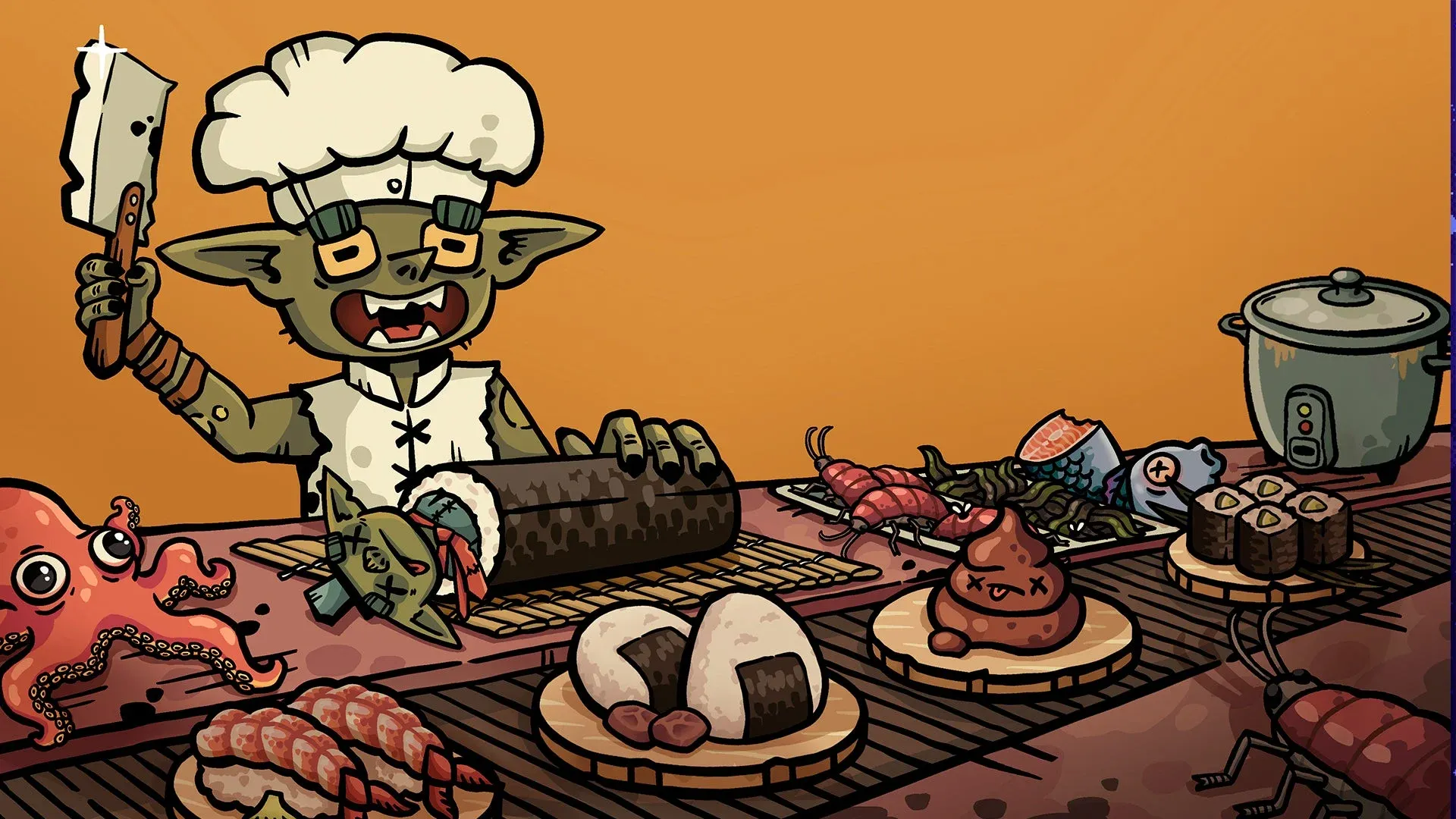


Goblin Sushi lands in a crowded genre of bite-sized roguelikes, but it earns its place at the table by doing something most of its competitors don't: it makes the cooking feel like the game, not just the theme. If you've been looking for something to scratch that "one more run" itch, this one delivers.

Use code TRYHARD33 at checkout to redeem this offer before code expires again.
Get 33% Off GAMES+ Subscription
What the game actually is
Goblin Sushi puts you in the role of a goblin chef running a sushi stall, battling chaotic orders, increasingly demanding customers, and a roguelike progression loop that ties permanent upgrades to how well you perform each run. Each session starts fresh, but the meta-progression layer means you're always building toward something. That loop is tight.
The cooking mechanics themselves are more involved than you'd expect from the art style. Ingredients have properties that interact with each other, some combinations buff your output while others cause chaos on the prep board. Learning which pairings work is genuinely satisfying, and the game does a good job of teaching through failure rather than tutorials.
How the roguelike structure holds up
Here's the thing: a lot of cooking games use roguelike as a buzzword and then deliver a shallow upgrade tree with no real decision-making. Goblin Sushi sidesteps that problem by making each run feel meaningfully different based on which upgrades you draft.
The upgrade drafts happen between rounds, and the choices are genuinely interesting. You might pick between a passive that speeds up knife work, an ability that lets you recycle failed rolls, or a customer patience modifier that buys you breathing room on harder waves. None of these are obviously correct, and that ambiguity is where the game finds its depth.
Run length sits at a comfortable 20 to 30 minutes, which keeps sessions from overstaying their welcome. Death sends you back to the hub, where you spend earned currency on permanent unlocks including new goblin characters with different starting stats, additional ingredient types, and harder difficulty modifiers for players who want more challenge.
Where it stumbles
Goblin Sushi isn't without friction. The customer queue UI gets cluttered fast once later waves introduce multiple simultaneous orders, and it can be hard to track which order belongs to which customer under pressure. A clearer visual separation there would help.
The permanent upgrade tree also front-loads its most exciting unlocks. After the first few hours, new characters and ingredients trickle in slowly enough that the meta-progression starts to feel like a grind rather than a reward. Players who burn through content quickly may hit that wall before the game's difficulty modifiers have a chance to compensate.
That said, the core loop is strong enough that even a somewhat slow unlock pace doesn't kill the momentum entirely. The cooking mechanics carry the experience.
How it compares to similar games
For context, Goblin Sushi sits in similar territory to other genre-blending indie roguelikes. The ingredient synergy system draws obvious comparisons to games like Goroons, which also builds its loop around combining elements in creative ways. Both games reward players who take time to understand the underlying systems rather than just playing reactively.
What Goblin Sushi does better than most in this space is pacing. Runs feel complete rather than truncated, and the difficulty curve within a single session is well-tuned. You're rarely steamrolled without warning, and the moments where things fall apart are usually traceable back to a decision you made two rounds earlier.
If you want to get deeper into this genre, the gaming guides cover a range of roguelike and strategy titles that share Goblin Sushi's DNA.
The verdict on Goblin Sushi
Goblin Sushi is a genuinely good time. The cooking mechanics have real depth, the roguelike structure makes smart use of upgrade drafts, and the run length is well-calibrated for both short sessions and longer play. The UI clutter in late waves and the slow meta-progression are real issues, but neither is a dealbreaker.
For fans of the genre, this is worth picking up. The core loop holds up across multiple runs in a way that many similar games can't sustain past the first hour. For players new to roguelikes, the Goroons guides collection is a solid starting point for understanding how these systems work before jumping into a new game.