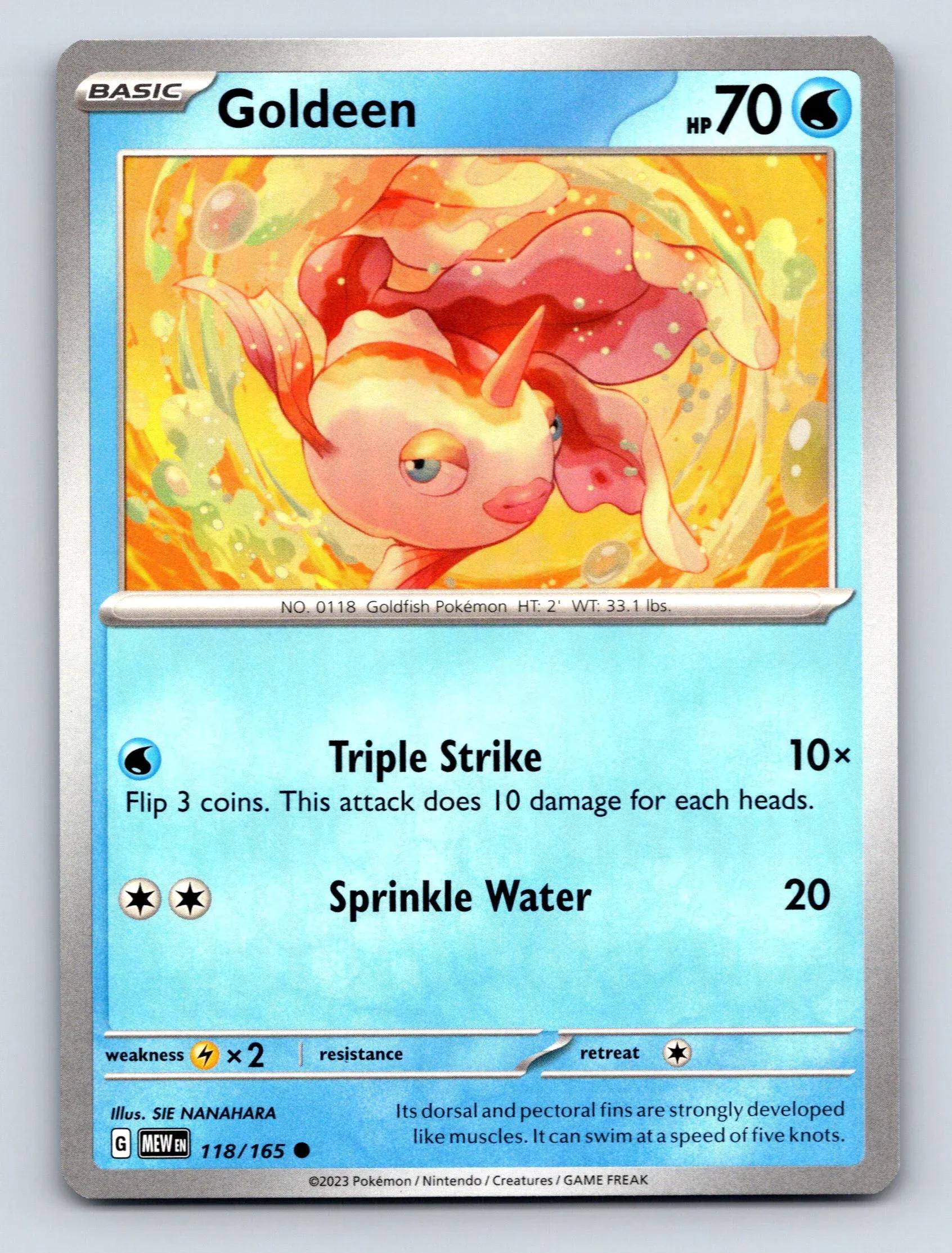

Goldeen has been part of the Pokémon franchise since Generation I, yet it still flies under the radar for most players. That horn on its forehead is not decorative. This is a Water-type with a specific identity, a clear evolution path, and a competitive niche that gets overlooked almost every time a new game drops.

Goldeen Pokédex stats view
What Goldeen actually brings to the table
Goldeen is a pure Water-type from Generation I that evolves into Seaking at level 33. Base stat total: 320, distributed as 45 HP, 67 Attack, 60 Defense, 35 Special Attack, 50 Special Defense, and 63 Speed. The numbers look unimpressive until you factor in that Goldeen leans into physical Water moves and carries Horn Drill, the one-hit KO move that gives it a threat profile most special Water-types can't replicate.
The ability options matter more than the stats suggest. Swift Swim doubles Speed in rain, turning Goldeen into a legitimate sweeper under the right conditions. Water Veil blocks burns, which is situationally useful. The hidden ability, Lightning Rod, pulls Electric-type moves away from teammates in doubles, making Goldeen a surprisingly functional support pick in rain-focused team compositions.
Before Seaking: how Goldeen was used in older games
In Red and Blue, Goldeen was a Good Rod catch that most players immediately boxed. Its combined Special stat of 35 meant it couldn't do damage on either side of the attacking spectrum. Seaking improved the numbers slightly but didn't change the fundamental problem: neither form hit hard enough to justify the team slot.
Gold and Silver didn't rehabilitate its reputation. Ruby and Sapphire flooded the region with Water-types, and Goldeen still couldn't compete for a roster spot unless someone was running a themed playthrough or completing a Pokédex. The perception that Goldeen was filler content stuck for over a decade.
The New Pokémon Snap effect: seeing Goldeen differently
Games that let you observe Pokémon outside of battle tend to change how players evaluate the entire roster. New Pokémon Snap, released in 2021, put players behind a camera instead of a Pokédex. No catching, no battling, just watching creatures exist in their environments.
The shift in perspective matters for something like Goldeen. When you're not immediately calculating base Speed stats, the design reads differently: an ornate, elegant fish with a genuinely striking silhouette. Players who encountered Goldeen through underwater photography sequences developed a different relationship to the Pokémon than those who only knew it from competitive tier lists. That disconnect explains why older, mechanically underwhelming Pokémon keep finding new audiences in games that prioritize observation over optimization.

Goldeen in its natural habitat
Where Goldeen sits now across current games
In Pokémon Scarlet and Violet, Goldeen spawns in South Province rivers and evolves into Seaking at level 33. Seaking's Waterfall and Megahorn combination hits hard enough to carry through story content, and the Lightning Rod hidden ability remains one of the better support tools available on a Water-type in doubles formats.
Neither Goldeen nor Seaking appear in serious ranked play, but both have carved out a presence in lower-tier formats like PU and ZU. For players building themed teams or working through regional Pokédex runs, understanding what Goldeen does well versus where it falls short saves backtracking and wasted experience points.
For deeper dives into Pokémon team building and other franchise entries, our gaming guides cover everything from type matchups to version-specific availability across the series.
The Pokémon that reward a second look
Goldeen will not anchor a competitive team in 2026. That was never the point. What it represents is the broader reality of Generation I Pokémon that never received a major redesign or a legendary connection: their value shifted from mechanical to cultural.
The franchise now spans enough games and formats that a Pokémon like Goldeen can be genuinely useful in one context (Swift Swim rain doubles), aesthetically compelling in another (photography-focused gameplay), and nostalgically significant in a third (original 151 completionism). Those three contexts coexist, which keeps older entries relevant across different player demographics.
If you want to see how Goldeen and Seaking stack up against other Water-types across the franchise's history, our game reviews section covers the mainline titles where these Pokémon appear. The full picture of where Goldeen fits keeps expanding with each new generation, and the next Pokémon title will almost certainly give it at least one more moment worth attention.