

PC and console gaming in 2025 produced strong performance across major franchises, blockbuster launches, and breakout indie successes. Fresh analysis reveals which games drew the largest player counts on Steam, PlayStation, and Xbox, while also showing how revenue flowed through Steam's marketplace over the year. The results paint a picture of a market where premium titles still command the largest audiences, but socially driven indie releases are carving out substantial space.

The year's biggest games were defined by player reach
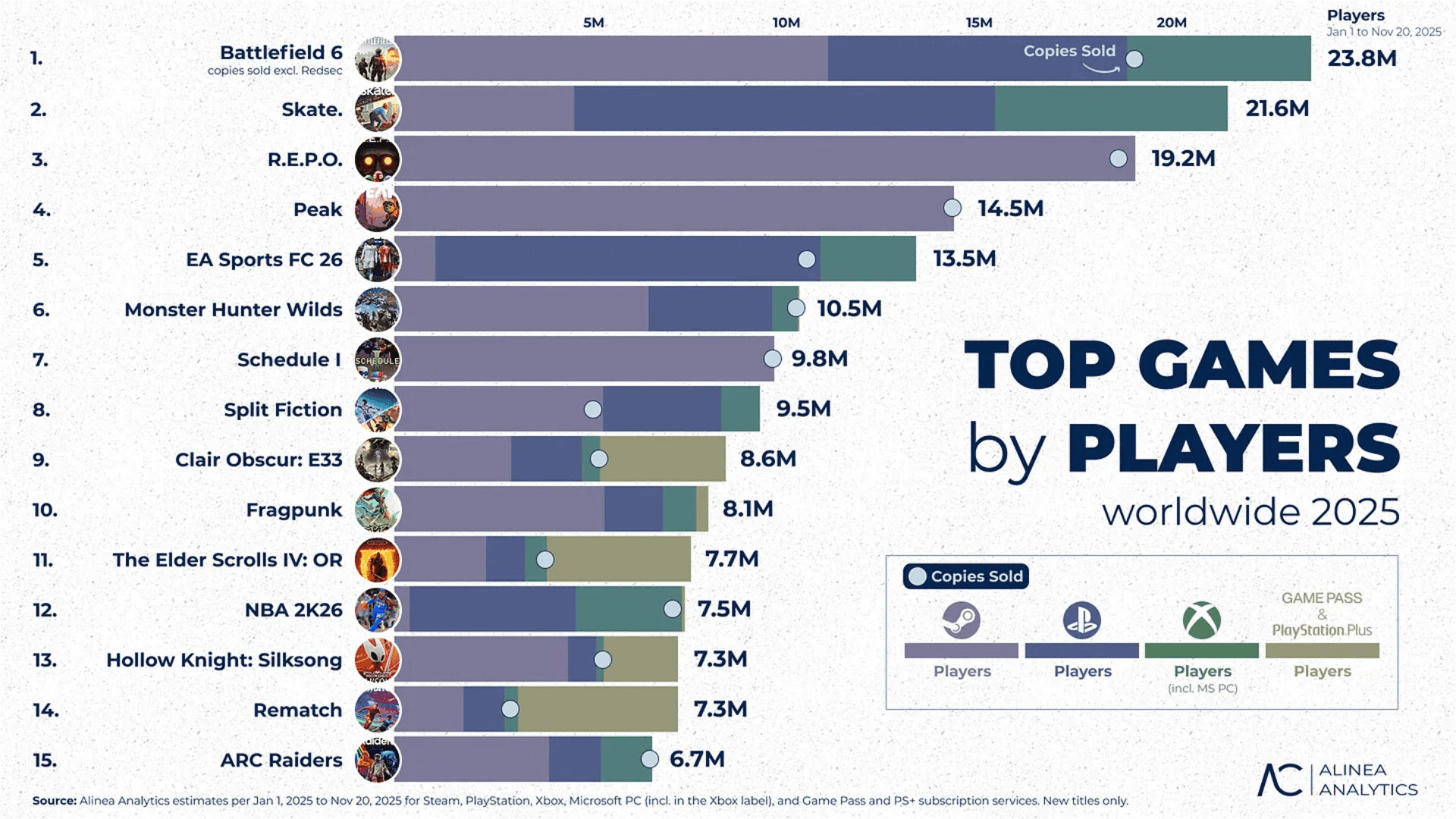
Total player counts across platforms remain the clearest measure of a game's cultural footprint. Battlefield 6 topped all new 2025 releases, pulling in over 26 million players when its free-to-play REDSEC mode is included. The base game alone sold more than 20 million copies, marking a return to form for the series after design shifts that brought it closer to what fans had been asking for.
EA's skate. reboot also posted massive engagement numbers, hitting roughly 23 million players throughout 2025 and holding onto more than 750,000 daily active users even after the initial surge cooled off. Its focus on accessibility and creator tools turned it into something closer to a social hub than a pure sports title.
Some of the year's most impressive performances came from games that weren't positioned as AAA releases. R.E.P.O., a cooperative horror game, reached nearly 19.6 million players. PEAK, a physics-based climbing game, crossed 15 million players on Steam by itself. Both leaned heavily into proximity voice chat and mechanics that generated organic, shareable moments between players. EA Sports FC 26 rounded out the top five, continuing its console dominance despite slightly lower unit sales, buoyed by deeper monetisation in Ultimate Team.
Steam revenue climbed steadily through the year
Steam pulled in an estimated $17.7 billion in 2025, up 15% from the prior year. That growth happened even as roughly 20,000 new games launched on the platform, showing just how concentrated revenue remains at the top. Only a small percentage of releases crossed the $1 million revenue mark, underscoring the ongoing difficulty of breaking through on PC storefronts.
Premium games drove the bulk of Steam's earnings, accounting for about 78% of total revenue. Free-to-play titles made up the other 22%, though many of the biggest free-to-play games run through their own launchers and aren't fully captured in Steam's figures. The pattern from 2025 is clear: premium PC games can still generate serious money when they launch strong or maintain long-term player interest.
Indie releases claimed a major slice of the market
Indie games pulled in around $4.5 billion on Steam in 2025, making up more than a quarter of the platform's total revenue. While thousands of indie games launched, a small number of breakout hits drove most of that figure.
The top five new indie releases by revenue generated over $500 million combined. Schedule I led that group, with R.E.P.O. close behind, and PEAK, Silksong, and Escape from Duckov all posting strong numbers. Many of these games were barely on anyone's radar a year earlier, showing how quickly a title can gain traction when it connects with players.
A recurring theme among these successes was the emphasis on social-first cooperative gameplay. Games built around shared challenges, proximity voice chat, and physics-driven chaos encouraged players to clip and share moments naturally. That player-driven visibility acted as a powerful marketing engine, especially on TikTok and Discord.
Cooperative mechanics proved commercially effective
The performance of R.E.P.O. and PEAK indicates that cooperative design has moved beyond niche appeal. These games embraced high-stakes scenarios where player mistakes became part of the fun, creating repeatable moments that kept them relevant long after launch.
Data from 2025 showed that cooperative games drove increasing revenue and engagement, particularly among friend groups seeking shared experiences over competitive matches. This shift suggests that co-op-focused design can be both affordable to develop and scalable, especially for independent studios.
The industry looks fragmented but healthy
By the close of 2025, PC and console gaming resembled less of a unified market and more of a set of intersecting ecosystems. Large-scale shooters, annual sports franchises, premium single-player experiences, and low-budget cooperative games all found sizable audiences. Titles like Expedition 33, Monster Hunter Wilds, and Split Fiction proved that premium releases could still succeed without free-to-play models, as long as they reached the right players.
Looking ahead to 2026, the data points to continued space for experimentation alongside established brands. Player behavior in 2025 demonstrated a willingness to engage with both familiar franchises and unconventional new concepts, provided the experience offered something worth sharing or replaying.
Frequently Asked Questions (FAQs)
What was the most played new game of 2025?
Battlefield 6 led all new 2025 releases, reaching over 26 million players across PC and consoles.
Did indie games perform well on Steam in 2025?
Yes. Indie titles generated more than $4.5 billion in revenue on Steam, representing over 25% of the platform's total earnings.
Are premium games still successful on PC?
Premium games made up roughly 78% of Steam's revenue in 2025, confirming that paid releases remain central to the PC market.
Why were co-op games so popular in 2025?
Cooperative games used social mechanics like proximity voice chat and physics-based interactions, which encouraged players to share gameplay clips and draw in new audiences organically.
How did EA Sports FC 26 perform compared to previous entries?
While unit sales dropped year over year, EA Sports FC 26 generated higher revenue thanks to increased monetisation, especially within Ultimate Team on console platforms.