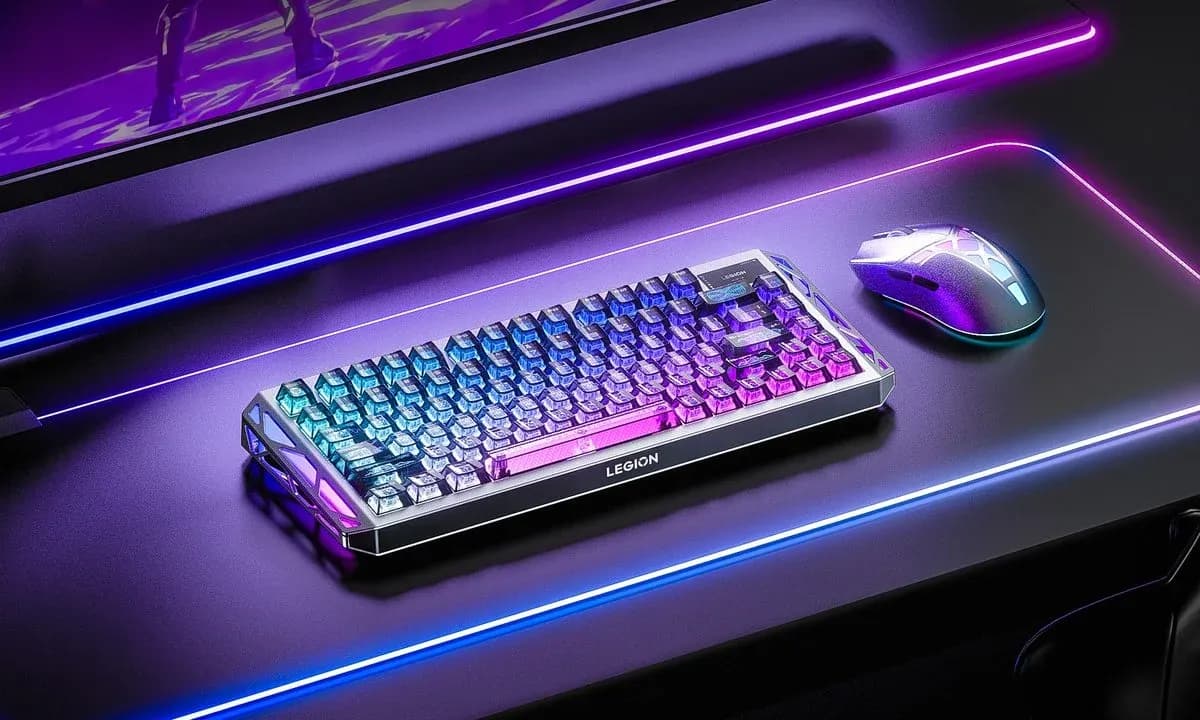

Hall effect keyboards have been flooding the market for a while now, but Lenovo just raised the bar on what a full peripheral setup from a single brand can look like. The new Legion R7 RT75 keyboard and Legion Y7MG mouse both support an 8,000Hz polling rate, meaning every keypress and mouse movement hits your PC faster than most players will ever notice, but competitive players absolutely will.
What the R7 RT75 keyboard actually brings to the table
The R7 RT75 runs a compact 75% layout with Hall effect magnetic switches, not TMR technology. That distinction matters: Hall effect switches track key position using magnets, giving you adjustable actuation down to 0.01mm precision. Features like rapid trigger, SOCD, DKS, and multi-point triggering are all on board for players who want to squeeze every frame out of movement inputs. If you've been optimizing your setup with something like Marathon's best controller and keyboard settings, this level of per-key tuning is exactly the kind of hardware that makes those configurations worth chasing.
The build itself is CNC-machined aluminum, and at 1.49kg it is not going anywhere mid-match. Lenovo added a carbon-fiber positioning plate, gasket-mounted structure, and five layers of sound-dampening material underneath. The result should be a board that feels and sounds noticeably better than most gaming keyboards at this price point. A 1.47-inch display in the top-right corner handles settings readouts and connection info, which is a small but genuinely useful touch.
Connectivity covers USB-C, 2.4GHz wireless, and Bluetooth. The 8,000Hz polling rate is available over wired and 2.4GHz, while Bluetooth drops to 125Hz. The key here is the battery: Lenovo fitted an 8,000mAh cell to handle the combined draw of Hall effect switches, 8K polling, RGB lighting, and that built-in display. That is a significantly larger battery than most wireless keyboards carry, and it will need to be.
The Y7MG mouse packs a lot into 59 grams
The Legion Y7MG weighs 59 grams despite using a magnesium-alloy upper shell, which is the more interesting engineering story here. Magnesium alloy is stiffer and more durable than the honeycomb plastic most ultralight mice rely on, so Lenovo is going for structural integrity without the weight penalty.
Inside sits PixArt's PAW3950 sensor, which tops out at 42,000 DPI and is one of the better optical sensors available right now. Optical switches rated for 100 million clicks round out the internals. Like the keyboard, it supports wired, 2.4GHz, and Bluetooth connections, with 8K polling available in wired and 2.4GHz modes. A 500mAh battery handles wireless operation.
Pricing and availability
Both peripherals launched in China this week. The R7 RT75 keyboard is priced at around $192, while the Y7MG mouse starts at roughly $73. That puts the keyboard in premium territory but not absurdly so given the aluminum chassis, Hall effect switches, built-in display, and 8,000mAh battery. The mouse at $73 is genuinely competitive for a 59g magnesium-shell mouse with the PAW3950 sensor.
What most players miss in announcements like this is the global availability question. Lenovo has not confirmed whether either peripheral will launch outside China, which is the real variable here. The specs are strong and the pricing is reasonable, but neither matters if the products never reach international markets.
For now, if you are building or refining a competitive PC setup, keep an eye on Lenovo's Legion peripheral lineup. Check out our gaming guides for setup optimization tips while you wait for global availability news to drop.