
Nintendo didn't announce an open-world strategy for the Switch 2. It just started shipping one.
When Mario Kart World launched earlier this year, its Free Roam mode felt like an experiment. A pleasant one, sure, but the world had noticeable dead space between objectives, and the rewards felt thin. The idea was there. The execution needed work. What nobody expected was that Nintendo Switch Sports Resort would be the game to iterate on it.
Wuhu Island is doing more work than it looks like
On paper, Nintendo Switch Sports Resort is a motion-control minigame collection. Bowling, Tennis, Badminton, the usual. But the real draw is the trio of leisure activities: Prop Plane, Skateboarding, and Power Cruising. Each one drops you into a different corner of Wuhu Island and lets you move through it freely, hunting down photo spots, hidden missions, and collectibles scattered across the environment.
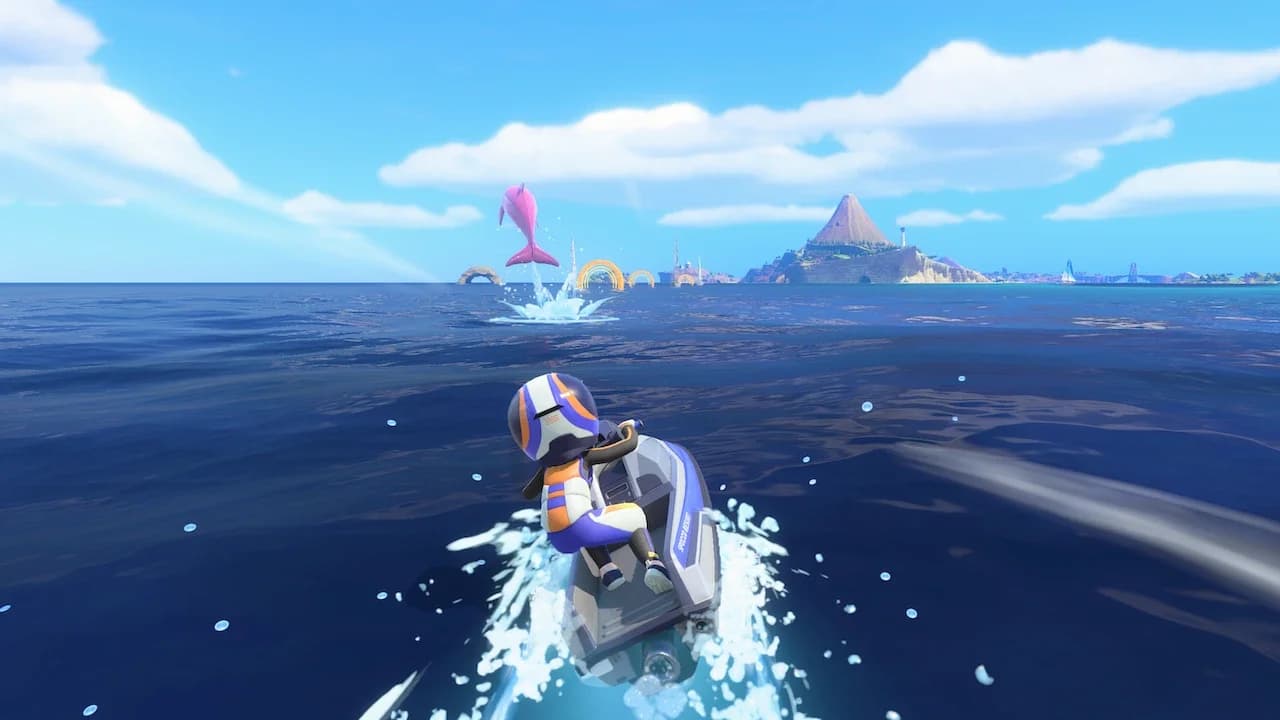
Prop Plane puts you in the sky, tilting a Joy-Con like a paper airplane to thread through caves and pop balloons. Skateboarding keeps you ground-level, using the Switch 2's mouse controls to kick and carve through the island's streets and landmarks. Power Cruising hands you a jet ski and sets you loose on the surrounding ocean, where you can chase dolphins if you know where to look. All three modes run on either a five-minute timed challenge or a freeplay option with no clock pressure.
Here's the thing: Wuhu Island is genuinely built to reward exploration. Every sport in the collection has a corresponding physical location on the island. You can fly over the open-air bowling alley. You can spot the entire golf island from the air, with all its holes laid out. Hidden resorts, secret caves, and landmarks fill in the gaps. The photo collectibles even include text descriptions that sketch out the island's customs and history, which is a small detail that does a lot to make the place feel inhabited rather than decorative.
What most players miss about the Mario Kart World comparison
Mario Kart World's Free Roam mode got this partially right. Weaving between tracks and seeing how they connect in one cohesive space was genuinely satisfying, and it gave players the clearest picture yet of what the Mario world actually looks like between its courses. The problem was density. The world spread its activities thin, and stretches of road between P-Switch missions felt empty in a way that broke momentum.
Nintendo Switch Sports Resort corrects that specific flaw. The five-minute timed runs work because there's always something within reach. You finish popping a cluster of balloons and a photo spot appears on the horizon. You chase a dolphin and stumble into a hidden cove. The pacing keeps you moving without ever feeling like you're grinding toward the next waypoint.
The Switch 2's stronger hardware is clearly enabling this. Wuhu Island isn't enormous, but it's dense enough that three separate traversal modes can each find their own distinct path through it without feeling like they're retreading the same ground.
A design philosophy taking shape across the platform
The pattern here is deliberate. Nintendo is testing open-world ideas inside franchises that wouldn't traditionally carry them, and keeping the scale manageable rather than inflating worlds with filler content. Neither Mario Kart World nor Nintendo Switch Sports Resort asks you to spend 40 hours clearing map icons. They offer compact, well-constructed spaces that hold up across repeated short sessions.
That philosophy has obvious implications for what comes next. Kirby and the World Beyond is on the horizon, and if Nintendo applies the same thinking to that game's world design, the results could be genuinely exciting. The Switch 2 library is also growing with ports and new titles that lean into the hardware's capabilities, from horror experiences like the upcoming Phasmophobia Switch 2 port to multiplayer survival games like Smalland: Survive the Wilds on Switch 2, which brings its own open-world exploration to the platform.
The early picture is encouraging. Nintendo isn't chasing open-world trends by making everything bigger. It's asking which of its worlds are worth actually living in, then building those worlds with enough care that you want to come back. For more on what's arriving on Switch 2, check out the latest gaming guides covering the platform's growing lineup.