

For thirteen years, the Arms Deal page on Counter-Strike.net has carried a promise Valve still has not fulfilled. In 2013, the company said players would eventually be able to submit both their own weapon designs and custom knife models for possible use in Counter-Strike.
The weapon-design part arrived just four months later and grew into a system where community artists can have their work added to the game and receive a share of the revenue. Custom knife models, however, never followed.
The central question is why Valve delivered one part of the plan almost immediately while, thirteen years later, there is still no public sign that the other is coming.
Use code TRYHARD33 at checkout to redeem this offer before code expires again.
Get 33% Off GAMES+ Subscription
The Promise
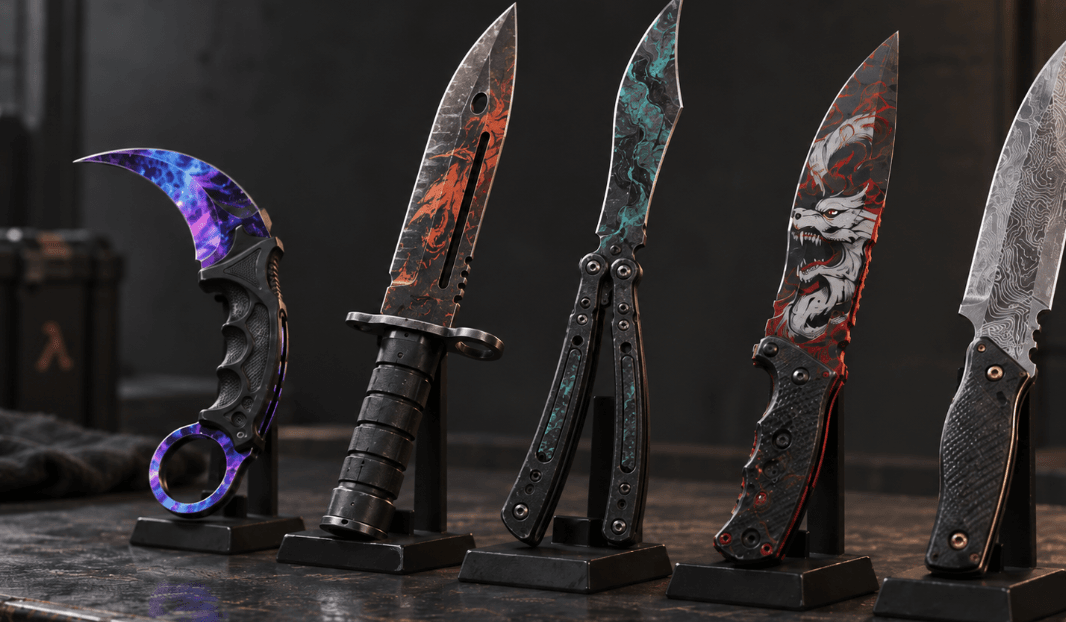
Counter-Strike: Global Offensive was only a year old when Valve released the Arms Deal update on August 14, 2013. The update introduced cases with cosmetic items, StatTrak kill counters, and five knife models: Bayonet, Flip Knife, Gut Knife, Karambit, and M9 Bayonet. Each was available in thirteen original variants, including Vanilla.
Valve stated its plans directly on the Arms Deal page, writing, “In the near future, you’ll be able to upload your own weapon finishes and custom knife models through the CS Workshop.”
Players were already submitting maps through the Workshop, and Valve had a process for reviewing community work before adding selected content to its games. Team Fortress 2 had also already demonstrated that player-made items could become official game content while generating income for their creators.
Extending the same approach to knife models therefore appeared to be a logical next step. Yet while weapon finishes quickly became part of Counter-Strike's content pipeline, custom knife models remained absent.
What Actually Shipped
Community Designs Became Part of the Game
On December 18, 2013, just four months after Arms Deal, Valve released the Winter Offensive Case and described it as the first case made with community-created weapon designs.
Artists could submit their work for possible selection by Valve, with creators receiving a share of the revenue when their designs were added to the game. Over the following years, hundreds of player-made weapon designs were selected for Counter-Strike, and for some artists, creating skins developed into a professional source of income.
The system worked because community artwork could be applied to an existing weapon model while leaving the weapon itself unchanged. This allowed Valve to introduce a regular stream of new cosmetic content without requiring every accepted submission to include a completely new weapon.
Valve now accepts community submissions for maps, weapon designs, stickers, and charms.
Knives Stayed Under Valve Control
Knife models never became part of the community submission system. Community submissions are not accepted for gloves either.
From the original 2013 lineup to the Kukri Knife added through the Kilowatt Case in February 2024, every one of the roughly 20 CS2 knives was created without a community model submission.
The color and pattern designs used on these knives were also created outside the community submission system, including the original sets and later Chroma and Gamma series.
The distinction is visible in the game's item descriptions. Community-made weapon designs credit their artists, while knife items list no community creator and remain Valve-produced content.
How Valve Pays Community Creators
Valve's existing community system also provides a financial incentive for artists.
When Valve selects a community submission, payment depends on how the item is distributed. For direct sales, the creator receives 25% of adjusted gross revenue after refunds, chargebacks, discounts, and applicable taxes have been deducted.
If multiple artists worked on the same item, they divide that share according to an agreed split.
Items distributed through cases use a different royalty system because players are paying to open a case containing several possible rewards rather than purchasing one specific design. Valve determines the royalty allocation for this format.
Since December 2025, some CS2 submissions can instead receive fixed payments, including $35,000 for a weapon design and $6,000 for a sticker or charm.
That system has made community-created Counter-Strike content an established part of the game's economy, making the continued absence of community knife models more noticeable.
Thirteen Years of Asking
Players continued asking Valve to accept community-made knife models more than a decade after the original Arms Deal announcement.
In November 2025, a Steam guide collected dozens of custom knife designs and directly asked Valve to open knife model submissions for CS2, pointing to the potential for creator income and a wider selection of knife designs.
Custom knife models already appear in mods for other games, including Garry's Mod, demonstrating that artists and modders have been creating alternative knife shapes outside Valve's official system for years.
CS2 community servers have also used plugins such as and to give players cosmetic items they do not own. These plugins only imitate access to existing items, however, rather than adding community-created knife models to Counter-Strike.
Valve's server rules do not allow this, and violations can lead to the removal of Game Server Login Tokens used to operate public servers.
The result is an unusual situation: the community has spent years creating alternative knife designs, while Valve's original promise remains visible on the Arms Deal page.
The Scarcity Theory, and Why October 2025 Complicated It
Why Scarcity Seemed Like the Main Explanation
For years, one of the most common assumptions was that Valve did not accept community knife models because it wanted to keep the number of knives limited.
Knives are among the rarest cosmetic items in Counter-Strike, and Valve decides when a new model is introduced. For most of the game's history, newly created knife items entered the economy primarily through paid case openings, where the result is random and knives occupy the rarest reward tier.
Valve also controlled which knife models appeared in cases and when new models were introduced.
Limiting the number of models and the routes through which new knives entered circulation helped maintain scarcity and supported high prices. Under this theory, accepting community-made knife models could give Valve more potential models to release and could potentially increase the supply of knives.
It was a plausible explanation, but it was never confirmed by Valve.
The October 2025 Update Added Another Way to Get Knives
On October 22-23, 2025, Valve expanded the Trade Up Contract, an in-game exchange system that allows players to turn several items into one item of a higher rarity.
Five regular Covert weapon skins, the highest standard rarity, could now be exchanged for a regular knife or pair of gloves from a collection represented among the input items. Five StatTrak Covert weapon skins could similarly be exchanged for a StatTrak knife from a represented collection.
For the first time, the Trade Up Contract could create new knife items and introduce them into circulation without requiring a case opening.
The change had an immediate impact on the Counter-Strike economy. Knife and glove prices fell sharply, while cheaper Covert skins increased in demand as players purchased them for use in Trade Up Contracts.
The update weakened the scarcity argument. Limited supply may still be part of the explanation for Valve's approach to knives, but it is no longer enough on its own to explain why community knife models remain unavailable.
Other Explanations Are Still Only Hypotheses
Valve has never publicly explained why community knife submissions were never added. Several possible explanations remain, but none has been confirmed.
Technical
A weapon finish uses an existing 3D model. A new knife requires its own model, rigging, hitboxes, sounds, and animations.
That makes knife submissions substantially more complicated than weapon skins. Inspect animations are also an important part of how players interact with knife cosmetics, making animation quality particularly important for this category.
Valve would therefore need a system capable of handling much more than artwork submissions.
Legal
Some Counter-Strike knife shapes resemble products made by real-world manufacturers. Community submissions could therefore require additional copyright and trademark checks before a model could be accepted.
Valve has already faced a copyright dispute involving the community-created M4A4 Howl weapon design and replaced its original artwork in 2014.
That history could make Valve more cautious about opening submissions for entirely new weapon models.
Design
Valve may simply prefer to maintain control over knife shapes, animations, colors, and patterns.
Keeping knife development internal means Valve can determine exactly how each new model looks, moves, and interacts with its cosmetic finishes. This level of control could be particularly important for one of Counter-Strike's most recognizable and valuable item categories.
Again, however, Valve has never publicly identified this as the reason.
What It Would Actually Take
Opening knife submissions would require Valve to create tools for full 3D models and animations, establish a separate review process for intellectual property concerns, and determine how model creators would be compensated if their work entered the game.
That is a more complicated system than the one currently used for weapon finishes, stickers, and other community content.
None of this explains why Valve originally promised the feature in 2013 and then delivered only half of it. The company had already established the Counter-Strike Workshop and demonstrated that community-created cosmetics could become a significant part of the game's economy.
Yet thirteen years later, there is still no public indication that custom knife models are being prepared for CS2.
Until Valve builds that process, the original Arms Deal page remains unchanged.
Thirteen years after the promise was made, the phrase “in the near future” still describes a feature Counter-Strike players have never received. It may be one of the longest “near futures” in Counter-Strike history.