
The UGREEN NASync DXP4800 GT is a high-performance four-bay network-attached storage (NAS) device designed for users who need substantial storage capacity, fast network transfers, and the flexibility to run more than just basic backups. Powered by an AMD Ryzen Embedded R2514 processor and equipped with dual 10GbE networking, two M.2 NVMe SSD slots, and expandable DDR4 memory, it aims to provide a versatile storage solution for creative professionals, home users, and small businesses.
With support for up to 144TB of storage, a growing software ecosystem through UGREEN's UGOS operating system, and features such as Docker, virtual machines, AI-powered photo management, and remote file access, the DXP4800 GT offers considerably more flexibility than a conventional external storage drive.
Currently available for $659.99, reduced from $729.99, the DXP4800 GT occupies an interesting position in the NAS market. It combines high-speed networking and capable processing hardware in a relatively compact enclosure, making it an appealing option for anyone looking to build a centralised storage system without moving towards considerably more expensive enterprise hardware.
Design and Build Quality: A Premium NAS With Practical Features
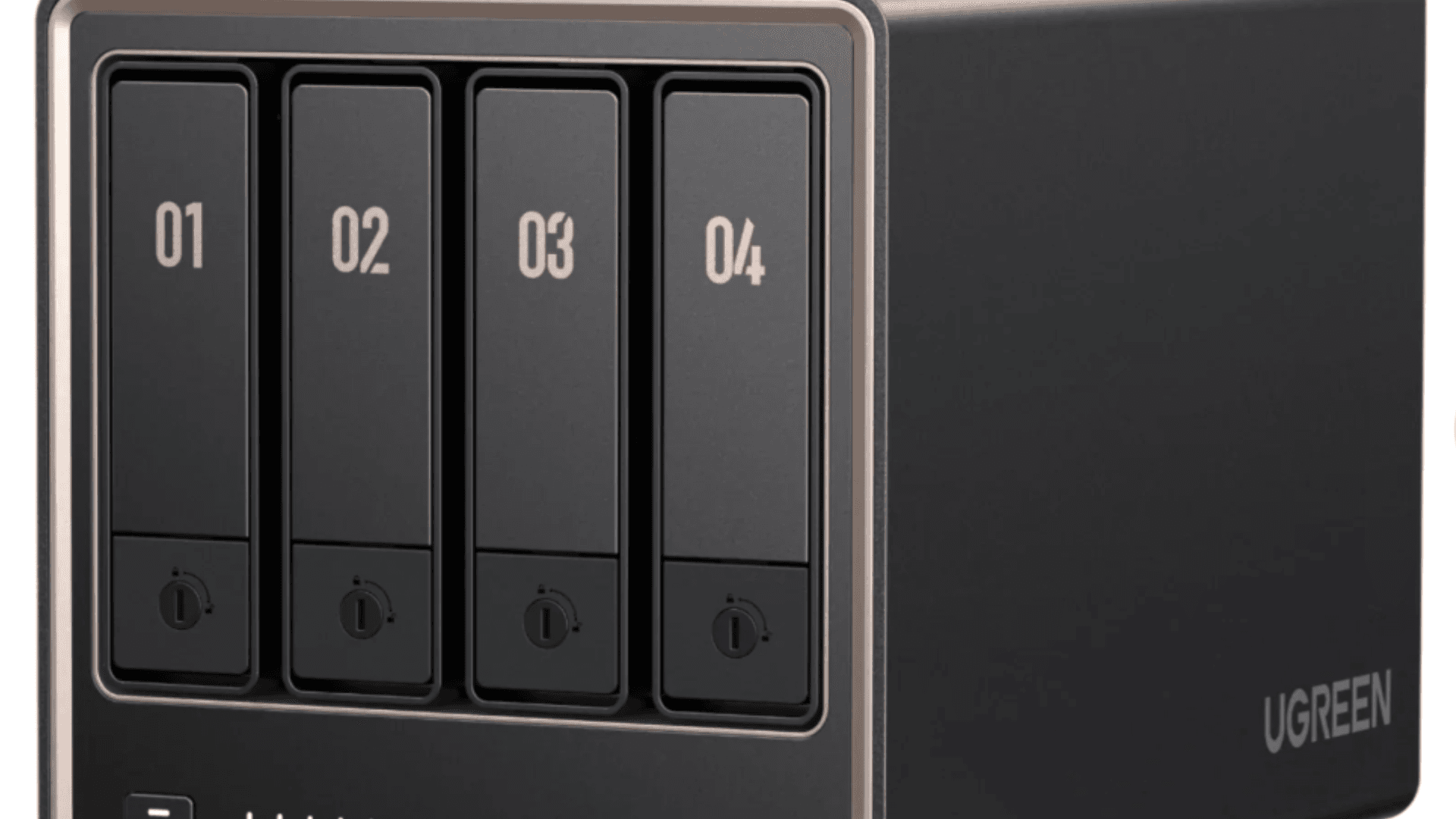
UGREEN has given the NASync DXP4800 GT a refined design that distinguishes it from traditional NAS enclosures. Its space-grey aluminium body, complemented by subtle gold detailing, creates a modern appearance that should fit comfortably into a home office, workstation, or creative studio.
Measuring approximately 10.1 x 7 x 7 inches, the four-bay NAS maintains a relatively compact footprint considering its storage capacity and networking capabilities. Its construction also feels purpose-built for continuous operation, with a magnetic dust mesh filter helping to reduce dust accumulation and a cooling system designed to maintain stable temperatures during extended workloads.
Accessibility is another consideration. Rather than placing every connection around the back, UGREEN has included several useful front-facing ports, making it easier to connect external storage devices and transfer files.
These include an SD 3.0 card reader, a 10Gbps USB-C connection, and a 10Gbps USB-A port. For photographers and videographers, the SD card reader is particularly convenient, allowing media to be transferred directly to the NAS without requiring an additional card reader or complicated setup.
The enclosure also includes rear USB connectivity and an HDMI output supporting 4K at 60Hz.
Overall, the DXP4800 GT strikes a good balance between practicality and appearance. Its design is relatively understated, while the accessible connections make it suitable for users who regularly work with external storage and removable media.
Performance: AMD Ryzen Embedded Processing
At the heart of the UGREEN NASync DXP4800 GT is the AMD Ryzen Embedded R2514 processor, featuring four cores and eight threads, with a maximum boost frequency of 3.7GHz.
This provides a capable foundation for a NAS designed to handle several workloads simultaneously. Beyond storing files and managing backups, the processor supports more demanding applications, including Docker containers, virtual machines, media management, and multiple concurrent file transfers.
The DXP4800 GT comes with 8GB of DDR4 RAM, which can be expanded to a maximum of 64GB. This is particularly useful for users planning to run several services or virtualised environments, as additional memory can help improve responsiveness when handling multiple applications.
The system also supports ODECC memory technology, adding another consideration for users prioritising data integrity and stability.
Its 64GB eMMC system storage provides dedicated space for the operating system, keeping the primary system installation separate from the main storage drives.
For everyday NAS tasks, the included hardware should provide sufficient performance for backups, file sharing, media libraries, and general storage management. More demanding workloads, such as multiple virtual machines or extensive Docker deployments, will benefit from upgrading the memory beyond the standard 8GB configuration.
The ability to expand RAM also gives the DXP4800 GT additional longevity, allowing its capabilities to grow as storage and application requirements change.
Dual 10GbE Networking: A Major Advantage
One of the most significant features of the DXP4800 GT is its dual 10GbE Ethernet connectivity.
Many consumer NAS devices still rely on 1GbE or 2.5GbE networking, which can become a bottleneck when transferring large files or accessing high-resolution media projects. UGREEN's decision to include two 10GbE ports makes this model particularly attractive to users who need faster network storage.
Each Ethernet port supports speeds of up to 10Gbps. When configured with a compatible managed switch and link aggregation, the two connections can provide up to 20Gbps of combined bandwidth across multiple simultaneous connections.
It is important to clarify that this does not provide a single 20Gbps connection to one workstation. Individual connections remain limited to the 10GbE link speed.
Nevertheless, the additional bandwidth can be valuable in environments where several users or devices access the NAS simultaneously.
UGREEN advertises theoretical transfer performance of up to 1,250MB/s, compared with approximately 315MB/s for 2.5GbE networking. Actual speeds will depend on the network configuration, client hardware, storage drives, and workload.
Users will also need compatible 10GbE network adapters, suitable cabling, and potentially a 10GbE switch to take full advantage of the available bandwidth.
For video editors, photographers, and content creators working with large files, this networking configuration is one of the strongest reasons to consider the DXP4800 GT.
It allows compatible workstations to access network storage at speeds that can make working directly from a NAS considerably more practical than relying on traditional gigabit networking.
Storage Capacity and NVMe Expansion
The DXP4800 GT offers four SATA drive bays, supporting hard drives of up to 32TB each. Combined with its two M.2 NVMe SSD slots, the system advertises a maximum storage capacity of 144TB.
This configuration provides considerable flexibility when building a storage environment.
The four SATA bays can accommodate traditional high-capacity hard drives, making them suitable for large media libraries, archived projects, backups, and general file storage.
Meanwhile, the two M.2 NVMe SSD slots provide opportunities to improve storage responsiveness through SSD caching and tiered storage configurations. The system supports caching speeds of up to 16GT/s, helping improve data access in suitable configurations.
Another notable feature is support for high-speed U.2 SSDs in drive bays one and two, providing additional options for users who require faster storage hardware.
The combination of traditional hard drives and NVMe SSDs is particularly useful because it allows users to balance capacity, performance, and cost.
For example, a content creator could use high-capacity HDDs for long-term project storage while reserving SSD capacity for frequently accessed files and active workloads.
The advertised 144TB maximum capacity is also substantial for a NAS in this category. However, it is worth remembering that the storage drives are sold separately, so the initial purchase price does not include the cost of populating the enclosure.
The actual usable capacity will also depend on the selected RAID configuration and storage setup.
RAID Support and Data Protection
Storage capacity is only one part of a reliable NAS system. Protecting stored information is equally important, particularly for users keeping professional projects, business documents, or irreplaceable personal photographs.
The DXP4800 GT supports several RAID configurations, including RAID 0, RAID 1, RAID 5, RAID 6, and RAID 10, alongside JBOD and Basic modes.
This gives users the flexibility to configure their storage around their priorities.
RAID 0 prioritises performance and capacity but provides no redundancy. RAID 1 mirrors data across drives, while RAID 5 and RAID 6 offer different levels of fault tolerance. RAID 10 combines mirroring and striping for users seeking a balance between performance and redundancy.
The availability of these configurations makes the NAS suitable for different storage requirements, from straightforward home file storage to more demanding professional environments.
UGREEN also includes security features such as encryption protocols, configurable permissions, and real-time virus scanning through its Security Manager.
However, RAID should not be mistaken for a complete backup solution. Although redundancy can help protect against certain drive failures, it does not protect against accidental deletion, ransomware, theft, or physical damage to the NAS. Important data should still be backed up to a separate device or off-site location.
UGOS: A Versatile Software Ecosystem
Hardware performance is important, but the operating system ultimately determines how useful a NAS becomes in everyday situations.
The DXP4800 GT runs UGREEN's UGOS operating system, which provides access to file management, storage configuration, remote access, media management, and a growing collection of applications.
One of its most appealing characteristics is its support for Docker and virtual machines. This allows users to go beyond conventional NAS functionality and deploy additional services directly on the device.
For technically experienced users, Docker support opens the door to running self-hosted applications and services, while virtual machines provide additional flexibility for testing software and operating separate environments.
The operating system also includes a poster-wall media player for organising film libraries and support for mounting cloud drives.
This makes the DXP4800 GT particularly interesting for home entertainment enthusiasts who want to consolidate their media collections into one central location.
There is also a Surveillance Center application, which brings camera monitoring, live viewing, recording playback, and event alerts into one interface.
For users building a connected home security setup, this provides another potential use for the NAS beyond conventional file storage.
UGOS is an important part of the overall experience, although users coming from more established NAS platforms may still find differences in application availability, configuration options, and advanced management features. UGREEN's software ecosystem continues to develop, and its long-term value will depend partly on the quality and consistency of future updates.
AI-Powered Photo Management
One of the more accessible software features is UGREEN's AI-powered photo management system.
Rather than requiring users to manually organise every photograph, the NAS can automatically sort images based on faces, locations, and objects.
Duplicate detection is also included, helping identify repeated photographs and reduce unnecessary clutter within large collections.
This is particularly useful for households and photographers who have accumulated thousands of images across smartphones, cameras, and other devices.
Centralising photographs on a NAS provides a convenient way to maintain a personal media library without relying entirely on subscription-based cloud storage.
The ability to organise images automatically makes the experience more manageable, especially as collections grow over time.
However, users should still consider their backup arrangements and privacy preferences when storing personal photographs on any network-connected device.
Remote Access and Connectivity
A NAS becomes considerably more useful when files can be accessed away from home or the office.
UGREEN addresses this through UGREENlink, its built-in remote access service.
The service allows users to access files from different devices without needing to configure a public IP address or undertake complicated network setup procedures.
For people who regularly move between workstations, laptops, and mobile devices, this can make the DXP4800 GT a more convenient central storage solution.
The NAS also supports automatic data backup through its front-facing USB connectivity, providing a straightforward way to transfer information from external devices.
Together, these features make the system suitable for users who want to maintain access to their files without depending entirely on third-party cloud services.
UGREEN also emphasises local data storage and encryption, giving users greater control over where their information is kept and how it is accessed.
As with any remotely accessible NAS, it remains important to maintain strong authentication, appropriate permissions, and current security updates.
Installation and Everyday Usability
Despite its advanced hardware, the DXP4800 GT is designed to make initial setup relatively straightforward.
UGREEN outlines a three-stage installation process covering preparation, hardware installation, and software configuration.
The included tools help with drive installation, while guided software setup allows users to configure the NAS and begin managing their storage.
This is an important consideration for people purchasing their first NAS, as network storage can initially appear more complicated than plugging in a conventional external hard drive.
The four drive bays provide room for future expansion, while the front-facing connections simplify everyday transfers.
However, users should be aware that this remains a more advanced storage product than a typical USB drive. Configuring RAID, setting up remote access, managing permissions, and deploying Docker applications will require some familiarity with network storage concepts.
For experienced NAS users, this should be relatively straightforward. Beginners may need additional time to understand the available settings and choose the most appropriate configuration.
Power Consumption and Continuous Operation
The DXP4800 GT is designed for 24/7 operation, making it suitable for users who want their files, backups, and applications available around the clock.
UGREEN lists power consumption at approximately 42.36W during drive access and 18.12W when the drives are in hibernation.
These figures provide a useful indication of its operating requirements, although actual consumption will vary depending on the number and type of installed drives, network activity, and workload.
The cooling system and magnetic dust filter are also intended to support sustained operation.
For users planning to keep the NAS running continuously, an uninterruptible power supply (UPS) is worth considering. UGREEN also offers a bundle containing the DXP4800 GT and a UPS, providing an option for those who want additional protection against unexpected power interruptions.
Price and Value for Money
At its current promotional price of $659.99, reduced from $729.99, the UGREEN NASync DXP4800 GT offers a compelling combination of hardware features.
Its dual 10GbE ports are a particularly attractive inclusion, especially for users who regularly transfer large files or work with high-resolution video.
The AMD Ryzen Embedded R2514 processor, expandable 64GB DDR4 memory, two NVMe slots, and four SATA bays also give it considerable flexibility.
However, the initial price is only part of the overall investment. Since the DXP4800 GT is sold without storage drives, users will need to purchase compatible HDDs or SSDs separately. Those planning to take advantage of its maximum capacity or RAID configurations should account for this additional expense.
It is also worth considering the wider network setup. Without compatible 10GbE networking equipment, users will not be able to access the full potential of its Ethernet connections.
For those who already have a suitable network infrastructure, however, the DXP4800 GT represents an attractive option for building a high-speed centralised storage system.
Verdict: Is the UGREEN NASync DXP4800 GT Worth Buying?
The UGREEN NASync DXP4800 GT is a capable and versatile four-bay NAS that combines high-speed networking, expandable storage, and useful software features in a relatively compact enclosure.
Its AMD Ryzen Embedded R2514 processor provides a solid foundation for multitasking, while the option to expand memory to 64GB gives users room to accommodate more demanding applications. The dual 10GbE ports are another major advantage, particularly for content creators and professionals working with large files.
The two NVMe SSD slots, support for high-capacity SATA drives, and multiple RAID configurations also make it a flexible storage platform. Meanwhile, UGOS adds functionality through Docker, virtual machines, AI-powered photo management, surveillance tools, and remote access.
There are a few considerations before purchasing. The 8GB of included RAM may be limiting for particularly demanding workloads, the storage drives are sold separately, and users will need compatible networking hardware to benefit fully from the dual 10GbE connections. UGOS also has room to mature as a software platform, particularly for users who require more advanced NAS management capabilities.
Nevertheless, these considerations do little to undermine the overall appeal of the hardware.
The UGREEN NASync DXP4800 GT is an excellent option for users looking for a high-speed NAS with substantial storage potential and enough processing flexibility to handle more than basic file backups. It is particularly well suited to content creators, home media enthusiasts, and small teams that need fast, centralised storage without moving into more expensive enterprise solutions.
At $659.99, it offers a strong hardware package and a good foundation for a long-term home or professional storage setup. For users who can take advantage of its 10GbE connectivity and expandable architecture, the DXP4800 GT is well worth considering.