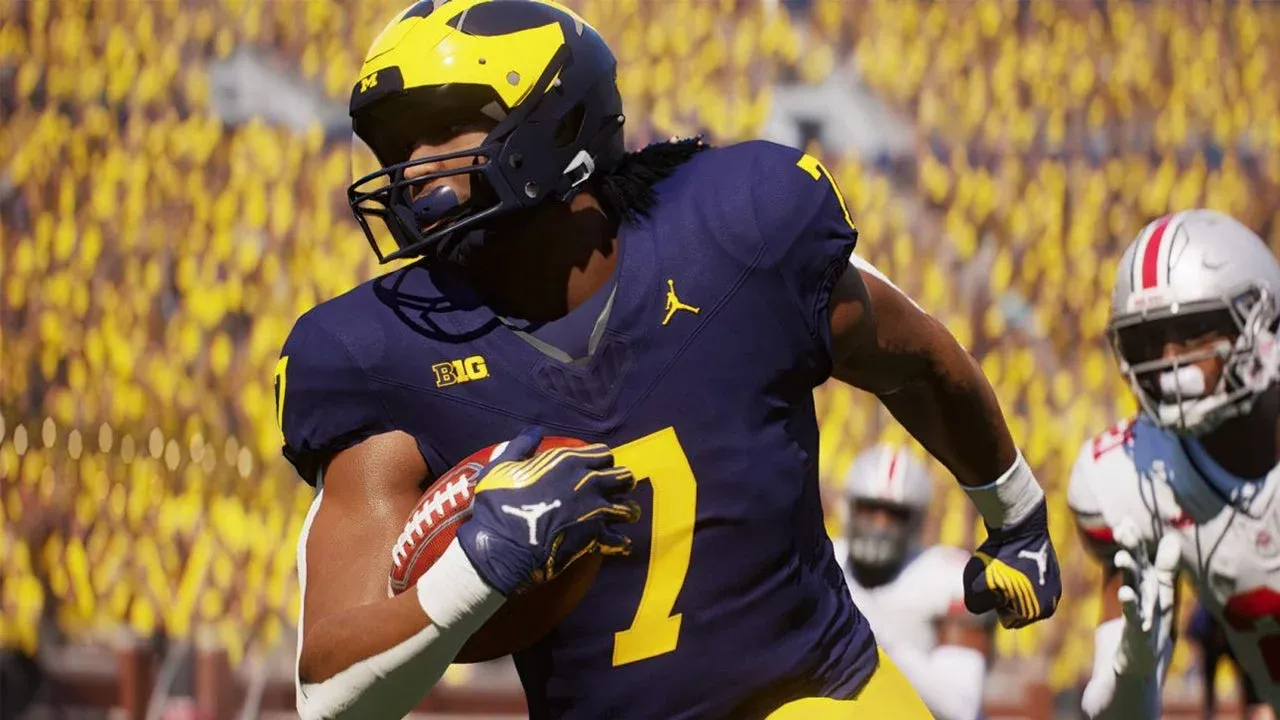
The one decision that shapes your entire Road to Glory career
Picking your quarterback archetype in EA Sports College Football 27 Road to Glory is not a cosmetic choice. It determines how your player moves, what throws you can make, and whether your offense survives on Heisman difficulty when the O-line inevitably fails to block a four-man rush. CFB 27 completely reworked how archetypes work compared to previous entries. Instead of just selecting a label, you now distribute stat points and your archetype is assigned based on that allocation. You can see it update live on the Customize screen, which makes it easy to dial in exactly what you want.
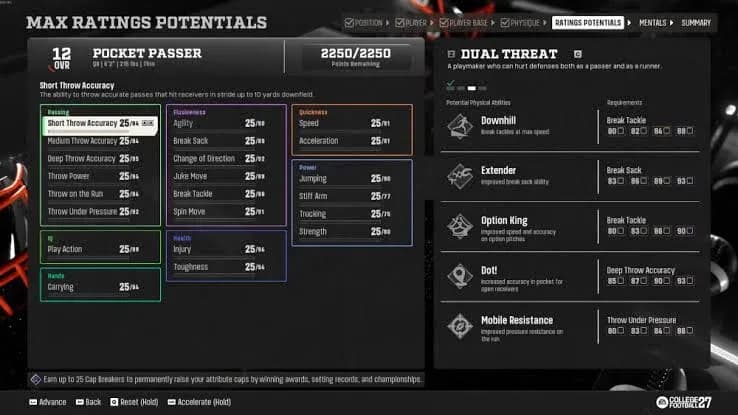
QB Archetype assigned by stat points


What are all the QB archetypes in CFB 27 Road to Glory?
There are four archetypes available to quarterbacks in Road to Glory:
- Dual Threat
- Backfield Creator
- Pocket Passer
- Pure Runner
Each one is tied to a set of legendary player templates you can use as a starting point. Dual Threat templates include Cam Newton, Michael Vick, and Vince Young. Backfield Creator templates are built around Johnny Manziel and Steve Young. Pocket Passer covers Andrew Luck and Drew Bledsoe. Pure Runner templates are Pat White and Tim Tebow. These templates come with pre-set height, weight, and stat distribution, so if you want a fast starting point, just pick the template closest to your vision and adjust from there.
How do the four QB archetypes compare?
| Archetype | Passing | Rushing | Best Scheme | Difficulty |
|---|---|---|---|---|
| Dual Threat | Strong | Elite | Spread, RPO, read-option | Easy-Medium |
| Backfield Creator | Strong | Above average | Improvisational, spread | Medium-High |
| Pocket Passer | Elite | Poor | Pro-style, traditional | Medium |
| Pure Runner | Weak | Elite | Option-heavy | High |
Which archetype is the best for Road to Glory?
Dual Threat is the strongest QB archetype in CFB 27 Road to Glory, and it is not particularly close. The reason comes down to how Heisman difficulty actually plays. Opponent defenses spam blitzes constantly, and offensive lines at most programs cannot reliably block more than four pass rushers. A pure passing build gets you killed in the pocket. A pure running build leaves you unable to threaten defenses downfield. Dual Threat sits right in the middle and benefits from both.
The archetype includes abilities like Dot! and Downhill, which directly support both throwing and scrambling production. You will not throw quite as deep as a Pocket Passer or run quite as fast as a Pure Runner, but the gap is smaller than it sounds in practice. The combination of reliable arm talent and real rushing threat forces defenses into impossible decisions.
After testing multiple builds against Heisman-level blitz packages, the Dual Threat's ability to extend broken plays with legs while still completing medium-range throws is what separates it. A Pocket Passer with no escape option just takes sacks. A Dual Threat turns those broken plays into first downs.
Is Backfield Creator worth using?
Backfield Creator is a legitimate second option, especially if you enjoy improvisation over structured plays. The archetype is built around off-platform throws, pocket movement, and agility, which means it rewards players who read the defense and react rather than those who follow scripted routes. Johnny Manziel and Steve Young are the template references here, which tells you exactly what the playstyle looks like.
The downside compared to Dual Threat is that Backfield Creator is less forgiving. You need to actually create those passing lanes through movement rather than having the raw speed to just run past defenders. On lower difficulties or with a strong supporting roster, it is excellent. On Heisman with a mid-tier program's offensive line, the margin for error shrinks considerably.
If your school runs a spread or RPO-heavy playbook, Backfield Creator pairs well with those concepts. Check the College Football 27 best playbooks and settings guide before committing to this archetype so your scheme actually supports the playstyle.
What about Pocket Passer and Pure Runner?
Pocket Passer is a fine archetype if you genuinely enjoy traditional quarterback play and your program has the offensive line to support it. Deep accuracy and awareness are its strongest attributes, and it excels in pro-style systems where you are reading coverage pre-snap and hitting timing routes. The problem in Road to Glory specifically is that most programs you start with do not have elite O-line protection. Pocket Passers without time to throw are just quarterbacks who take sacks.
Pure Runner is the hardest sell. The archetype calls for a small build focused almost entirely on QB runs and short passes, which creates two real problems. First, poor strength means fumbles and strip-sacks become a consistent issue. Second, the throwing stats are weak enough that you cannot threaten defenses downfield, which means defensive coordinators can load the box without consequence. Option-heavy schemes like those used by service academies can make Pure Runner functional, but for the majority of Road to Glory programs and offenses, the ceiling is too low.

Pass protection
How to build a Dual Threat QB from scratch
If you are not using a template and want to build your own Dual Threat, here is where to focus your stat points:
- Prioritize speed and acceleration early to establish the rushing threat
- Invest in throw accuracy (short and medium range) before worrying about deep accuracy
- Throw power matters more once you reach higher overall ratings; early deep throws on Heisman tend to get picked off regardless of power
- Keep an eye on agility as a secondary investment, since it directly affects pocket escape and scramble effectiveness
For a practical example of how freshman-year progression plays out: starting with 83 speed and bumping it to 86 within the first three games makes a measurable difference in pocket escape ability. Most of your early offensive production will come from designed QB runs and scrambles anyway, so the speed investment pays off immediately.
How does this connect to the rest of Road to Glory?
Your archetype choice affects more than just individual plays. It shapes which abilities become available to you, how your player develops across multiple seasons, and what kinds of programs will actually fit your playstyle. A Dual Threat QB with strong rushing production is a natural fit for spread programs with RPO-heavy playbooks. A Pocket Passer might thrive at a program with a historically strong offensive line and a pro-style tradition.
For the full picture on how player creation and progression work across your career, the College Football 27 Road to Glory complete guide covers Max Potential, Mental Abilities, and the weekly agenda in detail. If you want to know which programs give you the best chance to start early and build momentum, understanding the fastest quarterbacks in CFB 27 ranked by speed rating is also worth a look before you commit to a school.
The archetype decision is the foundation. Get it right and the rest of Road to Glory becomes a question of execution, not a fight against your own build. For more guides covering every mode in the game, browse the full EA Sports College Football 27 guide collection.