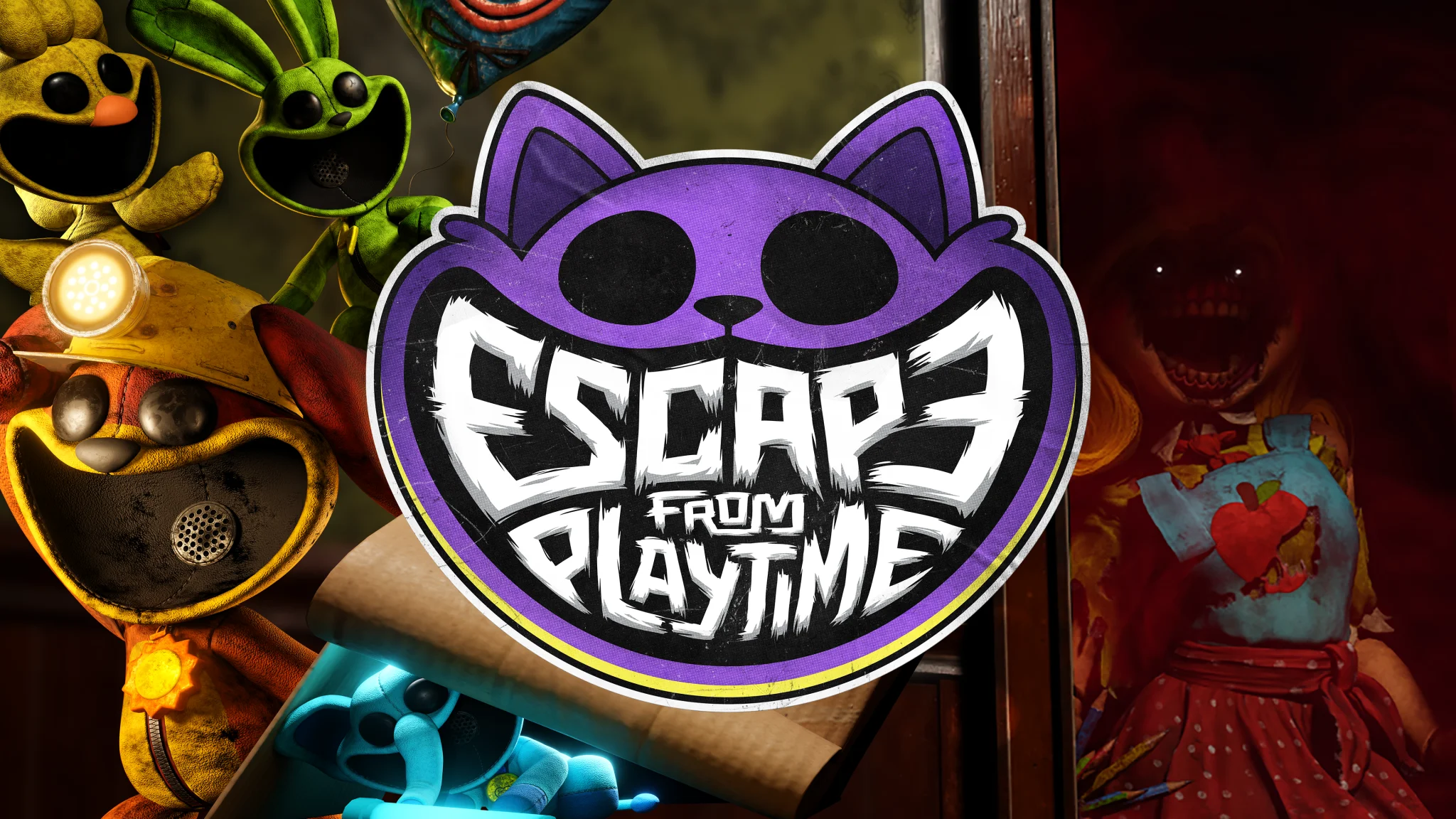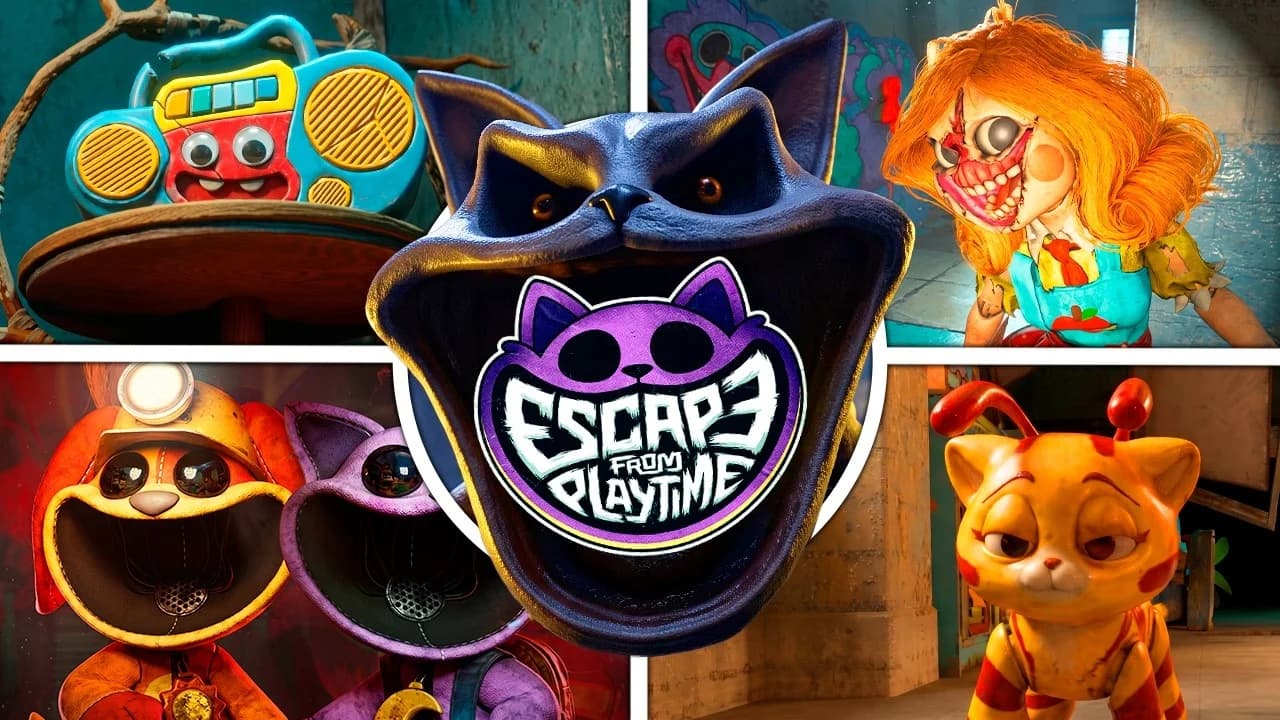

Escape from Playtime drops you into the Playtime Co. factory as one of the Smiling Critters, the candy-colored toy line from Poppy Playtime: Chapter 3, and immediately makes the place feel twice as dangerous. You're small. The factory is enormous. Something is always listening. If you've just picked up the game on Steam Early Access for $9.99 and have no idea where to start, this guide covers everything in the current build: how shifts work, which enemies to fear most, what your tools actually do, and how to claim the free Founders' Pack before it disappears.
For a deeper look at running the factory with a full squad, check out the Escape from Playtime co-op survival guide covering lobby setup, role assignments, and eight-player tactics.

Choose your Critter before each shift
What is Escape from Playtime?
Escape from Playtime is a co-op survival horror extraction game developed by Mob Entertainment, the studio behind the mainline Poppy Playtime series. One to eight players take control of the Smiling Critters and scavenge through procedurally generated sections of the Playtime Co. factory, collecting resources and hauling them back before time runs out or something worse finds them first.
The game sits in official Poppy Playtime canon, set on August 5, 1995, specifically after the Hour of Joy (the in-universe uprising where the factory's experiments turned on the staff) and before the events of Poppy Playtime: Chapter 1. A disembodied Voice crackles over the loudspeakers promising the Critters freedom and a new home in exchange for gathering materials toward an unspecified "sanctuary." Who the Voice is, and whether its promises hold, remains unanswered.
Game Director Brandon James described the intent: the game is designed so longtime fans find familiar faces and lore threads to pull on, while newcomers can jump in with zero prior knowledge of the series.
How do shifts work?
Each run is called a Shift. Your team drops into a procedurally generated section of the factory with one objective: collect scattered parts and resources, deposit them into Barry (a googly-eyed mobile cart), and meet the assigned quota before the area becomes unsafe.
Here's the short answer on the loop:
- Drop into the factory section
- Scavenge loot across classrooms, warehouses, testing labs, and connecting corridors
- Deposit collected items into Barry to accumulate points
- Hit the quota threshold to extract successfully
- Return to the Perm-A-Lounge hub between runs to regroup and check rewards
The quota requirement escalates significantly after each successful Shift, rising from a low initial threshold into the thousands as you progress. The factory layout changes between runs, so no memorized route carries over.
Fail to meet the quota, or fail to extract before red CatNap gas fills the area, and you earn demerits. Accumulate enough demerits and a redemption sequence triggers: you must climb upward to escape rising hazard smoke to survive.
What are all the playable Smiling Critters?
All eight Smiling Critters are available in the current Early Access build, but four require progression to unlock.
| Critter | Unlock Status |
|---|---|
| CatNap | Available from start |
| Hoppy Hopscotch | Available from start |
| Bobby Bearhug | Available from start |
| DogDay | Available from start |
| CraftyCorn | Unlock through progression |
| KickinChicken | Unlock through progression |
| Bubba Bubbaphant | Unlock through progression |
| PickyPiggy | Unlock through progression |
Beyond cosmetic differences, all Critters share the same core movement kit: climbing on virtually any surface (walls, desks, ropes, ceiling debris), jumping, and the ability to boost teammates up to higher areas or pull struggling players to safety.
How does climbing change the way you play?
The factory is built to feel enormous from a toy's perspective, and the climbing system is the main reason exploration stays tense rather than tedious. You can scale practically any surface using a dedicated climb button, which turns vertical space into both an escape route and a scouting tool.
The mistake most players make early on is treating climbing as an emergency option rather than a default movement habit. The factory's rooms can go as high as they go wide. Ceiling debris, stacked furniture, and ropes all offer paths that bypass ground-level hazards entirely.
Stamina management ties directly into this. CatNap gas forces players into higher areas, turning ordinary traversal into a frantic upward scramble. Running out of stamina mid-climb during a gas event is a fast way to end a run.
Team coordination through climbing matters too. Players can boost each other up to reach areas that would otherwise be inaccessible solo, and pulling a struggling teammate to safety from a ledge is one of the more reliable revival options when enemies are blocking the path back to Barry.
What tools are available in the factory?
Inventory space is limited to four slots, so every item you pick up is a decision. Most tools serve dual purposes: navigation aid and tactical option.
| Tool | Primary Use |
|---|---|
| Glow Stick | Mark paths back to extraction or flag important locations |
| Flare | Throw to create temporary barriers against specific enemies; also freezes Miss Delight |
| Air Horn | Signal teammates; also reveals your position to nearby enemies |
| Slap Hand | Stun, disable, or knock back enemies |
| Sewing Kit | Carried over from the Open Beta |
| Antidote | Cures Cat Bee's poisonous sting |
| Poppy-gel Injection | Carried over from the Open Beta |
| Hoppy Ears | Carried over from the Open Beta |
| Go-Go Goop | Carried over from the Open Beta |
| Bounce Pad | Carried over from the Open Beta |
| Sketch-A-Map | Minimap overlay added post-beta for navigation |
The Air Horn is worth a special mention. It can help teammates locate you when proximity voice chat range is too short, but it broadcasts your position to every enemy nearby. Use it only when the alternative is losing a teammate entirely.
If a teammate goes down, their dismembered parts can be collected and returned to Barry for a full revival. Those same parts can also be consumed on the spot for an emergency health boost instead. The choice matters more in later Shifts when revival trips to Barry cost significant time.
Who are the enemies, and how do you handle each one?
The current Early Access build includes four enemy types. Each one requires a completely different response, which is what keeps the limited roster from feeling thin.
Miss Delight
The standout enemy in the current build. Miss Delight is a cracked-porcelain teacher mannequin who actively stalks players and responds to sounds picked up through proximity voice chat. She cannot move while a direct beam of light is fixed on her, making flashlights and flares the key tools for dealing with her.
This is where proximity voice chat stops being a convenience and becomes a survival mechanic. Speaking too loudly, or at the wrong moment, gives Miss Delight your location. The tension this creates is specific: the tool you need to coordinate with your team is the same tool that gets you killed if you use it carelessly.
Boogie Bot
Small patrolling robots that sound an alarm when they spot a player, then speed toward the group and detonate on a timer. Quick exits and keeping movement routes clear are the main counters. They represent the bulk of enemy encounters in early Shifts.
Cat Bee
Floating enemies that latch onto players and apply a poisonous sting that ticks down health over time. The only cure is the Antidote item. Crucially, Cat Bee cannot be removed by the infected player alone: a teammate has to throw something at it to knock it free. Staying within throwing range of at least one teammate is the direct counter.
Bunzo Bunny
Hides on ceilings and grabs players who walk beneath. Anyone caught needs a teammate to throw an item at Bunzo to get free. Looking up before moving through new corridors is the simplest prevention.
| Enemy | Movement Pattern | Counter |
|---|---|---|
| Miss Delight | Active stalker, sound-triggered | Direct light beam; silence |
| Boogie Bot | Patrol loops, alarm on sight | Clear exit routes; disable before detonation |
| Cat Bee | Floats, latches onto players | Antidote; teammate throws item to remove |
| Bunzo Bunny | Ceiling ambush, grabs from above | Check ceilings; teammate throw to free |
How does proximity voice chat work as a mechanic?
Proximity voice chat in Escape from Playtime is range-limited: it only transmits to nearby players, not across the whole map. This forces a constant choice between staying close enough to communicate effectively and spreading out to cover more ground.
Miss Delight responds to sounds from proximity chat, which means every conversation carries risk. Coordinating a split to cover two corridors simultaneously is efficient. Getting spotted by Miss Delight because someone shouted about finding a Bounce Pad is not.
The puzzle gauntlet mode (structured linear Shifts that replace open scavenging with sequential escape-room challenges) tends to generate more team communication and more genuine panic than standard open-dungeon runs, specifically because the puzzles require real-time coordination in tight spaces where Miss Delight patrols.
For solo players, the game is technically playable alone, but the Cat Bee mechanic (requires a teammate to remove) and multi-person puzzles like the giant piano key room make certain sections significantly harder without help.

Miss Delight hunts by sound
What is the Founders' Pack, and how do you claim it?
For the first 30 days after Early Access launch, all players can claim the Founders' Pack at no additional cost. It includes alternate cosmetic skins for all eight Smiling Critters plus additional cosmetic rewards.
Two bonus rewards apply to specific groups:
- Project: Playtime Hoodie: Automatically granted to any player who logged at least one session in the now-discontinued Project: Playtime. This applies on top of the Founders' Pack.
- Chapter 1 discount: Owners of Poppy Playtime: Chapter 1 receive an additional 10% off Escape from Playtime beyond the standard launch discount.
What is on the Early Access roadmap?
Mob Entertainment is targeting roughly one year in Early Access, with a full 1.0 release aimed at late 2027. The studio has stated explicitly that this timeline responds to community feedback rather than a fixed schedule.
Planned additions across the rest of 2026 and into 2027 include:
- New factory zones beyond the current Playcare School starter area
- Additional enemy types (including more "Bigger Body" monsters from the mainline chapters, with added humanizing details)
- New items and cosmetics
- Expanded gameplay features shaped by player input
The game is currently PC-only on Steam. Mob Entertainment has noted it may explore console platforms after the Early Access period concludes.
For more strategies and everything else the factory throws at you, browse the full Escape from Playtime strategy guides collection as new content drops through the roadmap.
Frequently asked questions
Is Escape from Playtime connected to the main Poppy Playtime story?
Yes, it is fully canon. The game is set on August 5, 1995, between the Hour of Joy and the events of Poppy Playtime: Chapter 1. Mob Entertainment has confirmed it carries narrative implications for the wider series, meaning the mystery of the Voice and what the Critters are building will matter beyond this game.
Can you play Escape from Playtime solo?
Solo play is supported, but several mechanics are built around having teammates. Cat Bee requires a second player to remove, multi-person puzzles become significantly harder alone, and carrying enough loot to hit quotas in a single pass is much more difficult without help. The game's designed baseline is four players.
How is this different from Project: Playtime?
Project: Playtime, released in 2022 and since discontinued, was an asymmetric game where one player controlled a monster against six survivors. Escape from Playtime abandons that player-versus-player format entirely. All players cooperate against AI-controlled enemies in an extraction loop, which puts it in the same genre space as Lethal Company and R.E.P.O.
What action games are similar to Escape from Playtime?
If you enjoy co-op survival horror extraction games, you can explore more titles in the action games genre for comparable experiences built around teamwork and tension.