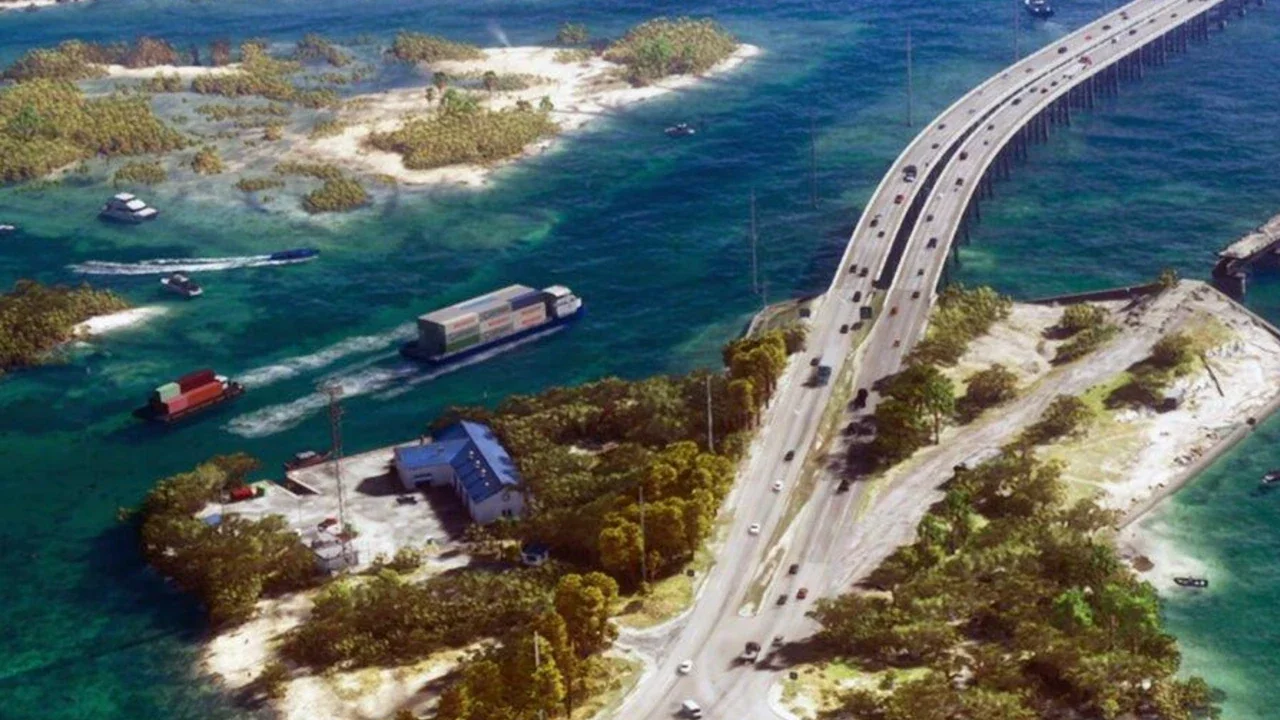

Vice City International Airport is on the western side of Vice-Dale County, southwest of Vice City, in Grand Theft Auto 6.
The airport has separate approaches for the passenger terminal and the operational airfield. Choose your destination before driving in: reaching the passenger building does not give you permission to enter the runway. For a first visit, the terminal approach is a better starting point than heading straight for a parked aircraft.
Airport map location
Look for the VCIA label just north of Mariana County. The clearest map landmark is the airport's two long runways, which form a wedge-shaped footprint. Use that shape to identify the complex, then narrow your destination to the entrance you need.
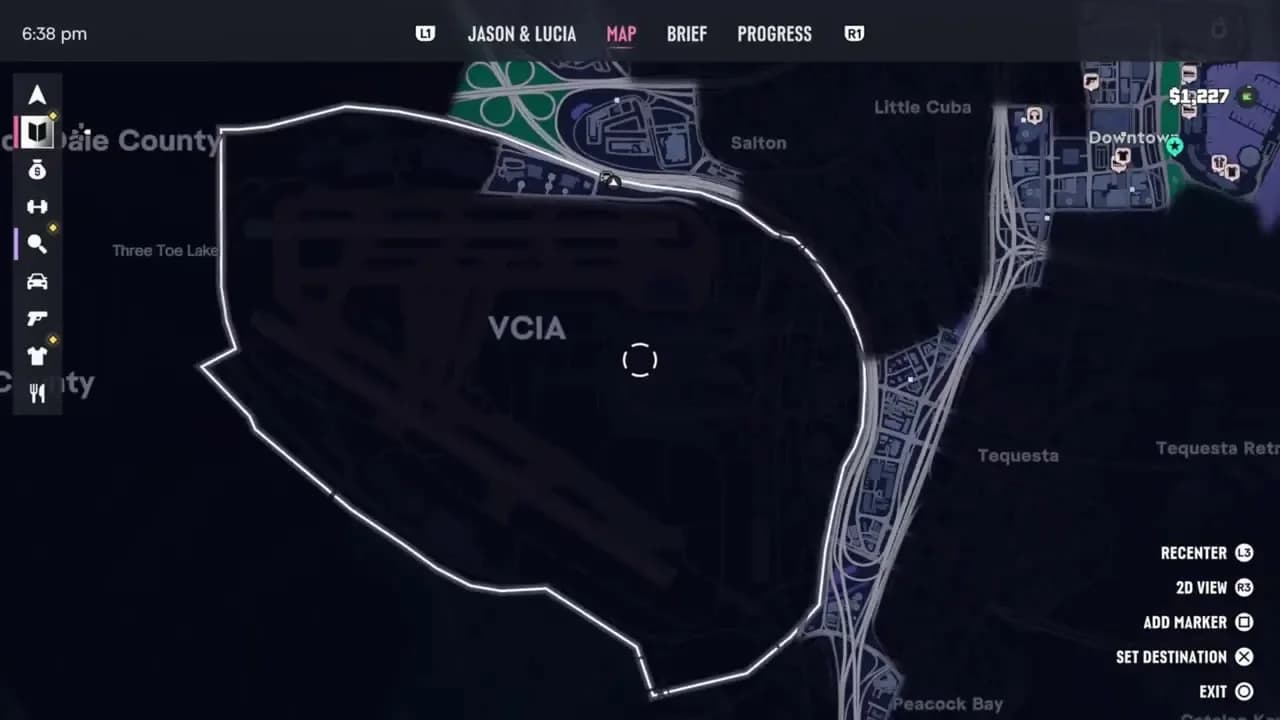
VCIA's two-runway footprint
The terminal, access roads, and parking facilities occupy a different part of the complex from the open runway surfaces. A marker placed anywhere inside the airport boundary can leave you aiming at the wrong side of a restricted fence.
When planning a route between Grand Theft Auto 6 locations, place your airport destination on the passenger approach if you want to explore the building. Save an airfield destination for a visit focused on aircraft.

How to reach the airport
Drive toward the passenger terminal
Use the airport's road entrance for a normal vehicle approach. Signs for Departures and Arrivals identify the passenger side, while the curved access road carries the VCIA CIRCULAR name.
To set up your approach:
- Open Map and move to the airport complex.
- Select the road-facing terminal approach, keeping your destination off the runway surfaces.
- Use SET DESTINATION, then drive into the passenger access area.
The entrance area has two parking garages and a taxi waiting area. These are useful landmarks when you arrive because they identify the terminal approach without requiring you to enter the operational grounds.
Use the air train and skybridge for indoor access
The air train station connects to the terminal through an elevated skybridge. Follow that connection to reach the passenger building without using a runway gate. This is the straightforward route if your goal is to explore inside.
Do not assume every street-facing door is a usable entrance. Head for the connecting walkway instead of circling the front of the building looking for a door that opens.
Airport entrances and restricted areas
Choose an entrance for your destination
The passenger connections and the airside approaches serve different purposes. Use the route that reaches your intended activity, not simply the nearest opening in the perimeter.
| Entrance or approach | Where it leads | When to use it |
|---|---|---|
| Air train station skybridge | Passenger terminal interior | Exploring the terminal |
| Restricted runway gate | Operational airport grounds | Reaching parked aircraft by the airfield roads |
| Climbable perimeter fence | Airport grounds beyond the boundary | Entering the airfield on foot |
Treat the fence as an alternative entry method, not a public passenger entrance. It puts you inside the airport perimeter; it does not turn the operational grounds into an unrestricted area.
Reach the terminal from the apron
If you are already beside the aircraft, a gate-side route using boarding stairs and the adjoining passage also leads into part of the terminal. This is useful when moving from the apron into the building, but it is an unnecessary detour when arriving from the station.
Inside, the terminal includes gate seating, check-in desks, and security-screening lanes. There is more to explore than a small entrance lobby.
What you can do at the airport
Find and take a passenger plane
Large passenger aircraft are parked near the main terminal gates and around the two runways. VCIA's named aircraft include the Botticher 015A and the Lapwing Streamer 216-C.
The Lapwing Streamer 216-C
Taking a plane requires more planning than reaching its door:
- Find an enterable aircraft. Some parked planes are locked, while others can be piloted. Move to another aircraft if your first choice is inaccessible.
- Clear the parking position. Reverse away from ground equipment if support vehicles block your path.
- Line up with a clear runway. Large passenger planes need a long acceleration run before takeoff, so leave enough space to build speed.
Avoid treating the nearest open patch of tarmac as a takeoff strip. Getting the aircraft moving is only the first part of leaving; you still need an unobstructed run ahead of you.
Take airport service vehicles
You can also find the Declasse D7700 utility truck, Brute Ripley service vehicle, and HVY Airtug around the airport. These give you ground-vehicle options if you want to explore the complex without committing to a flight.
Keep the vehicle names separate from the aircraft names when choosing what to search for. The D7700, Ripley, and Airtug are ground equipment, while the Botticher and Lapwing are aircraft.
Explore the terminal and its ATMs
The central terminal contains ATMs that can be broken into for petty theft. Head toward the passenger building for that activity instead of searching the hangars or runway edges.
VCIA has relatively few activity-specific map icons for its size. Its main attractions are free-roam exploration, vehicle theft, and the terminal robbery opportunities, so a quiet-looking map does not mean the airport has nothing to do.
Go elsewhere for smaller planes or military jets
Wild Hog Point is another aircraft destination, with small single-passenger planes. For faster military aircraft, the Grand Theft Auto 6 fighter jet location is at Mile Zero Air Station, a separate destination from VCIA.
Stay with Vice City International Airport if you want a large passenger plane. For an indoor visit, use the station skybridge; for aircraft theft, choose your entry point with the restricted airfield and your takeoff route in mind.