

The offensive plays that actually hold up in Madden NFL 27
Madden NFL 27 is a refinement year, and the offensive meta reflects that. The strongest setups are not exotic gimmicks — they are compact, well-structured concepts that force the defense into a bad trade on every snap. This guide breaks down the best offensive playbooks, the plays worth memorizing, the mechanics that decide whether those plays succeed, and the adjustments that keep them working when your opponent figures out your first read.
What makes a play worth running repeatedly?
Before getting into specific calls, it helps to understand what separates a reliable play from one that gets figured out by the second drive. Three things matter most.
First, the play needs to beat both man and zone without requiring three hot routes every snap. If a concept only works with heavy pre-snap setup, it is a combination call, not a repeatable weapon. Second, it has to put the defense in a bind where stopping one route opens another. Take away the flat and the seam is exposed. Sit on the seam and the flat becomes a free completion. Third, the routes should be readable quickly, because the timing-based catch meter in Madden 27 punishes late decisions just as hard as bad ones.
Return routes are the story this year. EA rebuilt WR/DB interactions with a new jostle system, and coverage defenders now contest routes at specific progression points rather than purely on speed. When a receiver breaks back toward the ball on a return route, the defender's momentum carries him past the break point, and the window opens cleanly. That is why return-route concepts dominate the current meta across multiple playbooks.
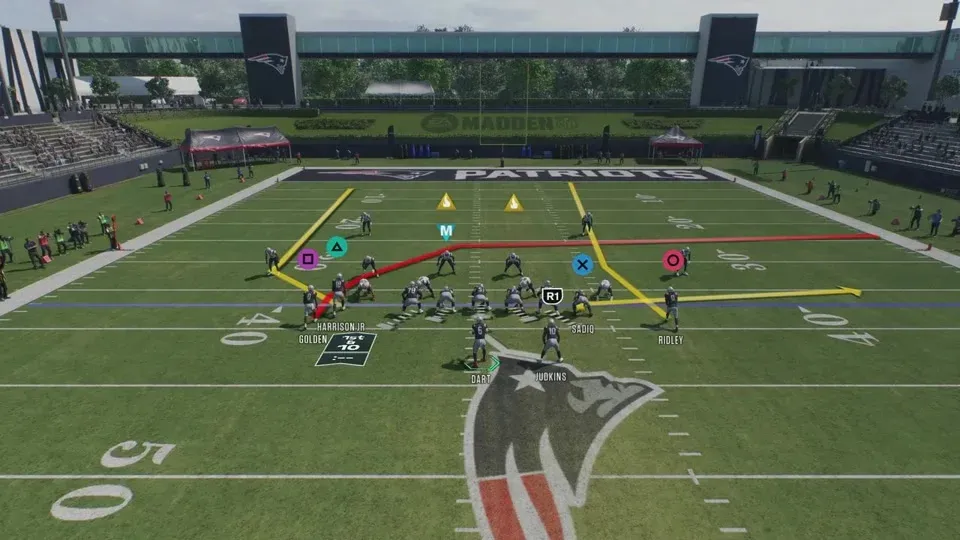
Tampa Bay Tight Doubles setup
Best offensive playbooks in Madden NFL 27
There are dozens of playbooks in the game, but a handful consistently produce results across skill levels and game modes.
Shotgun Classic
This is the most versatile offensive playbook in Madden 27. Everything runs out of the shotgun, which means you can audible into delayed handoffs, RPOs, quick passes, and play-action throws from the same formation look. Key plays include Boomerang RPO Alert Swing, MTN Dig Under, Inside Zone, Motion Diamond Fake Mesh Rail, and Shuffle Motion Halfback Swing. The formation flexibility makes it the right choice if you want one playbook that handles every situation.
Houston Texans
The Texans playbook is the best all-around team-specific option. It makes heavy use of the shotgun but includes enough under-center and pistol sets to keep defenses from pre-diagnosing your alignment. The popular Trips Close formation sits inside and features downfield passing concepts that stretch zones vertically. Key plays worth learning are Cheap Flat X Post, Post Z Return, Corner Double In, Motion MTN Slant Whip In, and the full suite of Halfback Duo, Base, Draw, and Stretch runs.
Cheap Flat X Post is particularly reliable because it has a built-in answer to both coverages: the return route in the seam beats trailing man coverage, while the flat and post serve as clean zone outlets. Call it stock and you still get a completion.
Miami Dolphins
The Dolphins playbook is the most explosive option but also the hardest to master. Motion is baked into almost every formation, and the RPO variety is wider than any other playbook in the game. Key plays include Cheat Fake Swing Wheel, Mesh Traffic, PA Cheat Post Comeback, and Cheat Halfback Double Pass. Expect more mistakes early, but also more big plays once you understand the spacing.
Arizona Cardinals and Gun Doubles Clamp Stack
The brand-new Gun Doubles Clamp Stack formation, featured prominently in the Cardinals playbook, is getting the most meta attention right now. It comes loaded with man-and-zone answers from one alignment, so the defense cannot pre-diagnose based on formation alone. The standout concepts from this set are Flood Seam (attacks middle-of-field coverage with an in-and-up route), Motion Shuffle Mesh Rail (motion-based variety that changes the look without changing the personnel), and Return Bench (a return concept you can adjust by putting the motion man on a drag and streaking the tight end into a high-low flood).
Honorable mentions
- San Francisco 49ers: one of the best rushing playbooks in the game
- Philadelphia Eagles: access to the Tush Push in short-yardage situations
- Los Angeles Chargers: motion-heavy pass-first offense
- Atlanta Falcons: solid all-around playbook built around Pistol Bunch Tight End
Breaking down the Tampa Bay playbook's top three plays
The Tampa Bay offensive playbook deserves its own section because it offers a compact three-play package that creates answers against zone, match, and man coverage without complicated pre-snap work. The key formations are Tight Doubles and Y Off Trips.
Cross Wheels from Tight Doubles
Place the running back and tight end toward the wide side of the field, then streak the inside slot receiver. The wheel route is your primary read. Against zone coverage without a hard flat, the receiver reaches the sideline quickly for consistent 5 to 25-yard gains. If a hard flat is present, wait until the wheel route moves behind the defender before throwing. Against man coverage, the tight-end drag, deep crosser, and running-back out route all become viable secondaries.
Hash mark positioning matters here. Keep the ball on a hash and put your running back and tight end to the wide side. The spacing is what makes the wheel route work.
RPO Read Flat from Y Off Trips
Before the snap, check the defender marked by the P key. If that defender is positioned deep or near the middle linebacker area, the tight-end flat becomes an easy quick read. If he crashes toward the flat, hand the ball to the running back. Avoid forcing the quarterback keep against disciplined defenses.
The RPO is effective because the defense has to account for both the perimeter throw and the inside run simultaneously. Even man-blitz looks leave enough space for positive yardage when you make the right read.
PA WR Cross from Tight Doubles
This is the deep-shot concept in the package. Put the tight end on a corner route and streak both short-side receivers. The two vertical routes pull the deep-middle defender away from the crossing receiver, creating a potential one-play touchdown against Cover 3. The play does not work against every coverage shell, but when the defense is sitting in a single-high look, the crossing route behind the vertical stretch is wide open.
How to run the ball effectively in Madden NFL 27
Passing money plays get the attention, but the run game is what keeps defenses honest. EA rebuilt short-yardage and the trenches this year with pile movement, contextual physicality, and a new QB Sneak Meter that weighs your offensive line's push against the defender's shed strength.
Halfback Duo is the most reliable inside run in the game right now. It hits regardless of the coverage shell and does not require specific blocking setups to generate yards. Halfback Stretch rewards pre-snap reads: check the defender's leverage and run away from it. Man coverage rolled left means run it right for an outside lane.
For designed QB runs, QB Zone and QB Wrap out of Pistol and Gun Wing Slot Offset sets punish defenses playing pure pass. They are also short-yardage gold with the new sneak meter.
Hold LT/L2 after breaking the huddle to see your blocking assignments. Any defender with a flame icon is unblocked, so you know before the snap which cut is dead. Stay off turbo until you pick a hole, then accelerate through it. Inside Zone can bounce to different gaps on different snaps if you stay patient.
What are the best passing mechanics to master?
The mechanics in Madden 27 reward fundamentals more than in previous years, and three systems directly affect whether your offensive plays succeed.
Pass leading uses the left stick while pressing the receiver icon. The rule is simple: throw where the receiver is going, away from the defender. If the corner has inside position, lead outside. Throw a drag inside toward a trailing defender and you have thrown it behind your own player.
Throw types matter on every rep. Tap for a lob, a medium press for a touch pass, hold for a bullet. Bullet most of your throws. When you need to clear an underneath defender, hold LB/L1 for a high ball and still hold the icon for a bullet — the ball clears the linebacker without hanging up for the safety.
Catch selection is a decision, not a default. A/X is possession, Y/Triangle is aggressive, X/Square is RAC. In heavy traffic, a possession catch often beats aggressive because the receiver goes down before the hit lands.
The timing-based catch meter is the most important new mechanic this year. A green result catches the ball unless the defense gets hands on it first or lands a perfect hit. A yellow is a ratings-based dice roll. A red means you held too long, and the ball hits the turf every time. Tap the catch button right before the ball reaches the receiver's hands for a consistent green. The meter only appears past a set throw distance, which is why you will not see it on a quick flat.
Recommended passing settings
- Passing Type: Placement and Accuracy for full control of every throw
- Passing Slowdown: Off
- Pass Lead Increase: Small
- Reticle Speed: 10-12 (adjust after a few games based on preference)
- Reticle and Meter Visibility: User Only
- Timing Catch Minimum Distance: 10 yards, UI feedback On
RPOs and the option game
Most players miss that you can hot route on many RPOs. If the route is not a bubble, it can usually be changed. Avoid RPO slants and posts over the middle because a user defender typically lives there, and the post often has not broken by the time the handoff decision arrives. Flip those to a streak or flat instead.
Bubble RPOs only work reliably with two blockers to that side, meaning trips or bunch. Bunch RPO Bubble gives you a blocker outside, a blocker on the slot, and the bubble receiver behind them.
For option football, the speed option lets you tap LB/L1 for a fast pitch or hold for a slower, catchable pitch. Speed options are solid in short yardage when you cut straight up for two yards. A bad option read results in a tackle for loss or a fumble, not an incompletion, so do not build a whole offense around it.
Five things most players get wrong on offense
- Throwing to the primary read when the defender is already there. Read the coverage first, not the route tree.
- Using lob passes over underneath defenders instead of a high-ball bullet with LB/L1.
- Hitting turbo before choosing a hole on runs, which removes your ability to bounce the play.
- Calling the same play four times in a row and wondering why it stopped working.
- Ignoring the catch meter in practice mode, then losing games because of mistimed buttons on wide-open throws.
How do you stop opponents from countering your offense?
The answer is variety within a small menu. Pick two or three plays from the same formation and rep them until you know every read cold. When your opponent adjusts to your primary concept, you already have a counter called from the same look. The defense cannot pre-diagnose based on personnel or alignment because everything looks identical pre-snap.
For the Tampa Bay package, that means Cross Wheels, RPO Read Flat, and PA WR Cross all come from Tight Doubles or Y Off Trips. For the Houston Texans package, Cheap Flat X Post and Post Z Return share enough formation dressing that the defense cannot tip which concept is coming.
The same principle applies to the Gun Doubles Clamp Stack. Flood Seam, Motion Shuffle Mesh Rail, and Return Bench all come from the same stack, so the defense is always guessing.
For more on building a complete offensive and defensive system, the Madden NFL 27 beginner's tips and tricks guide covers the fundamentals from stopping the run to building your MUT roster. If you want to take the Tampa Bay playbook into competitive Head-to-Head, the Madden NFL 27 Ultimate Team guide covers coin strategies, EVO tips, and playbook picks for MUT from day one.
For a deeper look at how defense counters these offensive concepts, the best defensive playbooks guide breaks down the top seven defensive schemes, including Cover 4 pressure and zone setups that specifically target return-route offenses.
For everything else, the full Madden NFL 27 strategy guide collection covers every major mode and system in the game.