

The best QB build in Madden NFL 27 Superstar Mode starts with one decision
Pocket passer or dual-threat. Everything else flows from that choice. Madden NFL 27 overhauled Superstar Mode with a branching Skill Tree system split across five categories, and the path you commit to early shapes your entire career trajectory. Get it wrong and you'll hit 85 OVR with mismatched attributes that don't actually work together on the field.
This guide breaks down both QB archetypes, explains how the Skill Trees interact, and shows you how to push toward 99 OVR without wasting Skill Points.
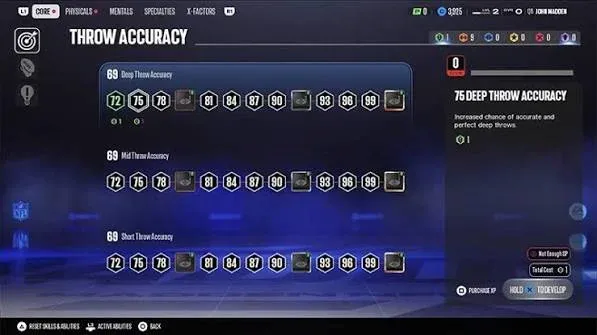
Madden nfl 27 superstar QB skill tree menu screen
How do the Madden NFL 27 Skill Trees work?
EA divided Superstar progression into five distinct categories: Core, Mental, Physical, Specialty, and X-Factor. Each one branches rather than following a single linear path, which means two players at the same position can end up with completely different ability sets depending on where they spent their points.
Here's the short answer on what each category does:
- Core handles fundamental player attributes and baseline passing ability
- Mental improves awareness and pre-snap reads, including abilities that help identify incoming pressure before the snap
- Physical develops athletic traits like Speed and Acceleration
- Specialty provides targeted gameplay improvements tied to specific situations
- X-Factor connects progression to the highest-impact abilities in the game
The mistake most players make is spending early Skill Points randomly across all five categories. The branching structure rewards specialization. Spreading points too thin early means you reach the mid-career stretch without any elite attributes, which makes both progression and on-field performance harder.
Pocket passer vs dual-threat: which QB build is better?
Neither is objectively superior. The right answer depends entirely on how you play. After testing both approaches across multiple career seasons, here's how they actually differ in practice.
Pocket passer build priorities
A pure pocket QB invests heavily in the Core and Mental trees. The goal is making every throw from a clean pocket while reading defenses efficiently before the snap.
Prioritize in this order:
- Throw Power
- Short Throw Accuracy
- Medium Throw Accuracy
- Deep Throw Accuracy
- Mental abilities for pre-snap pressure identification
This build punishes defenses that leave receivers open downfield and stays consistent on third downs. The weakness is obvious: an aggressive pass rush can neutralize it entirely if the Physical tree gets neglected.
Dual-threat build priorities
The dual-threat path splits investment between Core throwing upgrades and Physical development. Speed alone doesn't make a good scrambling QB. Rushing-related abilities and Throw on the Run attributes need to come from the Physical and Specialty trees to make the mobility feel impactful.
Prioritize in this order:
- Throw Power
- Speed
- Acceleration
- Throw on the Run
- Ball-carrier abilities via Specialty
- Medium and Deep Throw Accuracy
The payoff against aggressive pass rushes is real. A QB with strong Physical attributes can extend plays, create yards after the pocket collapses, and force defenses to account for the run threat. Trust me on this one: don't treat mobility as a late-game add-on. Build it in from the start or it never reaches a useful threshold.
How to reach 99 OVR in Madden NFL 27 Superstar Mode
The path to 99 OVR is about long-term consistency rather than any single attribute push. XP comes from playing games, completing objectives, and hitting career milestones. The G.O.A.T. Journey tracks your Superstar from early career through Hall of Fame consideration, and performance in each chapter feeds directly into progression.
For quarterbacks specifically, consistency matters more than peak games. Throwing several interceptions in one game hurts your performance rating and slows development. Efficient passing, touchdowns, and completed objectives accelerate it.
Some practical progression notes:
- Use post-game reports to identify weaknesses. EA's Superstar system provides performance tracking and feedback specifically to guide your next Skill Point spend.
- Career objectives reward Skill Points and advance Career Chapters. Prioritize objectives that align with your build rather than chasing ones that pull you toward the wrong playstyle.
- The Sphere of Influence system lets you build relationships within your career. These interactions affect opportunities and progression, so the mode rewards engagement beyond just posting stats.
For more on spending Skill Points efficiently across your roster, the Madden NFL 27 best evolution upgrade tips guide covers how to avoid wasting resources at every stage of progression.
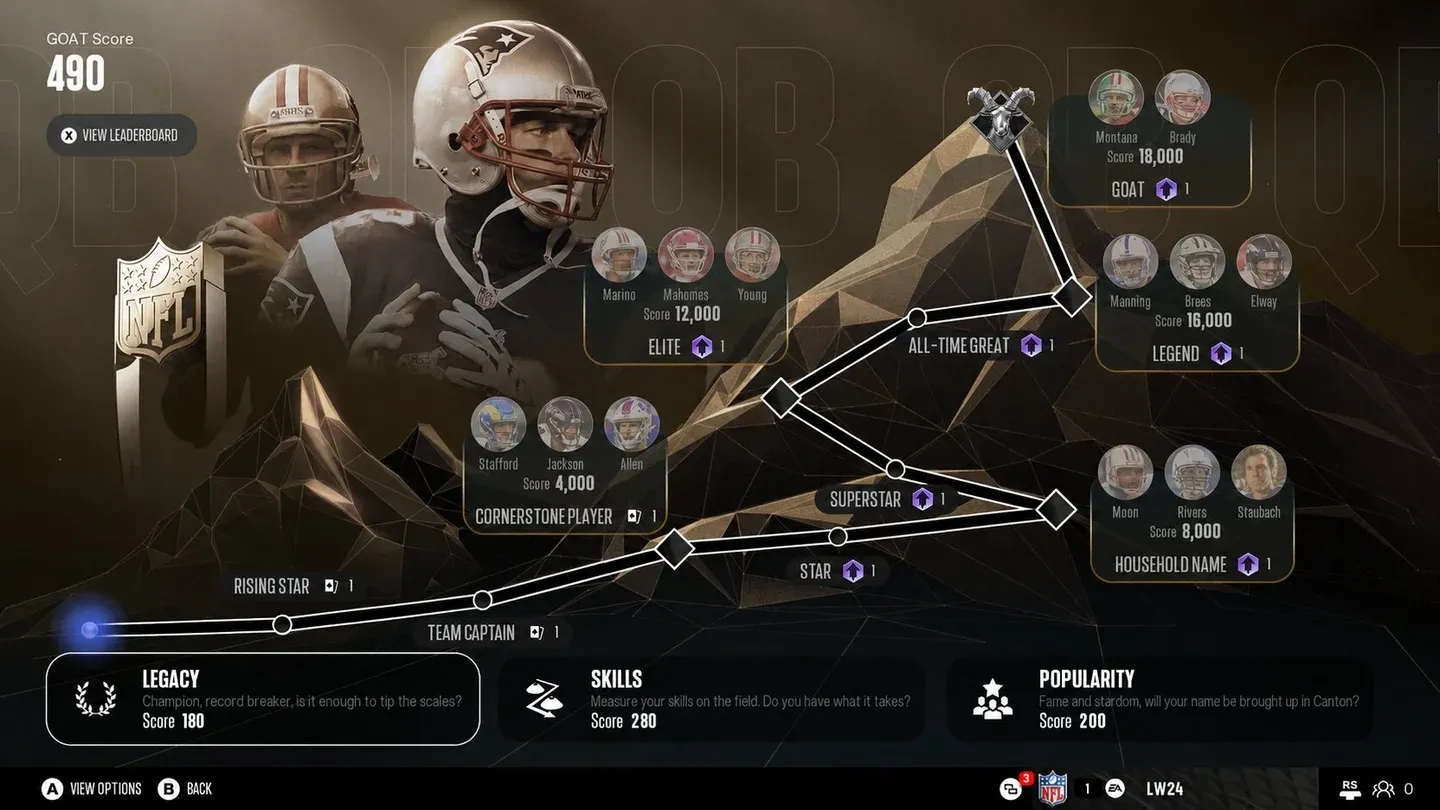
G.O.A.T. Journey progression tracker
What's the best team to start your Superstar QB career?
The source material focuses on tight ends mentioning Baltimore as a strong environment, but the same logic applies to QB builds: team context matters for early XP accumulation. A strong offensive line gives a pocket passer the clean pocket they need to complete objectives efficiently. A team with run game support opens up play-action opportunities that generate easier completions early in a career.
Choosing a team that fits your QB archetype means more organic completion of objectives, which means faster Skill Point accumulation in the first few Career Chapters.
Common mistakes in Superstar QB builds
After working through both archetypes, these are the patterns that consistently slow progression:
Chasing OVR instead of building a role. Spending points to raise the overall number quickly feels satisfying but produces a QB with no elite attributes. A 78 OVR QB with 95 Deep Throw Accuracy beats an 82 OVR QB with every passing stat at 75.
Ignoring Mental for dual-threat builds. Mobile QBs still need to read defenses. Pre-snap pressure identification from the Mental tree saves scrambles for when you actually need them rather than as a default reaction to any coverage.
Skipping Specialty for pocket passers. The Specialty tree contains situational improvements that make a pocket passer genuinely hard to stop in specific game situations. Treating it as optional leaves real performance on the table.
Not using post-game reports. The feedback system exists to guide your next spend. Ignoring it means guessing at weaknesses instead of addressing them directly.
Picking the right position and build identity
Quarterback is one of the most flexible Superstar positions because the Skill Tree system supports genuinely different playstyles at the same position. That flexibility is also the trap. Players who try to build both archetypes simultaneously end up with a QB who can't dominate from the pocket and can't consistently create with his legs.
Commit to one identity early. Adjust based on post-game feedback. Let the G.O.A.T. Journey milestones guide your Skill Point spending rather than chasing the fastest route to a round number.
For players still deciding which position fits their playstyle, the Madden NFL 27 Superstar best position guide covers every role from quarterback to safety with specific recommendations for different play preferences.
If you want to see how the same Skill Tree logic applies to other positions, the Madden NFL 27 Superstar wide receiver speed build guide shows how Physical and Specialty tree investment translates into a completely different offensive weapon. For a full collection of position-specific strategies, the complete Madden NFL 27 strategy guides are worth bookmarking as your career progresses.
FAQ
Can you switch from pocket passer to dual-threat mid-career? Technically yes, but the branching tree structure means early points spent on Core accuracy upgrades aren't recoverable. Switching late costs you the Physical investment window when it matters most for reaching elite Speed and Acceleration numbers.
Does the G.O.A.T. Journey affect Skill Point earnings? Yes. Career milestones and objectives within the G.O.A.T. Journey reward Skill Points directly. Completing Career Chapter objectives accelerates progression more than simply playing games.
What's the minimum OVR where a pocket passer becomes effective? The TE build source notes 82 OVR as an early effectiveness threshold for that position. For QBs, a pocket passer with prioritized accuracy attributes can produce strong numbers before that point if the throwing stats are developed ahead of the overall number.
Does the September 2026 Title Update affect any QB-specific mechanics? The September 16, 2026 update fixed the four-season retirement bug for quarterbacks and addressed progression issues in post-game menus and the NFL Combine flow. No QB-specific attribute mechanics were changed in that update.