
There is no official Steam page called “Top Wishlisted.” Developers usually mean Popular Upcoming, plus third-party rankings of the most wishlisted unreleased games. Valve has not published a ranking formula, so exact thresholds are estimates. Here is what is confirmed, what comes from community data, and what actually moves your wishlist count.
Key takeaways
- Wishlists are not a general visibility factor, according to Valve, with exceptions such as Popular Upcoming. They also trigger launch notifications.
- There is no published wishlist threshold. The often-cited 5,000 to 7,000 figure is Chris Zukowski's estimate, not a rule.
- Wishlists loosely predict sales. GameDiscoverCo reports median first-week ratios of 0.15 sales per launch wishlist for games with 25,000+ wishlists, or 0.10 for those priced above $10.
- Focus on what you control: page quality, demos, festivals, outside reach and weekly Steamworks tracking.
How do Steam wishlists work?
A wishlist is a player's saved list of games they want to track. The Steamworks wishlist documentation says a game needs only a publicly visible store page to be wishlisted. No integration is required.
Wishlisting can trigger:
- Launch notifications: email and/or mobile push when a game enters Early Access or full release.
- Discount notifications: discounts of at least 20% affecting the lowest-priced package and lasting more than 8 hours.
- Demo notifications: one email and push notification you can send when a free demo goes live, within two weeks of its first release.
- An email cooldown: users receive at most one email about an app every two weeks, potentially longer during busy periods such as seasonal sales.
Only users with verified email addresses receive emails, and some opt out. A wishlist is never a guaranteed purchase.
What is the Steam Top Wishlisted list?
Three different things get called “Top Wishlisted.” Mixing them up causes most of the confusion.
| Name | What it means | Who controls it |
|---|---|---|
| Popular Upcoming | A section of Steam's Upcoming Releases surfacing highly wishlisted unreleased games close to launch. | Valve; formula unpublished. |
| Most wishlisted rankings | Third-party lists of unreleased games, such as SteamDB's Most Wishlisted. | SteamDB, not Valve. |
| Your wishlist count | The number in your Steamworks reports. | You influence it through marketing. |
Valve's visibility documentation mentions Popular Upcoming once, as an exception to wishlists not being an algorithmic factor. It does not explain how the tab works.
How Popular Upcoming works: facts versus estimates
Everything in the right-hand column is an outside estimate and can change.
| Known from Valve | Estimated through community analysis |
|---|---|
| Wishlists are “not a factor” in algorithmic visibility, with exceptions such as Popular Upcoming (Steamworks). | Ranking blends wishlist total, wishlist velocity and release-date proximity, according to Chris Zukowski, as summarized by Steam Page Analyzer. |
| Valve's Erik Peterson said Popular Upcoming is “affected by the number of wishlists” at devcom 2023 (quoted by How To Market A Game). | Zukowski's estimated floor is roughly 5,000 to 7,000 wishlists, with 7,000 to 12,000 safer, depending on release-week competition. Valve has published no threshold. |
| Valve says there is “no special milestone or number around wish lists” (Valve Q&A, quoted by How To Market A Game). | A game effectively gets one run on the list; Early Access can use it up. |
| Valve updated Popular Upcoming on June 5, 2026, “to better capture the most anticipated releases of the coming month” (PCGamesN). | The window moved from about a week to about a month, raising the bar for small games, according to Steam Page Analyzer's limited June 2026 data. |
| Wishlisters receive launch, discount and demo notifications, per Steamworks. | Featured games gain roughly 750 to 2,000 wishlists daily. One January 2026 sample of 163 games found a median stay of about one day. |
The practical reading: Popular Upcoming rewards games with an already large, fast-growing wishlist base near release. It is a result of earlier marketing, not a lever you pull directly. Threshold estimates can also shift after Valve's update.
In one case from the same analysis, Parcel Simulator entered with about 42,000 wishlists, and its developer credited only about 2,000 to the feature. Treat that as one anecdote.
Do wishlists turn into sales?
Valve says you cannot accurately predict sales from wishlists. GameDiscoverCo's external estimates offer rough benchmarks, calculated as first-week sales divided by the wishlist balance at launch:
| Dataset | Median first-week sales per launch wishlist |
|---|---|
| Games launching with 25,000+ wishlists | 0.15x |
| The same set, restricted to games priced above $10 | 0.10x |
| A 2024 anonymous poll of games with 10,000+ wishlists | 0.17x |
The same author's earlier survey found median year-one revenue about 3.16x week-one revenue, so launch week is not the whole story.
For planning, 20,000 wishlists multiplied by 0.10 to 0.17 suggests roughly 2,000 to 3,400 first-week sales. That is arithmetic using community medians, not a promise. Results vary widely by genre, price, reviews and timing.
How to get more wishlists on Steam
Valve gives you no direct ranking lever. Your job is to attract more qualified visitors and increase the share who wishlist. These levers are in rough order of controllability.
1. Fix store page conversion first
Traffic is wasted on a weak page. In his February 2026 Next Fest survey, Chris Zukowski put the page-conversion “sweet spot” for games with 1,000+ wishlists at roughly 20% to 30% (source).
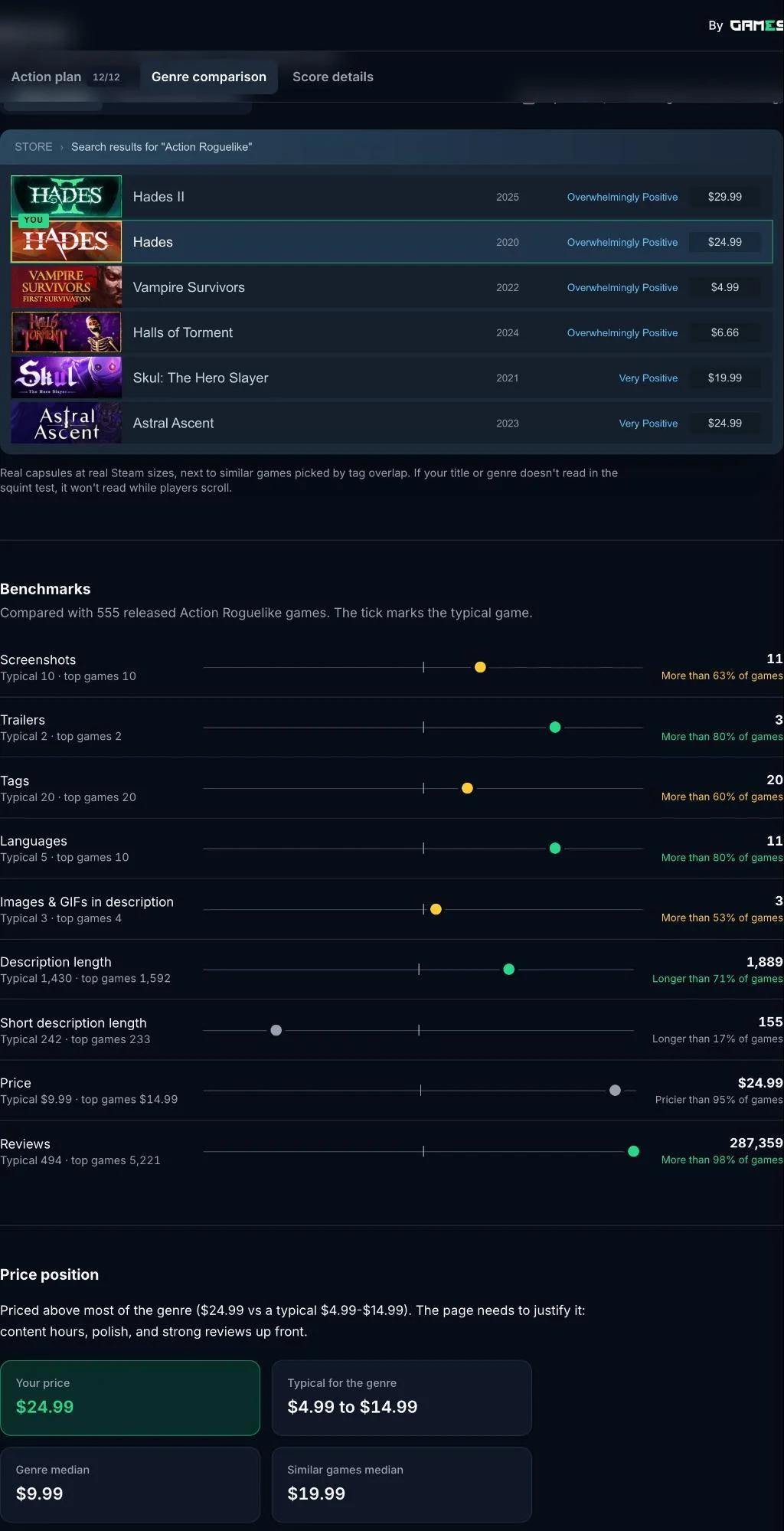
The SteamBuddy dataset of 22,429 Steam games offers concrete page comparisons:
- A typical game has 9 screenshots; top games have 10.
- Typical short descriptions contain 214 characters; top games use 224. The limit is 300.
- Most games use all 20 tag slots.
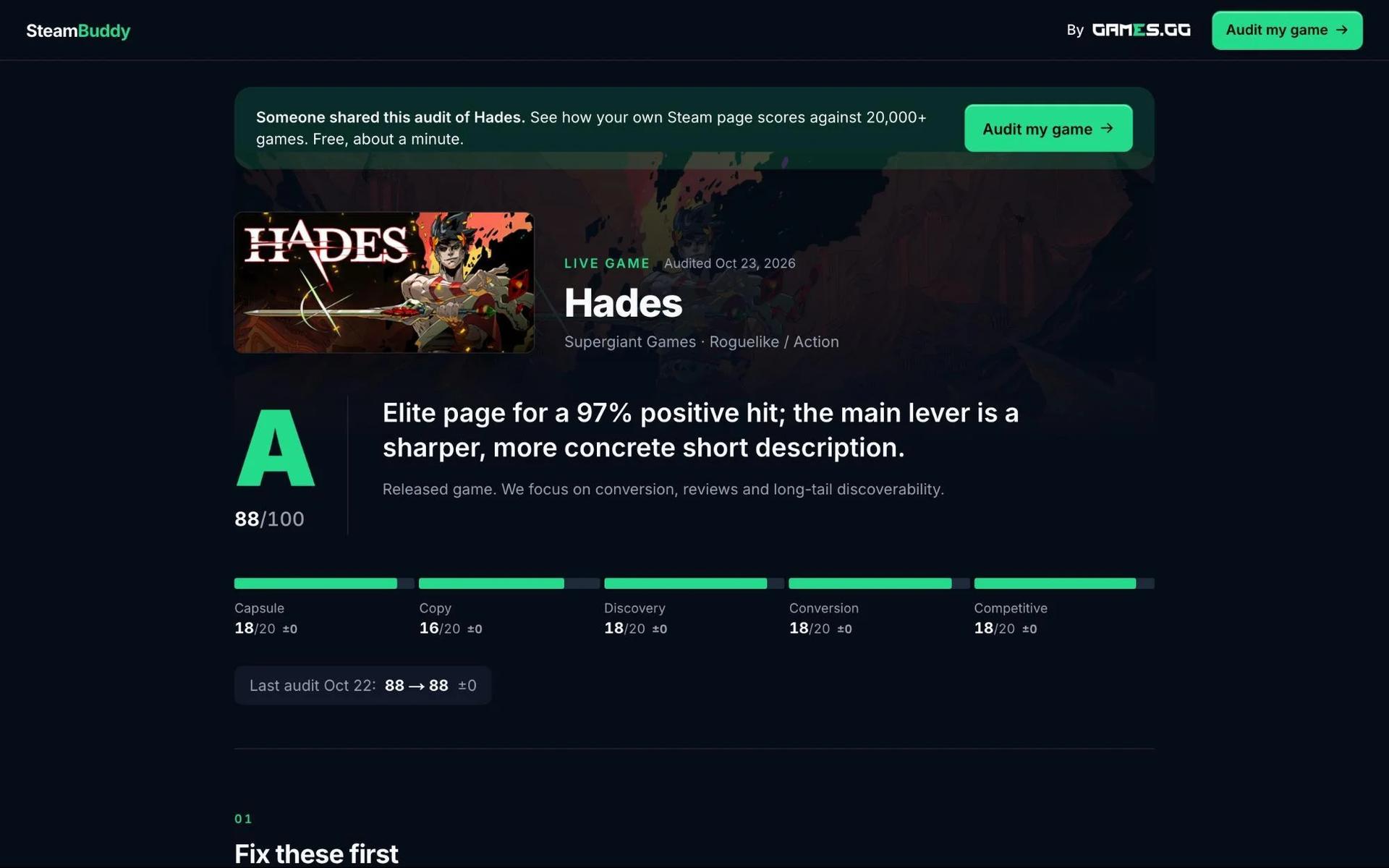
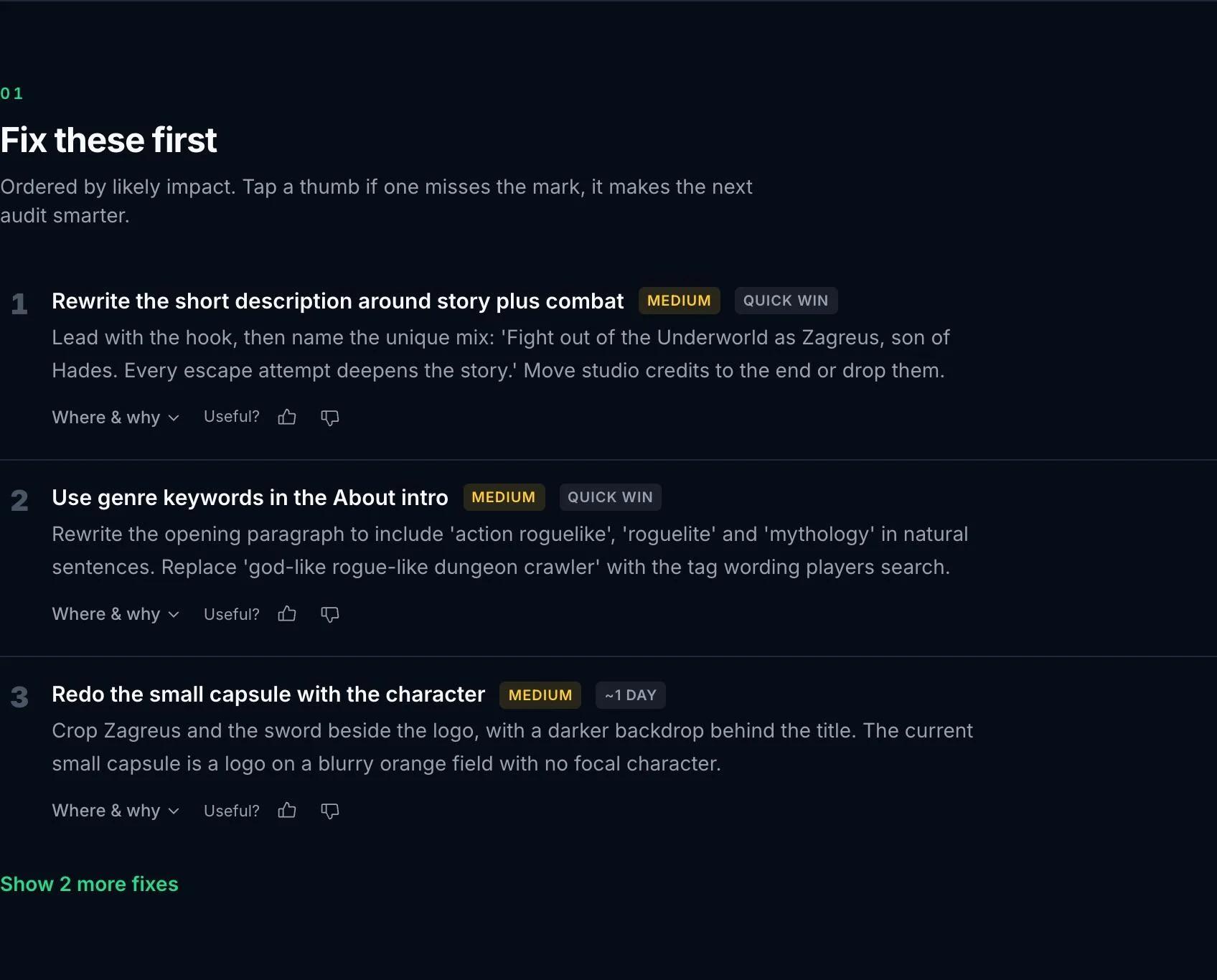
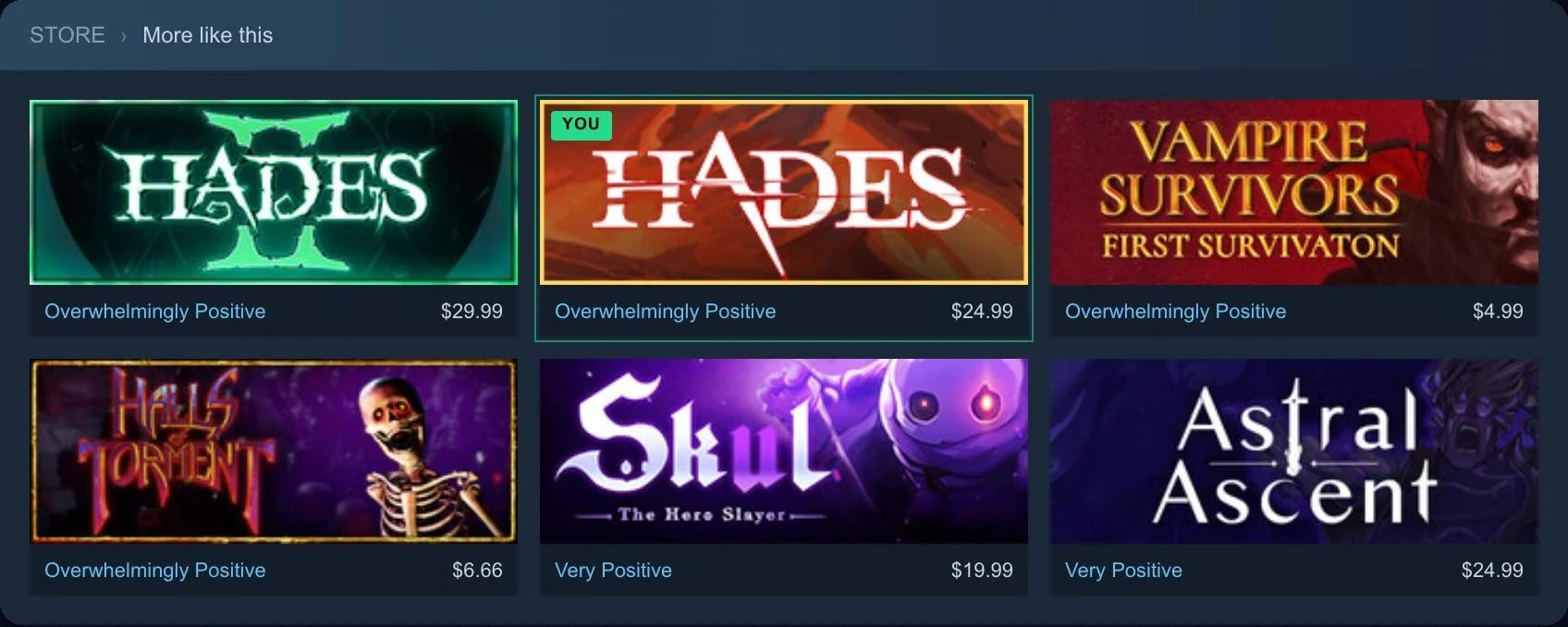
The free SteamBuddy audit scores your capsule, copy, tags and wishlist conversion out of 100 against 20,000+ games, then lists fixes by impact and effort.
2. Use demos and Steam festivals
Festivals are the largest repeatable source of organic wishlists. Zukowski's February 2026 Next Fest survey of 182 developers found that existing wishlists were the strongest predictor of wishlists earned, with a Spearman correlation of 0.825.
Median gains were:
- 322 wishlists for games entering with fewer than 1,000.
- 1,006 wishlists for games entering with 1,000 to 9,999.
Full details and dates are in our Steam Next Fest 2027 developer guide. Self-reported survey data skews toward engaged developers, so treat it as directional.
3. Send creators and communities to the page
Streamers, YouTubers, Discord communities and Reddit posts can all send visitors to your page. Because the page converts those visits, quality comes first and reach second.
Our guides to marketing an indie game with no budget and the full 2026 game marketing playbook cover the tactics in order.
4. Add listings, social reach and paid campaigns
- A free game listing on GAMES.GG reaches a gamer audience at no cost.
- Social media features put wishlist links in front of an established gaming audience.
- Steam wishlist campaigns are a paid option. Advertising and campaigns should send real players to your page. Judge vendors by cost per wishlist and later conversion: uninterested users inflate totals without producing buyers.
5. Plan your release around competing games
Popular Upcoming compares games releasing close together, so a crowded release week can push you out. Check competing releases before locking a date. Our guide to when to start marketing your game shows how far ahead to build wishlists.
How to track wishlists in Steamworks
The Steamworks wishlist reporting documentation explains that the Sales and Activation Reports Portal tracks additions, purchases and deletions. Make this a weekly routine:
- Open your app in the portal and select Wishlists. Data updates daily for the previous day; today's activity does not appear yet.
- Track net additions, meaning additions minus deletions, rather than just the total.
- Use the Regional Sales Report for country-level wishlists. Platform-specific figures are almost always a subset of the total.
- In the CSV export, MonthCohort is the month someone wishlisted, while DateLocal is the Pacific-time date they purchased from the wishlist. Use these to examine how older wishlists convert.
- Log the number after every festival, creator video, post or campaign so you can identify what worked.
Common mistakes to avoid
- Chasing a magic number: Valve says no specific count unlocks visibility.
- Buying low-quality wishlists: inflated totals drag down conversion.
- Entering Early Access before you are ready: one analysis suggests it can use up your Popular Upcoming run.
- Ignoring velocity: community ranking estimates favor a rising wishlist count over a flat one near release.
Where to start
Run your page through the free SteamBuddy audit, fix the top three items, then plan outside reach through GAMES.GG Steam wishlist campaigns or a free listing.