

Overview
Amnesia: A Machine for Pigs drops you into the boots of Oswald Mandus, a wealthy industrialist who wakes from fever dreams in his London mansion on New Year's Eve, 1899. His children are missing. Something mechanical and alive is stirring beneath the floorboards. The game wastes no time establishing its tone: this is not a haunted house story, it is a reckoning with industrialism, colonialism, and the cost of ambition left unchecked.
The Chinese Room, the studio behind Dear Esther, took over development from Frictional Games and left a clear mark on the game's DNA. Where Amnesia: The Dark Descent leaned into resource management and sanity mechanics, A Machine for Pigs strips those systems back considerably. There is no oil to collect, no tinderboxes to hoard. The focus shifts almost entirely to atmosphere and story, which is either a relief or a disappointment depending on what you came for.

Amnesia: A Machine for Pigs content image
Gameplay and mechanics
The core survival horror loop here is built around exploration and evasion. Mandus carries a lantern, moves through dark Victorian corridors, and occasionally encounters the grotesque pig-human hybrids that populate the machine's depths. Combat is not an option. Hiding and running are your only tools.

Amnesia: A Machine for Pigs content image
Key mechanics at a glance:
- Lantern management for visibility
- Environmental puzzle-solving
- Document and note collection for story context
- Evasion-based monster encounters
- No traditional inventory system
The puzzle design is light compared to its predecessor. Most obstacles dissolve with a lever pull or a found key rather than anything that demands extended problem-solving. Players who want mechanical depth may feel underserved, but the reduced friction keeps the narrative momentum intact.

Amnesia: A Machine for Pigs content image
World and setting
The 1899 setting does serious heavy lifting here. Gas-lit corridors, industrial machinery, and slaughterhouse imagery combine into an environment that feels genuinely oppressive. The machine itself, a vast underground complex, serves as both a literal threat and a metaphor for the dehumanizing machinery of empire. The Chinese Room clearly did their research: the period detail is specific enough to feel lived-in rather than decorative.
Oswald's story unfolds through journal entries, phonograph recordings, and environmental storytelling. The writing is dense and literary, which tracks given The Chinese Room's background in narrative-focused games. Some players find the prose overwrought; others consider it the game's strongest asset. Both reactions are reasonable.
Visual and audio design
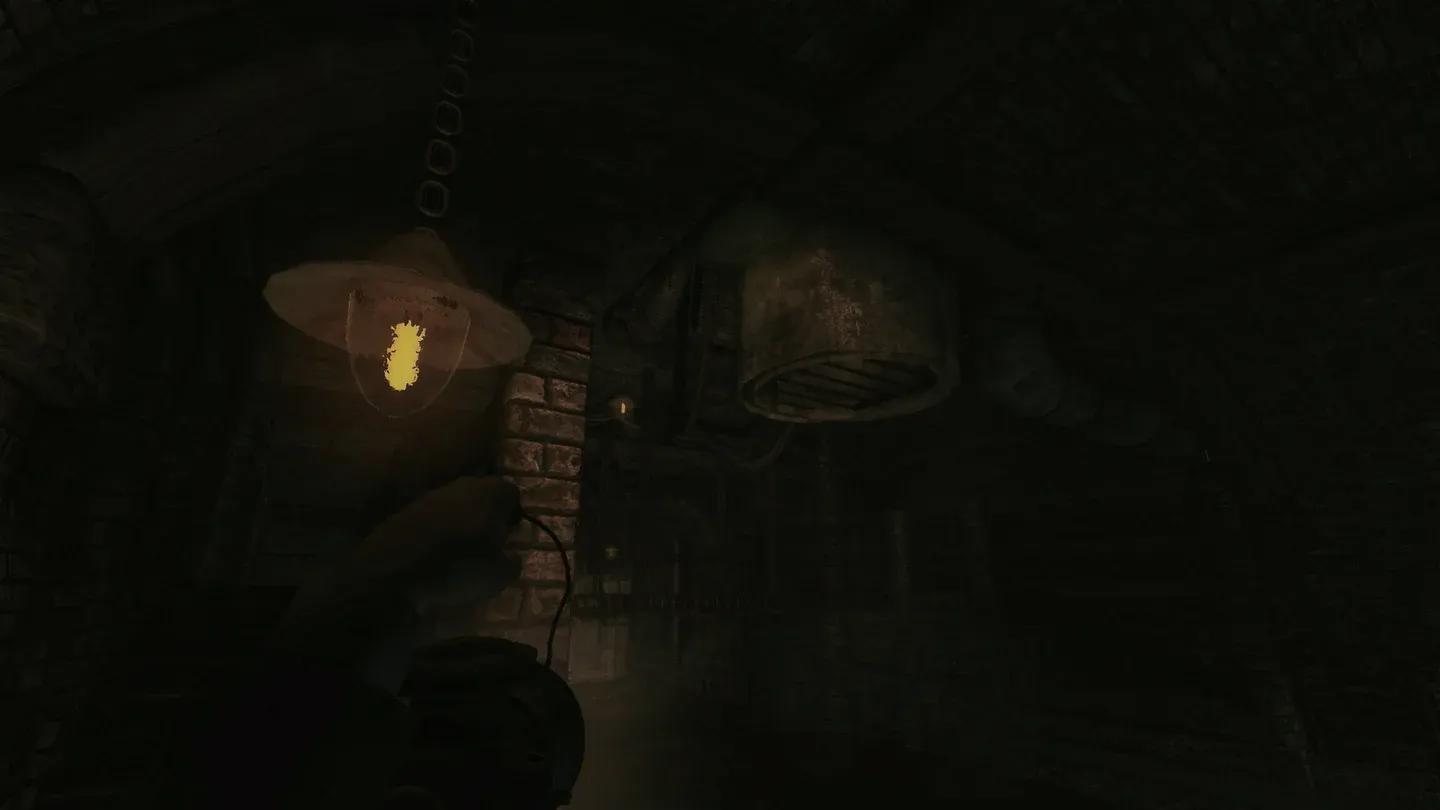
Frictional Games' HPL Engine 2 does solid work rendering the underground environments. The lighting model in particular earns its keep, with the lantern casting convincing shadows across stone walls and rusted machinery. The game is not technically impressive by any modern standard, but the art direction compensates for what the engine lacks.
The sound design is where A Machine for Pigs genuinely excels. Jessica Curry's score is spare and melancholic, built around piano and strings that swell at exactly the right moments. The ambient audio, distant mechanical grinding, muffled animal sounds, the creak of pipes, keeps tension elevated even in empty rooms. It is one of the better horror soundtracks the genre produced in that era.

Amnesia: A Machine for Pigs content image
Impact and legacy
Released in September 2013, A Machine for Pigs landed to mixed but respectful reviews. Players who wanted a direct sequel to The Dark Descent were largely frustrated by the stripped-back mechanics. Players who engaged with it as a narrative horror experience found something genuinely affecting. That split has defined the game's reputation ever since: it sits comfortably in the catalog of horror games that prioritize story over systems, alongside titles like SOMA and Layers of Fear.
Available across PC, Mac, PlayStation, Xbox, Nintendo Switch, iOS, Steam, and Epic Games Store, the game has reached a wide audience over the years. Its approximately 5 to 6 hour runtime keeps it digestible as a single-session experience. For fans of atmospheric first-person horror with literary ambitions, A Machine for Pigs remains a worthwhile entry point into what The Chinese Room does best.
| Requirement | Minimum | Recommended |
|---|---|---|
| Processor | High-range Intel Core i3 / AMD A6 CPU or equivalent. | High-range Intel Core i5 / AMD FX CPU or equivalent. |
| Memory | 2 GB RAM | 4 GB RAM |
| Graphics | Mid-range NVIDIA GeForce 200 / AMD Radeon HD 5000. Integrated Intel HD Graphics should work but is not supported; problems are generally solved with a driver update. | High-range NVIDIA GeForce 400 / AMD Radeon HD 6000. Integrated Intel HD Graphics should work but is not supported; problems are generally solved with a driver update. |